Recommended resources
The freely available resources this lesson will direct you to.
Hello! Welcome back.
In our last lesson, we explored the design and operational sequence of a Kroll batch reactor. We covered the how—the machinery, the inert atmosphere, and the critical control of temperature and pressure. Today, we shift from a qualitative description to a quantitative one.
This lesson focuses on answering the question: how much? You will learn to perform mass balance calculations for the reduction stage, quantifying the consumption of magnesium and the generation of the magnesium chloride byproduct. This is the foundation of process accounting. Just as a business must track every dollar, an industrial process must track every kilogram of material. These calculations are the first step in building a techno-economic model, directly linking the chemistry to the plant's operating costs and efficiency.
1. The Stoichiometric Recipe
The heart of any mass balance calculation is the balanced chemical equation. It provides the exact ratio of reactants consumed to products created. For the Kroll reduction, the equation is:
This equation tells us that 1 mole of titanium tetrachloride reacts with 2 moles of magnesium to produce 1 mole of titanium and 2 moles of magnesium chloride.
To convert these molar ratios into mass—the unit we care about for industrial production—we use the molar mass of each compound.
| Compound | Formula | Molar Mass (g/mol) |
|---|---|---|
| Titanium(IV) Chloride | 189.68 | |
| Magnesium | 24.31 | |
| Titanium | 47.87 | |
| Magnesium Chloride | 95.21 |
Let's walk through a simple, ideal calculation.
Problem: Assuming a 100% complete reaction, how much magnesium () is required to react with 1,000 kg of titanium tetrachloride (), and how much titanium () and magnesium chloride () are produced?
Solution Steps:
-
Convert input mass to moles:
-
Use stoichiometric ratios to find moles of other substances:
-
Convert moles back to mass:
Notice that the total mass of reactants (1000 kg + 256.3 kg = 1256.3 kg) equals the total mass of products (252.3 kg + 1003.9 kg = 1256.2 kg), confirming the law of conservation of mass.
Now, try a quick practice problem yourself based on the image below.
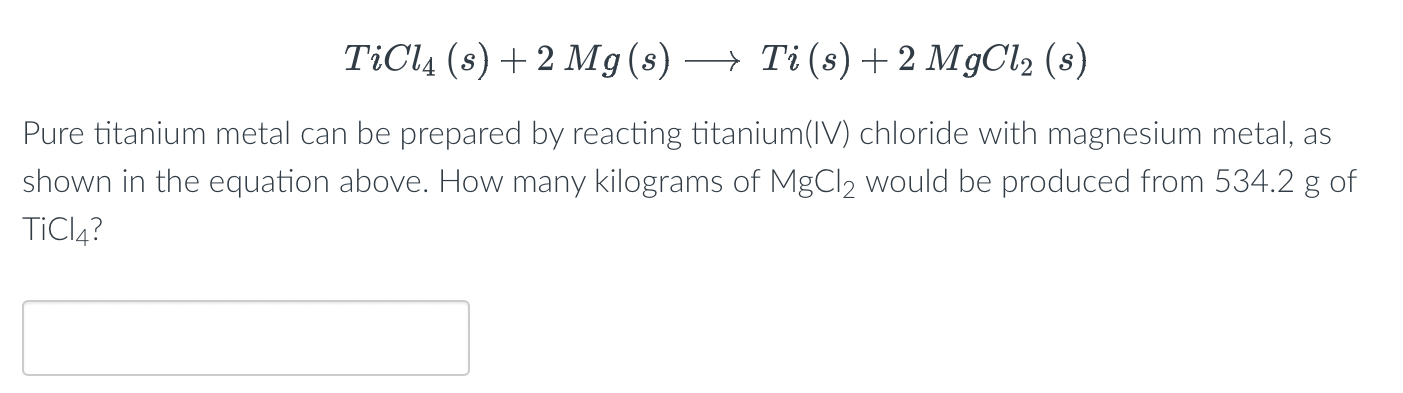
Take a moment to calculate the answer. You should find that for 2.50 g of TiCl₄, approximately 2.51 g of MgCl₂ are produced.
2. Reality Check: Excess Reactants and Incomplete Conversion
Industrial processes are not ideal. To maximize the conversion of the expensive, purified , operators use more magnesium than the stoichiometric "recipe" calls for. This is known as using an excess reactant.
[PDF] Direct Reduction Processes for the Production of Titanium Metal ...
This report from the National Materials Advisory Board explains the practical reasoning behind using excess magnesium.
Please read the paragraph that begins 'The reaction is highly exothermic...'. Note the reason given for using a 'greater than stoichiometric quantity' of magnesium.
As the text states, the surplus of magnesium is used "to assure complete reduction of the titanium tetrachloride". By flooding the reactor with the reducing agent, the process designers ensure that as much as possible finds a magnesium atom to react with. This pushes the reaction towards completion and maximizes the yield of titanium from the valuable feedstock.
However, even with excess magnesium, the conversion is never 100%. Some may be lost through venting, or some may fail to react. This is captured by the conversion rate.
[PDF] SAC Hockaday and K Bisaka - Pyro.co.za
The paper on Mintek's lab-scale reactor provides real-world data on conversion rates. This allows us to see how experimental results deviate from the 100% ideal.
First, examine Table 3, 'Ti sponge mass recovered and implied conversion of TiCl4 to Ti'. Note the conversion percentages achieved in experiments 2, 3, and 4. Then, read the 'Conclusion' section, focusing on the paragraph that begins 'Based on preliminary sponge analysis...'. The text lists several practical reasons why conversion levels are below 100%.
The Mintek experiments show a conversion rate of around 80-82% is more realistic. The reasons are practical and highlight the challenges of industrial chemistry:
- Loss of gaseous during pressure venting.
- Entrapment of unreacted magnesium in the solid sponge, making it unavailable.
- Losses of fine titanium particles during handling.
Let's incorporate these factors into a more realistic problem.
Problem: We want to produce 10,000 kg of titanium sponge in a batch. A typical industrial process uses 25% excess magnesium and achieves an 85% conversion rate of to . Calculate the required mass of and , and the mass of produced.
Solution Steps:
-
Calculate the theoretical required for the target Ti output (Ideal Case):
- First, find moles of Ti desired:
- From stoichiometry, moles = moles .
- Theoretical mass of :
- First, find moles of Ti desired:
-
Adjust for Real-World Conversion Rate:
- The 39,623 kg is the amount that must successfully react. Since only 85% of the input reacts, we need to feed more.
- Required input:
-
Calculate Required Magnesium with Excess:
- First, find the stoichiometric Mg required for the actual amount of fed:
- Add the 25% excess:
- First, find the stoichiometric Mg required for the actual amount of fed:
-
Calculate Byproduct:
- The amount of byproduct is based on the amount of that actually reacted.
- Moles of reacted:
- Moles of produced:
- Mass of produced:
This more complex calculation gives you a much better estimate of the material requirements for an actual plant, forming the basis for your cost model.
3. A Look at an Industrial Batch
Let's see how our calculations stack up against published data from a real industrial operation.
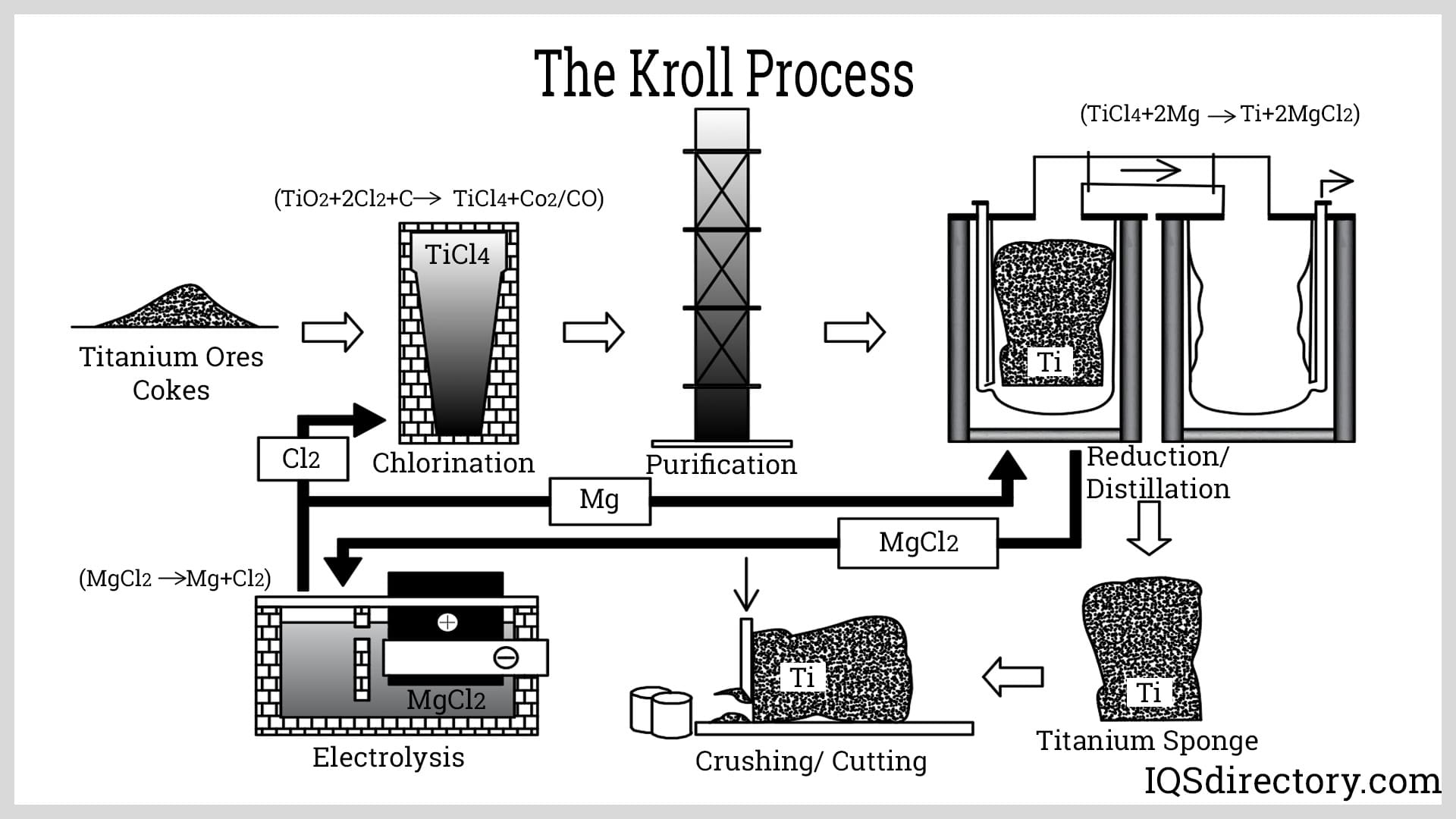
The following reading describes the OREMET process, a large-scale modification of the Kroll process.
[PDF] Direct Reduction Processes for the Production of Titanium Metal ...
This section from the 'Direct Reduction Processes' report provides rare insight into the scale and material quantities of a commercial titanium operation.
Please read the section '2. Improvements', focusing on the description of the Oregon Metallurgical Corporation (OREMET) process. Pay close attention to the specific quantities mentioned for a single batch: pounds of magnesium, percent excess, pounds of titanium tetrachloride, and the resulting mass of sponge and tapped magnesium chloride.
The OREMET process data provides a fantastic opportunity to check our understanding. Let's analyze their numbers (using 1 lb = 0.453592 kg):
- Inputs:
- TiCl₄: 46,000 - 47,000 lbs (approx. 20,865 - 21,319 kg)
- Mg: 16,000 - 17,000 lbs (approx. 7,257 - 7,711 kg), stated as "25 percent in excess of stoichiometric requirements."
- Outputs:
- Ti Sponge: 13,000 - 14,000 lbs (approx. 5,897 - 6,350 kg)
- MgCl₂ Tapped: 46,000 lbs (approx. 20,865 kg)
Verification Exercise:
Let's see if their "25% excess" claim holds up.
Using the average input of 46,500 lbs (21,092 kg) of :
- Moles =
- Stoichiometric Moles Mg =
- Stoichiometric Mass Mg = (or ~11,918 lbs)
- Adding 25% excess: (or ~14,900 lbs)
The OREMET input is 16,000-17,000 lbs of Mg. This is slightly more than our calculated requirement of ~14,900 lbs, suggesting their "25% excess" figure is a rounded number and they may use closer to 35-40% excess in practice. This is a crucial insight—published numbers often simplify the complex reality. As an investor or operator, you would need to dig deeper to understand the true consumption factor.
Similarly, we can calculate the theoretical titanium yield from 46,500 lbs of :
- Theoretical Ti Mass = (or 11,735 lbs).
The actual output is 13,000-14,000 lbs of sponge. The sponge, however, is not pure titanium; it contains residual Mg and MgCl₂ before purification. This accounts for the higher mass.
Conclusion
Today, we have translated the chemistry of the Kroll reduction into the language of industrial operations. You are now equipped to calculate the material inputs and outputs for this critical process step, accounting for the practical realities of excess reactants and incomplete conversion.
Key Takeaways:
- Mass balance calculations are founded on the stoichiometric ratios of the balanced chemical equation: .
- Industrial practice deviates from theory: excess magnesium (e.g., 25% or more) is used to maximize the conversion of the primary feedstock, .
- Real-world conversion rates are below 100% (typically 80-90%) due to physical process limitations, and this must be factored into any serious calculation.
- By quantifying material flows, you are building the essential data needed for a techno-economic analysis, estimating raw material costs, and evaluating process efficiency.
The output of the reactor, as we've seen, is not a finished product. It's a crude "sponge" contaminated with significant amounts of unreacted magnesium and magnesium chloride. In our next lesson, we will examine the crucial purification steps—vacuum distillation and leaching—used to remove these impurities and produce the high-purity titanium sponge required by the market.