Recommended resources
The freely available resources this lesson will direct you to.
Hello! Welcome to our fourth and final lesson in the module on ideal sources.
In the last lesson, we investigated how to combine ideal voltage sources. We saw that connecting them in series causes their voltages to add or subtract, while connecting them in parallel requires them to have the exact same voltage. Any attempt to connect ideal voltage sources of unequal voltage in parallel resulted in a logical contradiction, an "invalid" configuration in circuit theory.
Today, we'll complete this topic by exploring the other side of the coin. Our goal is to reason about the physical result of combining current sources in parallel versus series, including why certain configurations are invalid. As you'll see, the rules for current sources are a beautiful mirror image—or "dual"—of the rules for voltage sources. This symmetry is a recurring theme in circuit analysis that will appeal to your interest in abstract, logical systems.
A Quick Refresher: The Ideal Current Source
Let's briefly recall what an ideal current source does. It is a "current enforcer." It guarantees that a specific, constant amount of current flows through the branch it's in, no matter what voltage develops across its terminals.

This behavior is the direct opposite of an ideal voltage source, which enforces a constant voltage for any current. Keep this fundamental behavior in mind as we combine them.
1. Current Sources in Parallel: Combining Flows
Let's start with the more intuitive case: connecting current sources in parallel. Imagine two rivers flowing into a single, larger river. The total flow of the large river is simply the sum of the flows of the two smaller rivers.
This is precisely what happens with current sources. When connected in parallel, their terminals are joined at the same two nodes. Any current they supply must combine at these nodes before flowing into the rest of the circuit.
Sources in Series and Parallel (Circuits for Beginners #10)
The video 'Sources in Series and Parallel' from the channel Aaron Danner, which we used in the last lesson, demonstrates this principle very clearly.
Please watch the segment from 09:12 to 10:10. Notice how the two parallel sources, one supplying 2A and the other 1A, combine to create an equivalent 3A source. The logic is straightforward: the total charge flowing out of the node per second must be the sum of the charges flowing into it.
As with voltage sources, the direction matters:
- Parallel-Aiding: If the sources are oriented to push current in the same direction, their currents add up:
- Parallel-Opposing: If they are oriented in opposite directions, the net current is their difference. The stronger source "wins" and determines the direction of the net current:
This is directly analogous to voltage sources in series.
2. Current Sources in Series: The Logical Puzzle
Now for the more interesting case. What happens when we connect current sources in series, one after the other in a single, un-branched wire?
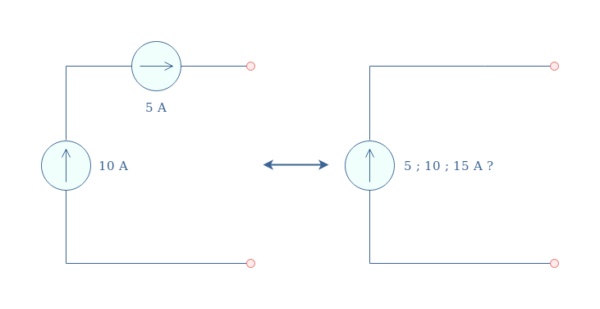
Let's break this down into two scenarios.
Case 1: Series Sources with Equal Current
Imagine two 5A sources are connected in series.
- The first source enforces a current of 5A.
- The second source also enforces a current of 5A.
Since they are in the same wire, they must carry the same current. In this case, their demands are identical and consistent. The resulting current in the wire is simply 5A.
So, why would you do this? Just as parallel voltage sources share the current, series current sources share the voltage.
Sources in Series and Parallel (Circuits for Beginners #10)
Let's return to the video by Aaron Danner to see why this configuration can be useful.
Watch from 10:10 to 12:18. The video explains that while the current doesn't increase, the total voltage required from the load is split between the two sources. Each source only has to do half the work (supply half the power). This is the dual of two parallel batteries sharing a current load.
Case 2: Series Sources with Unequal Current (An Invalid Configuration)
Now we arrive at the heart of the puzzle from the image above. What if we connect a 10A source in series with a 5A source?
- The 10A source enforces a current of 10 Amperes (10 Coulombs per second) through the wire.
- The 5A source enforces a current of 5 Amperes (5 Coulombs per second) through the very same wire.
This creates a fundamental contradiction. A single wire can only have one value of current flowing through it at any given moment. It is a logical and physical impossibility for the current to be both 5A and 10A simultaneously.
Sources in Series and Parallel (Circuits for Beginners #10)
The video states this conclusion succinctly.
Watch the short clip from 12:18 to 12:38. The key phrase here is 'mathematical impossibility,' which should sound familiar from our discussion of unequal voltage sources in parallel.
To deepen your intuition for why this is impossible, let's go beyond the surface-level contradiction and look at the underlying physics.
Why can't different current sources connect in series?
The community on the Electronics Stack Exchange provides some excellent, intuitive explanations for this problem. Please read the top two answers on this page.
Read the first answer (by user57037) and the second answer (by Janakiram). The first answer explains this from the perspective of charge conservation: you can't have more charge entering a section of wire than is leaving it, because charge cannot accumulate. The second answer frames it as a pure logical contradiction, which aligns with how we've been approaching these ideal component puzzles.
The key takeaway from the reading is rooted in the conservation of charge. Current is the flow of charge, and charge cannot be created or destroyed, nor can it pile up indefinitely in an ideal conductor. A 10A source demands that 10 Coulombs of charge pass a point every second, while a 5A source demands that only 5 Coulombs pass the same point. This conflict has no resolution in an ideal circuit.
This is the dual of unequal voltage sources in parallel, where the conflict was that a single pair of nodes cannot have two different voltages.
Summary: The Duality of Sources
Let's summarize these rules in a table. Notice the beautiful symmetry. The rule for voltage sources in series mirrors the rule for current sources in parallel, and vice versa.
| Configuration | Voltage Sources (Voltage Enforcers) | Current Sources (Current Enforcers) |
|---|---|---|
| Series | Valid: Voltages add or subtract. Used to get a higher/different voltage. | Invalid if unequal: Violates conservation of charge (one wire, one current). |
| Parallel | Invalid if unequal: Violates definition of voltage (one node pair, one voltage). | Valid: Currents add or subtract. Used to get a higher/different current. |
This principle of duality is a powerful tool for reasoning about circuits. If you understand a concept for voltages, you can often infer the corresponding concept for currents just by swapping the terms (voltage ↔ current, series ↔ parallel, open circuit ↔ short circuit).
Conclusion
In this lesson, we completed our look at combining ideal sources. You now have a solid, intuition-based understanding of how they behave.
Key Takeaways:
- Parallel Current Sources: Their currents add (if aiding) or subtract (if opposing). This is the standard way to combine them to achieve a larger total current.
- Series Current Sources: This configuration is only valid if the sources have the exact same current. In this case, the current remains the same, and the sources share the total voltage required by the circuit.
- Invalid Series Connection: Connecting ideal current sources of unequal value in series is forbidden. It creates a physical contradiction by demanding two different currents in the same wire, which violates the principle of charge conservation.
Preview of the Next Lesson:
The principle we used today—that charge cannot accumulate at a point in a circuit—is so fundamental that it has its own name: Kirchhoff's Current Law (KCL). In our next lesson, we will begin a new module on conservation laws and formalize KCL. You'll see how this simple, intuitive idea becomes the cornerstone of nodal analysis, one of the most powerful techniques for solving any circuit.