Recommended resources
The freely available resources this lesson will direct you to.

Hello! Welcome to the first lesson of our third module, where we'll explore the fundamental conservation laws that govern all electrical circuits.
In our last lesson, we discovered that connecting two ideal current sources of unequal value in series was an "invalid" configuration. The reason was a logical contradiction: a single wire cannot have two different currents flowing through it simultaneously. This impossibility stemmed from a core principle: charge cannot be created, destroyed, or accumulate at any point in a circuit.
Today, we're going to formalize this powerful idea. It's known as Kirchhoff's Current Law (KCL), and it's one of the two most important laws in circuit analysis. Our goal is to explain KCL as a direct consequence of the conservation of charge and then use it to reason about how current distributes at a node. This lesson is all about building the physical intuition that allows you to "see" how current flows and splits, a skill that is crucial for solving any circuit you encounter.
1. KCL as Conservation of Charge
At its heart, KCL is a simple statement about the flow of charge. A node in a circuit is just a junction where two or more wires meet. Since an ideal wire cannot store charge, any amount of charge that flows into a node must instantly flow out.
A common and effective way to visualize this is the water pipe analogy. Imagine a junction where several water pipes meet. Water is incompressible, so it can't "pile up" at the junction. The total volume of water flowing into the junction per second must exactly equal the total volume of water flowing out.

Current is the flow of charge, so the same logic applies. Let's watch a video that explains this connection formally.
The video 'Kirchhoff's Current Law (KCL)' by Neso Academy provides an excellent explanation of KCL and directly links it to the law of conservation of charge.
Please watch from the beginning to 06:56. Pay close attention to the final section (starting at 04:05), which explains why the law must be true based on the fact that a node cannot store, generate, or destroy charge. This is the core intuition behind KCL.
2. Formulating KCL Equations
As the video explained, KCL can be stated in two equivalent ways, which gives us two ways to write the equations for a node:
- The sum of currents entering a node equals the sum of currents leaving it.
- The algebraic sum of all currents at a node is zero.
To use the second form, we need a consistent sign convention. The standard convention is:
- Currents entering the node are positive (+).
- Currents leaving the node are negative (-).
Let's revisit the image of the node.
Using the first formulation (in = out):
Using the second formulation (algebraic sum = 0):
As you can see from simple algebra, these two equations are identical. You can use whichever form feels more intuitive to you. The in = out form is often easier for initial reasoning, while the algebraic sum = 0 form is standard for systematic methods like nodal analysis, which we will cover soon.
For a clear, text-based summary of these concepts, please read the first part of the following article from the Ultimate Electronics Book.
Read the sections titled 'Kirchhoff’s Current Law (KCL)' and the examples that follow. Stop when you reach the section titled 'Exceptions to Kirchhoff’s Current Law'. Focus on how the same circuit can be described using both formulations of the KCL equation.
3. Applying KCL to Reason About Circuits
Now let's put this into practice. The real power of KCL is that it gives us a tool to find unknown currents by enforcing the conservation of charge at every junction.
Simple Application
Consider the parallel circuit below. The total current leaves the battery and reaches the top node. There, it splits into three paths: , , and . These three currents then recombine at the bottom node to form again, which flows back to the battery.
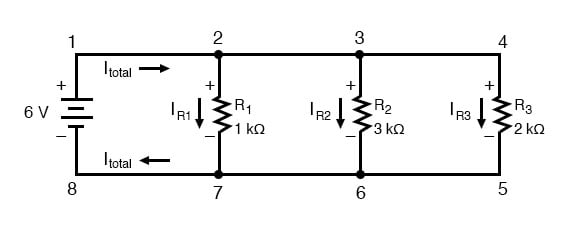
Let's apply KCL at the top node (labeled '1' and '2' in the diagram, which are the same node).
- Current In:
- Currents Out: , ,
Using the in = out form, the KCL equation is:
This makes perfect intuitive sense: the total flow splits among the available paths.
Solving for an Unknown Current
KCL is essential for solving problems where some currents are unknown. Let's see a worked example.
Kirchhoff's Current Law (KCL) explained
The video 'Kirchhoff's Current Law (KCL) explained' by ALL ABOUT ELECTRONICS provides a clear, step-by-step example of finding an unknown current in a circuit with multiple nodes.
Watch the example problem from 03:47 to 07:50. Notice how KCL is applied systematically at each node to work backward from the known currents to find the unknown ones. The logic here is similar to how you might trace data flow through a network to troubleshoot an issue.
4. A Reasoning Challenge
Let's test your intuition. Consider the circuit below. All three resistors, R_A, R_B, and R_C, are identical. A total current enters from the left.
A circuit with identical resistors for a current ranking task.
The current flows through resistor R_A. At the node between the resistors, this current splits into two paths, with current flowing through R_B and current flowing through R_C.
Based on KCL, how would you rank the currents , , and from largest to smallest?
Think about it for a moment before reading the solution below.
Solution:
- Apply KCL at the first node: The current flowing into the node is . The currents flowing out are and .
- Reason about the result: Since current is always positive in this simple DC circuit, the equation tells us that must be larger than both and .
- Consider the split: Because resistors R_B and R_C are identical, there is no reason for the current to prefer one path over the other. The flow will split equally. Therefore, .
- Combine the insights: We know is the largest, and and are equal to each other and smaller than .
So, the correct ranking is: ** **.
This type of reasoning—combining KCL with other facts about a circuit (like symmetry)—is a key skill for developing deep circuit intuition.
Conclusion
In this lesson, we formalized the principle of charge conservation into Kirchhoff's Current Law. You are now equipped to analyze any junction in a circuit and understand how current behaves.
Key Takeaways:
- KCL is Conservation of Charge: It states that charge cannot accumulate at a node.
- Two Formulations: KCL can be expressed as either
Sum of currents in = Sum of currents outorThe algebraic sum of currents at a node is zero. - Fundamental Tool: KCL is not just a formula; it's a fundamental law that allows you to reason about how current splits and combines, enabling you to find unknown quantities in a circuit.
Preview of the Next Lesson:
KCL is one of the two pillars of circuit analysis. The other is its dual: Kirchhoff's Voltage Law (KVL). While KCL is about the conservation of charge, KVL is about the conservation of energy. In the next lesson, we will explore KVL and see how it allows us to reason about voltage drops and gains around any closed loop in a circuit. Together, KCL and KVL form the complete toolkit for analyzing any resistive circuit.