Recommended resources
The freely available resources this lesson will direct you to.
- Kirchhoff's Voltage Law - KVL Circuits, Loop Rule & Ohm's Law - Series Circuits, Physicswww.youtube.com
- Kirchhoff's voltage law (conceptual) | Electricity | Physics | Khan Academywww.youtube.com
- Kirchhoff's Voltage Law Explained: The Energy Loop Principletechietory.com
- 2.13 Kirchhoff's Voltage Law and Kirchhoff's Current Lawultimateelectronicsbook.com
Hello! Welcome to the second lesson in our module on the fundamental conservation laws of circuits.
In our last lesson, we explored Kirchhoff's Current Law (KCL), which is rooted in the conservation of charge at a circuit's nodes. We saw that current behaves like water in a system of pipes: whatever flows into a junction must flow out.
Today, we will explore KCL's powerful counterpart: Kirchhoff's Voltage Law (KVL). If KCL is about charge conservation at a point, KVL is about energy conservation around a loop. Your goal for this lesson is to be able to explain KVL as an expression of energy conservation and use it to reason about how voltage is distributed around any closed path in a circuit. This concept is central to building the physical intuition you're aiming for, allowing you to see a circuit not just as a collection of wires, but as an energy system.
1. The Energy Journey Around a Circuit
Let's begin with an analogy that gets to the heart of KVL.
Kirchhoff’s Voltage Law Explained: The Energy Loop Principle
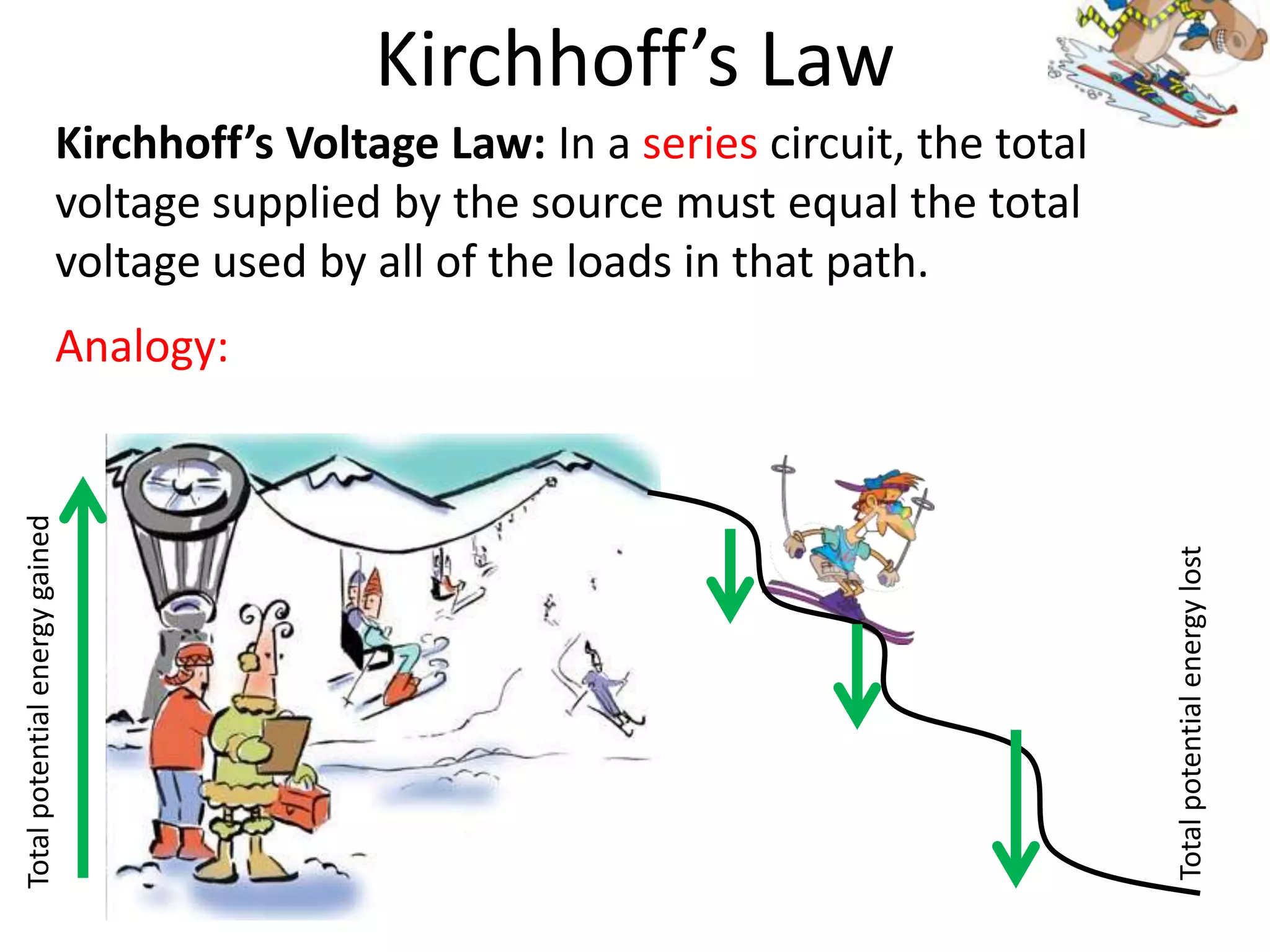
Imagine hiking on a circular trail. You go up hills and down into valleys, but when you return to your starting point, your net change in elevation is zero. Read the introduction of the article from Techietory to see how this simple idea perfectly captures the essence of KVL.
Read just the introductory section, titled 'Introduction: The Energy Journey Around a Circuit'. Focus on the connection between net elevation change on a hike and net voltage change in a circuit loop.
Just as elevation represents gravitational potential energy, voltage represents electrical potential energy per unit of charge. A charge moving around a closed loop in a circuit is like a hiker completing a circular trail. By the time it returns to its starting point, it must have lost exactly as much energy in the "valleys" (resistors and other loads) as it gained on the "hills" (batteries and other sources). The net change in its energy must be zero. This is the core principle of KVL.
2. Tracing the Energy: A Conceptual Walkthrough
To build on this intuition, let's trace the journey of a single coulomb of charge as it travels around a circuit loop. We'll track its potential energy (voltage) at every step.
Kirchhoff's voltage law (conceptual) | Electricity | Physics | Khan Academy
The Khan Academy video 'Kirchhoff's voltage law (conceptual)' does an excellent job of making this abstract idea concrete. It uses a 'charge in your pocket' analogy to walk through a loop, explaining voltage changes at each component.
Watch from the beginning to 08:55, and then from 10:37 to the end (13:29). Pay close attention to: The distinction between resistors as passive 'slides' (where potential always drops) and batteries as active 'elevators' (which can raise potential). How the final potential at the end of the loop must equal the starting potential, forcing the sum of all changes to be zero.
As the video demonstrates, the key idea is that a charge carrier cannot magically gain or lose energy over a complete cycle. The energy provided by sources must be fully accounted for by the energy dissipated in loads. This leads to the formal statement of KVL.
3. Formalizing KVL and Applying Sign Conventions
Kirchhoff's Voltage Law is formally stated in two equivalent ways:
- The sum of all voltage rises around a loop equals the sum of all voltage drops.
- The algebraic sum of all voltages around any closed loop is zero.
The second form is most common for calculations, but it requires a consistent sign convention. Getting the signs right is the most critical part of applying KVL correctly.
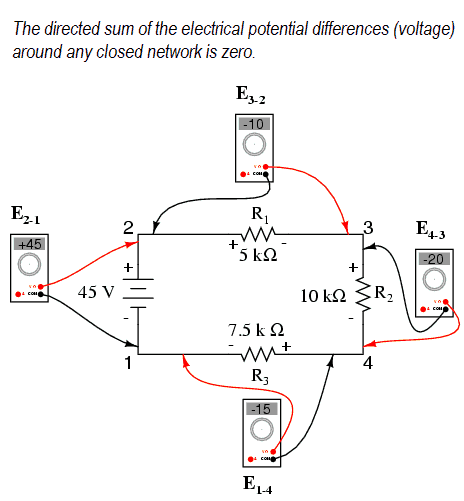
To apply KVL systematically:
- Assume a current direction for each loop. (If you're wrong, the current will come out negative, which is fine!)
- Assign voltage polarity to resistors based on this current. Current flows from higher potential (+) to lower potential (-) through a resistor. For voltage sources, the polarity is fixed (long bar is +, short bar is -).
- Choose a loop direction to trace (clockwise or counter-clockwise). This is your direction of "walking" around the loop.
- Write the KVL equation:
- If you trace from
-to+through a component, it's a voltage rise (add the voltage). - If you trace from
+to-through a component, it's a voltage drop (subtract the voltage).
- If you trace from
Kirchhoff’s Voltage Law Explained
The article from Techietory provides a very clear, systematic guide to these sign conventions and how to apply them. It also highlights common mistakes, which is incredibly useful for avoiding pitfalls.
Read the sections 'What is Kirchhoff’s Voltage Law?', 'The Physical Basis: Conservation of Energy', 'Sign Conventions', and 'Common Mistakes and Misconceptions'. This will solidify your understanding of the formal law and how to apply it without error.
4. Putting KVL into Practice
Now let's apply this systematic process to solve for unknown quantities in a circuit. We'll combine KVL with Ohm's Law () to create equations we can solve.
Kirchhoff's Voltage Law - KVL Circuits, Loop Rule & Ohm's Law - Series Circuits, Physics
This video from The Organic Chemistry Tutor provides clear, worked examples. It demonstrates not only how to find the current but also how to calculate the absolute potential at any point in the circuit, reinforcing the 'elevation' analogy.
Watch the two main examples in the video: Single-Loop Circuit (04:10 - 10:13): Observe how the KVL equation is set up and solved for current. Pay special attention to how he calculates the potential at points A, B, and C, showing how the voltage drops around the loop. Loop with Two Batteries (10:13 - 16:21): This example is great for practicing sign conventions when multiple sources are present. Notice how the batteries work together (series-aiding) in this case.
By following this process—choosing a direction, assigning polarities, and summing the voltage changes—you can analyze any loop in a resistive circuit. This, combined with KCL, forms the basis for the more advanced mesh and nodal analysis techniques you'll learn soon.
A quick note for your advanced studies: KVL, as we've defined it, is a cornerstone of the lumped-element model of circuits. It assumes that the electric field is conservative. This is an excellent model for nearly all DC and low-frequency AC circuits. However, as you advance into electromagnetism, you'll encounter Faraday's Law of Induction, which shows that a time-varying magnetic field can create a non-conservative electric field, technically violating KVL. In practice, we account for this effect by modeling it as a component (an inductor), thereby preserving the utility of KVL for circuit analysis.
Conclusion
In this lesson, you've unlocked the second fundamental law of circuit analysis. You can now see circuits from two complementary perspectives: the flow of charge (KCL) and the flow of energy (KVL).
Key Takeaways:
- KVL is Conservation of Energy: It dictates that the total energy a charge gains from sources in a loop must equal the total energy it loses to loads.
- The Loop Rule: The algebraic sum of all voltage differences around any closed loop must be zero ().
- Systematic Application: Applying KVL successfully depends on a consistent sign convention. By tracing a loop and accounting for voltage rises (
-to+) and drops (+to-), you can build the equations needed to solve a circuit.
Preview of the Next Lesson:
Now that you have the powerful tools of KCL and KVL, you can move beyond simple calculation to qualitative reasoning. In the next lesson, we will focus on building your intuition further by learning to predict, without any numbers, how the currents and voltages in a circuit will shift when a component is added or removed. This skill is the hallmark of a true expert in circuit analysis.