Recommended resources
The freely available resources this lesson will direct you to.
Hello again. In the previous lesson, you identified the primary energy sources used to generate electricity. This lesson shifts from where electrical energy comes from to what electric charge is doing. A balloon that attracts hair and a lamp supplied by a circuit both involve electric charge, but they are not the same kind of electrical situation.
By the end, you should be able to read an exam scenario and explain whether it describes static electricity, current electricity, or a brief discharge of static charge. That last distinction matters: a spark involves moving charge, even though it is usually described as a static-electricity event.
When charge accumulates
Objects contain positive and negative charge. When some electrons transfer from one object to another, the object gaining electrons becomes negatively charged; the object losing them becomes positively charged. Charge has been transferred, not created.
A familiar example is rubbing a balloon on hair. Electrons can transfer to the balloon, leaving the balloon negatively charged and the hair relatively positively charged. The separated charges attract. The important feature of static electricity is that the charge accumulates and remains separated for a time. “Static” does not mean that no electrons moved while the objects were being charged.
Watch the opening of Captain Physics’s Static Electricity – GCSE Physics for the balloon example. Then watch its explanation of lightning to see what can happen after a much larger charge buildup.
Static Electricity - GCSE Physics
Captain Physics uses a balloon to show how charge separation occurs, then uses lightning to show how accumulated charge can discharge.
Watch balloon charging for the electron transfer and the resulting positive and negative charges. Skip ahead to lightning discharge; focus on the difference between charge building up and charge moving suddenly through the air. Stop at 00:02:48.
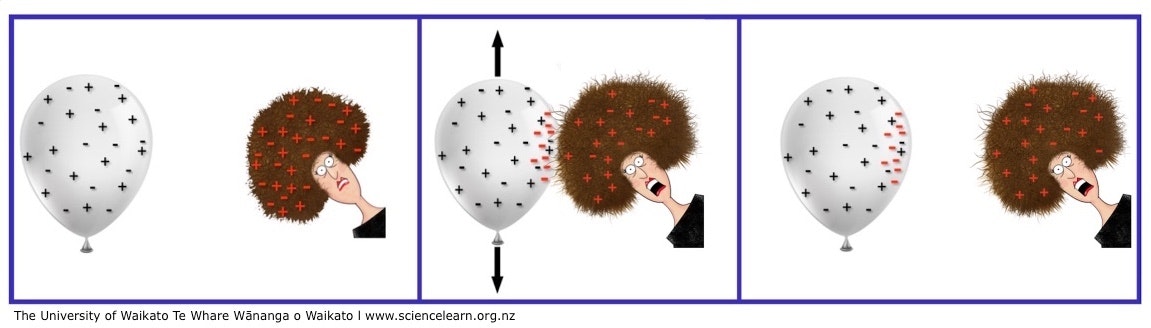
An insulating material often helps a charge imbalance persist because charge cannot readily travel away through it. Rubbing is one common way to transfer charge, but it is not the definition of static electricity. For an exam question, look for the resulting buildup of separated charge, not just the word friction.
When charge has a path
Suppose the charged objects can exchange charge through a conducting path—or the electric field becomes strong enough for a spark to cross an air gap. Charge flows briefly, reducing the imbalance. This is a static discharge. A small shock after walking across a carpet is an everyday example.
Compare that with a lamp supplied by an electrical source. While the source maintains the electrical drive and the circuit provides a complete path, charge continues to flow and the lamp can remain lit. This is current electricity in the usual circuit sense. If the path is broken, that sustained current stops.
Read SparkFun Learn’s What is Electricity? for these two situations side by side. Its discussion of circuits supplies the key question to ask about a working load: is there a complete path for ongoing flow?
What is Electricity? - SparkFun Learn
SparkFun Learn contrasts accumulated charge with continuing charge flow and introduces the circuit needed for a working electrical load.
Under “Static or Current Electricity,” read Static Electricity from its opening definition through the final paragraph about protecting electronic components. Then read Current Electricity. Under “Circuits,” read the opening explanation, stopping after the paragraph about a broken copper wire. Focus on what sustains flow, rather than treating every movement of charge as an operating circuit.
Moving charge is electric current, even during a spark. The distinction in an introductory exam is about the whole event. A static-electricity scenario begins with accumulated charge and may end in a brief discharge. A current-electricity scenario describes charge flowing through an operating circuit while a source supplies it. A discharge does not keep a lamp operating once the original charge imbalance has been relieved.
An isolated charged metal object can also hold static charge. Metal allows charge to move within it; if the object has no route for the charge to leave, it can remain charged. Conversely, an open switch in a battery circuit stops sustained current, but that alone does not make the circuit a balloon-style static-electricity example. The cause of the charge situation matters.
Following an event through time
A scenario can change classification as it unfolds. Imagine rubbing insulating material, then approaching a metal object and feeling a single shock:
- Before contact: Charge has accumulated and remains separated. This is the static-charge stage.
- At the shock: Charge moves briefly through a newly available path. This is a static discharge; current flows during the discharge.
- Afterward: The particular imbalance that produced the shock has been reduced, so it does not sustain flow.
The Voltage and Current chapter of the Electronics Textbook makes this transition concrete with charged wax and wool. It also describes why touching a doorknob can produce a short shock.
Voltage and Current | Basic Concepts Of Electricity | Electronics Textbook
Read this account to connect a stationary charge imbalance with the brief flow that occurs when a path becomes available.
In “Voltage and Current,” within “Basic Concepts Of Electricity,” find the wax-and-wool example near the start. Read the wire example, stopping before the longer water-reservoir comparison. Then, in “Understanding the Concept of Voltage,” read the carpet example, from scuffing shoes to the shock at the doorknob. Notice that the flow lasts only while the stored imbalance is being relieved.
This also explains why voltage alone does not prove that current is flowing. A charge imbalance can exist before a discharge; an electrical source can also have voltage across an open switch. To identify an operating current circuit, look for a supplied path through which charge can continue to move. Whether a circuit uses direct current or alternating current does not change that basic classification: current is still flowing, even if its direction reverses.
Classifying exam-style scenarios
A reliable exam answer identifies both what happens to the charge and what makes it happen. These examples show how to phrase the distinction without relying on a single clue word.
| Scenario | Classification and reason |
|---|---|
| A rubbed balloon attracts hair while held nearby. | Static electricity: transferred charge has accumulated on the objects, producing attraction without an operating circuit. |
| A person touches a metal object and feels one brief spark after charge has built up. | Static discharge: charge accumulated first, then flowed briefly when a path became available. |
| A closed-switch lamp stays lit while connected to its supply. | Current electricity: a source drives continuing charge flow through a complete circuit and the lamp. |
| A charged metal sphere rests on an insulating support with no conducting path away. | Static electricity: although the sphere conducts, its net charge can remain because it is isolated. |
Watch for two tempting but unreliable shortcuts. First, “electrons moved” does not automatically make the answer “current electricity” in the intended exam contrast: electrons move while charging an object and during a static discharge. Second, “a metal object is involved” does not automatically make the answer “current electricity”. You still need to establish a path and, for ongoing load operation, a source maintaining the flow.
In written responses, a short explanation is usually stronger than a label alone. For the balloon, you might write: “This is static electricity because rubbing transfers electrons, leaving a charge imbalance that remains on the separated objects.” For the lit lamp: “This is current electricity because the source drives continuing charge flow through the complete circuit and its load.” For a spark, name both stages: “Static charge built up, then discharged as a brief current when a path formed.”
These distinctions also have practical consequences. A static discharge can damage sensitive electronic components or ignite a flammable atmosphere; sustained current from an electrical supply presents different operating and shock hazards. Do not use a shock or spark as a way to test which situation you have.
Key takeaways
Static electricity describes charge that has accumulated and remains separated; it may produce attraction or later discharge. Current electricity describes charge flowing through a path, typically sustained by an electrical source in an operating circuit. A static discharge connects the two ideas: it is a brief current caused by a previously built-up charge imbalance.
For an exam scenario, ask what caused the charge situation, whether charge is accumulating or flowing, and whether a source and complete path sustain that flow. Next, you will work with the SI prefixes used to express electrical quantities—including charge, current, and voltage—at different scales.