Recommended resources
The freely available resources this lesson will direct you to.
- metric unit conversions shortcut: fast, easy how-to with exampleswww.youtube.com
- Electric Current & Circuits Explained, Ohm's Law, Charge, Power, Physics Problems, Basic Electricitywww.youtube.com
- Metric Prefixes and SI Units - SparkFun Learnlearn.sparkfun.com
- Metric Prefix Conversions - Electrical Engineering Textbooks | CircuitBreadwww.circuitbread.com
Hello again. In the previous lesson, you distinguished charge that has built up from charge flowing through a circuit. Now the focus is on how much of an electrical quantity a value represents. A current written as is the same current as ; the prefix changes the size of the unit, not the physical amount.
This lesson will help you convert voltage, current, resistance, power, and charge between the units you are likely to see in Level One questions and on electrical equipment. The method is the same for all five quantities.
A prefix changes the unit’s size
An electrical value has a number and a unit. The unit tells you what is being measured; a prefix attached to it tells you the size of that unit.
| Quantity | Unit | Unit symbol |
|---|---|---|
| Voltage | volt | |
| Current | ampere | |
| Resistance | ohm | |
| Power | watt | |
| Charge | coulomb |
Read the “Common Electronics Units” subsection of SparkFun Learn’s Metric Prefixes and SI Units. It puts these units together before introducing prefixes.
Metric Prefixes and SI Units - SparkFun Learn
SparkFun Learn’s unit table is a useful reference for identifying what stays the same during a prefix conversion: the underlying electrical quantity.
Under “SI Units,” find the “Common Electronics Units” subsection. Read the electronics unit table, from its introductory sentence through the sentence immediately after the table. Focus on the rows for voltage, current, power, charge, and resistance.
A conversion can change milliamperes into amperes, but it cannot change amperes into volts: those measure different quantities. You will later use formulas to relate different quantities. A prefix conversion alone only rewrites one quantity in a different-sized unit.
Reading the prefix scale
The image below places the unprefixed unit at , meaning one unit. Prefixes to its left represent larger units; those to its right represent smaller ones. Each label shows how many unprefixed units make up one prefixed unit.
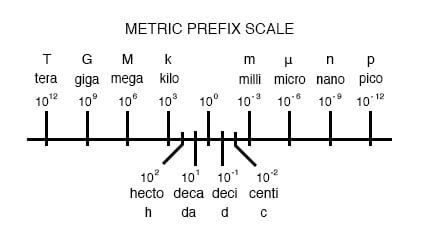
For electrical work, start with these commonly encountered prefixes:
| Prefix | Symbol | Size of one prefixed unit | Example |
|---|---|---|---|
| mega | units | ||
| kilo | units | ||
| no prefix | — | unit | |
| milli | units | ||
| micro | units | ||
| nano | units |
The prefix has the same multiplier regardless of the unit. A kilovolt is one thousand volts; a kilowatt is one thousand watts. This is why one conversion method will work across the whole lesson.
Pay close attention to letter case. means mega; means milli. Thus and are vastly different amounts of power. The symbol for kilo is a lowercase . Also keep the unit attached: is milliamperes, while is millicoulombs.
In SparkFun’s “The Prefixes” section, read the two tables headed “Describing the Large” and “Describing the Small.” You do not need to memorise every extreme prefix shown there; concentrate on the ones in the table above and on the case-sensitive symbols.
Metric Prefixes and SI Units - SparkFun Learn
The prefix tables extend the scale beyond the familiar kilo and milli values and show why capitalisation matters.
Under “The Prefixes,” locate the subsections “Describing the Large” and “Describing the Small.” Begin with the two tables and stop after the explanation of upper- and lowercase prefix symbols. Find mega, kilo, milli, micro, and nano in particular.
Converting without guessing the decimal direction
The safest approach is to pass through the unprefixed unit. First express the given value in volts, amperes, ohms, watts, or coulombs. Then express that result in the requested prefix, if necessary.
For example, convert to volts. Since each kilovolt contains volts,
Going the other way, convert to amperes. Each milliampere is one thousandth of an ampere:
Notice the check built into those results. A larger unit needs a smaller number to describe the same amount. Milliamperes are smaller than amperes, so becomes , not .
The following short video demonstrates how a prefix scale determines decimal movement. Its examples use metres rather than electrical units, but the prefix calculation is identical.
metric unit conversions shortcut: fast, easy how-to with examples
Watch metric unit conversions shortcut: fast, easy how-to with examples from Crash Chemistry Academy to see the power-of-ten scale used for conversions.
Watch prefix meanings for how a prefix attaches to a unit. Then follow the first conversion from metres to centimetres and the longer conversion from kilometres to centimetres. Focus on finding the difference between prefix powers before moving the decimal point.
SparkFun’s “Conversion” section gives the particularly useful electrical pattern: each move between adjacent prefixes spaced three powers apart—such as kilo and mega, or milli and micro—changes the number by a factor of .
Metric Prefixes and SI Units - SparkFun Learn
Return to SparkFun Learn for conversions stated directly in amperes, watts, and other electrical units.
In the “Conversion” section, read the conversion explanation through its short list of prefix relationships. Stop before “Bits and Bytes.” Follow why amperes to milliamperes multiplies the number by 1{,}000, while kilowatts to megawatts divides it by 1{,}000.
There is an important limit to the “three decimal places” shortcut. The image also shows prefixes such as centi and deci, which are not three powers apart from their neighbours. Use the stated powers of ten rather than assuming every mark on the scale represents a factor of .
Applying the method to five electrical quantities
The calculation does not depend on whether the unit is volts or coulombs. What matters is the starting prefix and the requested prefix.
Voltage: volts to millivolts. Since one volt contains millivolts, a reading of can be written as
Current: milliamperes to microamperes. A milliampere is amperes and a microampere is amperes. Their sizes differ by a factor of :
This may initially look surprising: the number grew from to . That is correct because a microampere is a smaller unit than a milliampere.
Resistance: megaohms to kiloohms. A component marked has a resistance of million ohms. Expressing that same resistance in kiloohms gives
Passing through ohms makes both prefix changes visible and gives you a way to check the answer.
Power: kilowatts to watts. If power is specified as , the equivalent value is
No power formula is needed: this is only a change of units.
Charge: coulombs to millicoulombs. Charge uses coulombs, symbol . A charge of is
The same scale applies again: one millicoulomb is coulomb.
For a direct check when two prefixes are involved, compare their powers of ten. If the starting prefix has power and the target prefix has power , multiply the starting number by . For the resistance example, mega has power and kilo has power , so . Passing through the unprefixed unit is often easier to explain in written work; the exponent difference is a quick way to verify it.
Keeping conversions dependable
When reading a question or an equipment marking, identify the whole unit symbol before calculating. In , the lowercase belongs to the unit: it means milli, not mega. If the requested answer is in amperes, write down the relationship before moving the decimal.
Three checks catch many conversion errors:
- Keep the quantity unchanged. A resistance conversion should begin and end in ohms, whether prefixed or not.
- Compare unit sizes. Changing to a smaller unit makes the numerical value larger; changing to a larger unit makes it smaller.
- Convert back mentally. For example, is , which is .
These checks matter most when a question contains several values with different prefixes. Recording both the number and its unit at each step makes it much harder to mistake for .
Key takeaways
An SI prefix is a power-of-ten multiplier attached to a unit. Converting between prefixes does not change the electrical quantity: and describe the same current. Use the prefix scale, pass through the unprefixed unit when helpful, and check that the number changes in the direction expected for the new unit. Preserve letter case—particularly versus —and always include the resulting unit.
Next, you will use current, charge, and time together. Being able to express current in amperes and charge in coulombs will make that calculation much more reliable.