Recommended resources
The freely available resources this lesson will direct you to.
Hello again. In the previous lesson, you followed electrical power from generation through transmission and distribution to a load. Now we will look more closely at generation: what forms of energy can a source provide before electrical energy is produced?
By the end of this lesson, you should be able to classify common electricity sources as renewable or non-renewable and name the primary energy each converts. That distinction is useful when reading descriptions of power plants, solar installations, and site generators: the equipment may look similar, while the energy supplying it is quite different.
Start with the energy source
Electricity is not a primary energy source in this classification. It is an output produced from another form of energy. Primary energy is the energy available from the original source—for example, sunlight, moving water, coal, or uranium. A source is generally called renewable if natural processes replenish it on a human timescale. A non-renewable source relies on a finite fuel that is not replaced on that timescale.
Read the Energy Information Administration’s Sources of energy for the source categories. Concentrate on what makes a source renewable or non-renewable, rather than memorizing where particular sources are most widely used.
Sources of energy - U.S. Energy Information Administration (EIA)
The U.S. Energy Information Administration distinguishes primary energy from electricity and groups common sources by whether they are replenished. Read this first so that the classifications have a clear basis.
In “Energy sources,” read the opening distinction. Under “Nonrenewable energy,” find the paragraph beginning “These energy sources are called” and read the fuel explanation; then read the paragraph beginning “Nuclear energy is produced” through its final sentence in the nuclear explanation. Under “Renewable energy,” read the definition, followed by the five-source list. Notice that renewable does not mean available at every moment.
The image below provides a quick visual check of those categories. It shows energy sources and their uses overall, not the amount of electricity generated by each source. For instance, petroleum appears largely in transportation, although petroleum-fuelled equipment can also generate electricity.
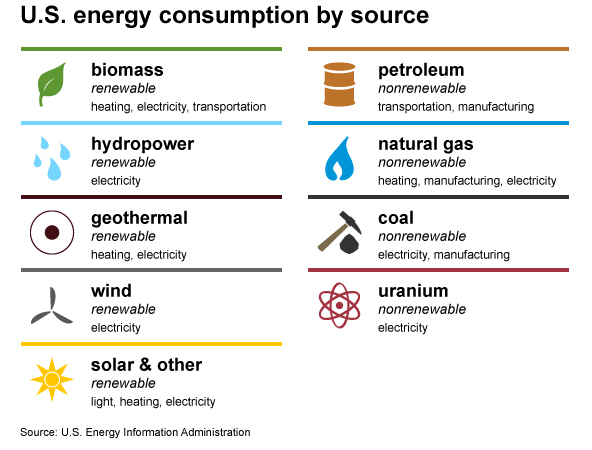
A useful trade distinction follows from this: the source determines the renewable classification; the device alone does not. A generator driven by a diesel engine and one driven by a turbine both produce electricity, but their classifications depend on what supplies the engine or turbine.
From primary energy to electricity
Many generating systems use a rotating generator. Water, wind, steam, or hot gases turn a turbine or engine shaft; the generator converts the shaft’s mechanical energy into electrical energy. The moving shaft is an important intermediate stage, but it does not tell you where the energy originally came from.
Watch this short portion of ClickView’s Electricity Generation Explained for the common generator arrangement and some different ways of supplying a turbine.
Electricity Generation Explained | Science | ClickView
ClickView’s Electricity Generation Explained shows why identifying a turbine is not enough to identify the primary energy source.
Watch the generator overview for the relationship between a turning turbine and a generator. In the heat sources, distinguish burning fuel from nuclear fission: both can provide heat, but the primary energies differ. Finish with the geothermal example, where heat comes from within the Earth.
For a more precise account, use the Energy Information Administration’s How electricity is generated. It also covers an important exception to the rotating-generator pattern: a photovoltaic cell converts sunlight directly into electricity.
How electricity is generated - U.S. Energy Information ...
The U.S. Energy Information Administration explains the conversion equipment behind the source categories. Read the selected passages to separate the primary input from the final step that produces electricity.
Under “Turbine driven generators,” read the opening paragraph, from “Most U.S. and world electricity generation” through its list of turbine types, in the generator principle. In the paragraph beginning “Steam turbines are used,” read from “Most steam turbines have a boiler” through the end of that paragraph in the steam examples. Near the end of the same section, find the consecutive paragraphs beginning “Hydroelectric turbines” and “Wind turbines”; read the water and wind descriptions, focusing on what moves the blades rather than the dated generation figures. Under “Other types of generators,” find the paragraph beginning “Solar photovoltaic cells” and read the photovoltaic description. Then read the paragraph beginning “Internal-combustion engines” in the engine examples; notice why knowing the engine type is not always enough to identify its fuel.
The key distinction is between the primary input and the conversion equipment. Coal-fired and nuclear stations can both use steam turbines. Their machinery may perform the same final conversion, but coal supplies chemical energy and uranium supplies nuclear energy. Conversely, a solar photovoltaic panel does not need a turbine to produce electricity.
Classifying the common sources
The following table gives the answer you would usually need in a Level One classification question. Where several energy forms occur along the way, the “primary energy” column names the source’s starting energy—not the mechanical energy at the generator shaft.
| Electricity source | Classification | Primary energy converted |
|---|---|---|
| Solar photovoltaic | Renewable | Radiant energy in sunlight |
| Wind | Renewable | Kinetic energy of moving air |
| Hydropower | Renewable | Energy of moving or falling water |
| Geothermal | Renewable | Thermal energy from within the Earth |
| Biomass | Renewable* | Chemical energy stored in recently grown organic material |
| Coal | Non-renewable | Chemical energy stored in coal |
| Natural gas | Non-renewable | Chemical energy stored in natural gas |
| Petroleum fuels, such as diesel | Non-renewable | Chemical energy stored in the fuel |
| Uranium in a nuclear reactor | Non-renewable | Nuclear energy released by fission |
*Biomass is classified as renewable when its source can be replenished. That does not mean every way of harvesting it is sustainable.
It helps to picture what happens between source and output. In a wind turbine, moving air turns the blades and the generator produces electricity. In hydropower, moving or falling water does that work instead. In a coal-fired station, burning coal releases heat, steam turns a turbine, and the generator produces electricity. A nuclear station also commonly uses steam, but fission—not combustion—supplies the heat. Geothermal electricity uses heat from within the Earth, while biomass generation can use the chemical energy in plant material or fuels made from it.
Solar needs one extra distinction. A photovoltaic (PV) panel converts sunlight directly into electrical energy. A solar-thermal generating plant instead captures solar energy as heat and can use that heat to run a turbine. Both start with sunlight and are renewable; only the latter uses heat-driven machinery. “Solar” therefore identifies the primary source, while “PV” or “solar-thermal” tells you more about the conversion method.
Reading source descriptions accurately
In practice, descriptions often name equipment rather than the energy source. A standby diesel generator, for example, is normally classified as non-renewable because its diesel is a petroleum fuel. The word generator tells you what produces the electrical output; diesel tells you the primary fuel. A rooftop PV system, by contrast, is renewable because sunlight supplies its radiant energy.
Be more cautious with the phrase steam-turbine plant. Steam tells you what turns the turbine, but not what supplied the heat. It could come from coal, nuclear fission, biomass, geothermal energy, or solar-thermal equipment. You need one more piece of information before classifying the source.
The same caution applies to “gas.” Natural gas extracted as a fossil fuel is non-renewable; gas produced from recently grown organic material can be biomass-based. For an exam answer, use the stated origin of the fuel, not merely its physical state or the type of machine burning it.
Finally, do not confuse renewable with “produces electricity continuously.” Sunlight and wind are replenished naturally, but their availability varies. Do not confuse non-renewable with “must be burned,” either: uranium is non-renewable, yet a reactor releases its energy by fission rather than combustion.
Key takeaways
To classify an electricity source, first identify its original energy input. Sunlight, wind, flowing water, Earth’s heat, and replenished biomass are common renewable sources. Coal, natural gas, petroleum fuels, and uranium are common non-renewable sources. Then name the energy form being converted: radiant, kinetic, thermal, chemical, or nuclear. A turbine, steam system, or generator describes how electricity is produced, but may not reveal which source supplied the energy.
Next, you will move from where electricity comes from to the difference between static electricity and current electricity.