Recommended resources
The freely available resources this lesson will direct you to.
Hello, and welcome. This first module begins with the big picture: how electrical energy reaches the equipment that uses it. Before studying circuits and calculations, it helps to know what each part of the supply system is meant to do.
In this lesson, you will follow electricity from a source to a load and identify four functions: generation, transmission, distribution, and utilization. These terms describe jobs, not just pieces of equipment. Being able to tell those jobs apart will make unfamiliar diagrams and trade questions easier to interpret.
Four distinct jobs
Imagine a generating station supplying a heater in a building. The station produces electrical power by converting another form of energy. The power may then travel a long distance on transmission lines. Closer to the building, a distribution network delivers it locally. Finally, the heater’s element uses electrical energy to produce heat.
The heater is a load: equipment that takes electrical energy from a supply to perform a function. Its operation is utilization. The building receives electricity, but the building itself is not necessarily the load; the heater, lamps, motors, and other operating equipment within it are loads.
Watch the grid overview in How Does the Power Grid Work? from Practical Engineering. Follow the change in purpose at each stage, especially where the account shifts from long-distance transport to local delivery.
Practical Engineering’s How Does the Power Grid Work? provides a visual trace of the stages from a generating facility toward consumers.
Watch the grid journey, beginning with the diagram of a typical grid and ending as power approaches its final users. Focus on what generation, high-voltage lines, substations, and distribution feeders each do; the later explanation of transformer construction is not needed yet.
Notice that generation does not mean creating energy from nothing. It means converting energy into electrical energy. For this lesson, the important distinction is simply between making electrical power available and moving or using that power. The different energy sources used for generation are the subject of the next lesson.
Following the path on a supply diagram
The image below shows a simplified route from a power plant to a house. Read it as a map of functions, rather than as a drawing of every component you would find on site.
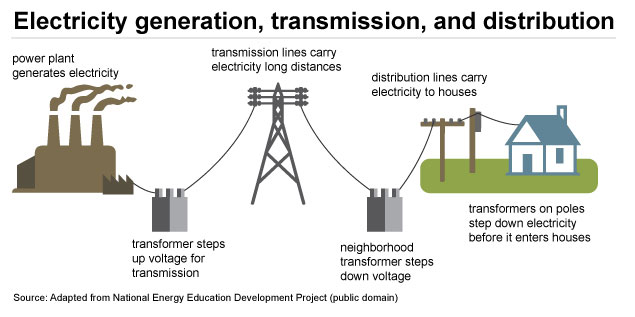
At the plant, a generator supplies electrical power. Before that power travels on long-distance lines, a step-up transformer raises its voltage. This supports more efficient transmission: for a given amount of power being carried, a higher voltage allows a lower current, reducing heating losses in the lines. You will calculate voltage, current, and power in later modules; for now, remember the purpose of the voltage change.
The tall-line portion of the image represents transmission: moving electrical power over long distances, generally at high voltage, from generating areas toward places where it is needed. A transformer does not generate electricity merely because it changes voltage. It adjusts the supply for the next part of the journey.
Near customers, substations and other transformers step the voltage down. Distribution then carries power over shorter, local routes toward customers. There may be more than one voltage reduction: the diagram shows a neighborhood transformer and a transformer near the house. A distribution feeder, a nearby transformer, and the final connection supplying a premises all contribute to delivery; they are not the equipment using the electrical energy.
For a second account, read the two short passages under “How electricity gets to your home” in the U.S. Energy Information Administration’s Electricity in the U.S. They identify the grid’s main components and distinguish long-distance lines from local delivery.
Electricity in the U.S. - Energy Kids: U.S. Energy Information Administration (EIA)
Read the U.S. Energy Information Administration’s account to reinforce the roles of the grid, transmission lines, distribution lines, and transformers.
Under “How electricity gets to your home,” read “The electric power grid,” from “Electricity is generated at power plants” through the sentence ending “enough electricity to meet demand”: the grid overview. Then, under “Delivering electricity,” read from “Power plants generate electricity” through the transformer bullet ending “deliver electricity to homes and businesses”: the delivery explanation. Focus on each component’s function rather than memorizing equipment names.
One wording detail is worth handling carefully: the reading calls its local-line bullet “Distribution transmission lines.” For identifying the stages, use transmission for the long-distance, high-voltage network and distribution lines for local delivery. Also, “lower voltage” does not mean safe to touch. Electrical supplies at customer premises can still cause severe injury or death.
Where delivery ends and utilization begins
Return to the house in the image. The distribution system has delivered electrical power to it, but the drawing stops before showing what happens inside. A lamp producing light, a fan motor producing motion, and a heater producing heat are examples of utilization. Each is a load converting electrical energy into a useful output.
That distinction matters when labelling equipment. A line, service connection, or transformer supplies or conditions power; it is not normally called the load simply because it is the last item drawn before a building. Likewise, a customer is the person or premises receiving supply, while a load is the electrical equipment using it.
Consider a workshop supplied from a distant generating station. The station’s generator performs generation. High-voltage lines carrying power across a long distance perform transmission. The local feeder and transformer serving the workshop are part of distribution. When a drill operates, its motor is a load performing utilization. If the drill is switched off, the supply network can still be present; that particular load is simply not operating.
The four-stage picture is a useful typical grid path, not a rule that every supply must pass through every stage. Electricity produced and used at the same premises, for example, need not cross a long-distance transmission network. What remains reliable is the question behind each label: Is this equipment producing electrical power, transporting it over a distance, delivering it locally, or using it?
Key takeaways
Generation converts another form of energy into electrical power. Transmission transports that power over long distances, generally at high voltage. Distribution delivers it locally at voltage levels suited to the customers being supplied. Utilization occurs when a load uses electrical energy to do a job, such as producing heat, light, or motion.
Next, you will look more closely at electricity sources and classify them by the forms of energy they convert.