Recommended resources
The freely available resources this lesson will direct you to.
- The Science & Practice of Perfecting Your Sleep | Huberman Lab Essentialswww.youtube.com
- Lower Stress With an End-of-Day Ritual | Dr. Cal Newport & Dr. Andrew Hubermanwww.youtube.com
- Science of Sleep: How is Sleep Regulated?sleep.hms.harvard.edu
- How to Fall Asleep Fast: 15 Science-Backed Techniqueswww.bodyspec.com
Hello! In our last lesson, we established protocols for structuring your meals to prevent the post-lunch energy dip, ensuring you maintain high performance throughout the afternoon. Now, we shift our focus from daytime energy to evening preparation for sleep.
This lesson addresses a common obstacle for busy entrepreneurs and professionals: the inability to "switch off" at night. Your learning outcome is to explain how reducing cognitive and physiological arousal in the evening accelerates sleep onset. You will learn the science behind why a "wind-down" is not a luxury but a biological necessity for sleep, and you'll get the foundational concepts for the practical protocols we will build in the following lessons.
The Problem: Hyperarousal, The Enemy of Sleep
You cannot go from a state of high alert—closing deals, solving problems, planning your next move—directly into a state of deep sleep. As sleep scientist Dr. Matthew Walker puts it, sleep is not like a light switch that you can just flip. It's more like landing a plane; it requires a gradual, controlled descent.
The technical term for being "revved up" or "wired" is hyperarousal. This is a state where both your mind (cognitive arousal) and body (physiological arousal) remain in a "daytime" mode, actively preventing sleep.
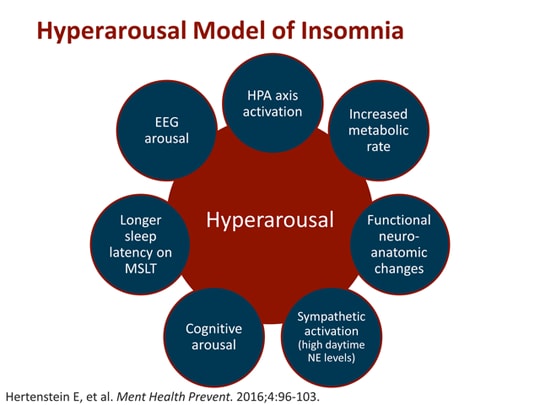

The 'Why': Overriding the Brain's "Sleep Switch"
To understand why hyperarousal is so disruptive, we need a very simple model of how your brain controls sleep.
Science of Sleep: How is Sleep Regulated?
To understand the core mechanism, let's look at a brief explanation from Harvard Medical School's Division of Sleep Medicine. This will give you the 'why' behind our protocols.
Read the section titled 'A "Flip-Flop Switch" Between Sleep and Wakefulness'. It's a short section that starts about halfway down the page. Focus on the concept of 'mutual inhibition' between wake-promoting and sleep-promoting brain areas.
As you just read, your brain has wake-promoting centers and sleep-promoting centers that inhibit each other. This is the "flip-flop switch":
- When your wake centers are active, they suppress the sleep centers. You are alert.
- When your sleep centers are active, they suppress the wake centers. You are asleep.
Cognitive and physiological arousal acts as a powerful signal that keeps your wake-promoting centers firing. Stress, worry, excitement from a late-night work session, or even physical tension from sitting at a desk all day tells your brain, "It's not safe to sleep yet! Stay alert!" This keeps the "wake" side of the switch locked on, preventing the transition to sleep.
The goal of a wind-down routine is to systematically remove these arousal signals, allowing the "sleep" side of the switch to finally take over.
The 'How': De-Arousal Strategies
Let's look at the two components of hyperarousal and the strategies to dismantle them. These are not yet granular protocols (we'll build those in the next lessons), but the foundational concepts you need to understand.
1. Reducing Cognitive Arousal (The Racing Mind)
Cognitive arousal is a state of mental overactivity—ruminating about the past, worrying about the future, or simply being unable to stop thinking about work.
A common analogy, which you'll hear in the video below, is that of open browser tabs on a computer. If you try to put a computer to sleep with dozens of active programs running, it will struggle, the fan will whir, and it won't rest properly. Your brain is the same. The solution is to systematically "close the tabs" before you try to sleep.
Lower Stress With an End-of-Day Ritual | Dr. Cal Newport & Dr. Andrew Huberman
In this clip, Dr. Andrew Huberman and productivity expert Dr. Cal Newport discuss structured, protocol-based methods for offloading work-related thoughts to enable mental shutdown.
Watch the segment from the beginning until 02:31. Pay close attention to Cal Newport's concept of a 'shutdown ritual' and the 'demonstrative anchor' he uses to signal to his brain that the workday is complete.
The key principles for reducing cognitive arousal are:
- Externalization: Getting thoughts out of your head and onto paper (or a digital document). This signals to your brain that the information is captured and no longer needs to be actively held in your working memory. This is the logic behind Newport's end-of-day review and the "worry journal" technique.
- Boundary Setting: Creating a clear and formal end to your workday. The "shutdown complete" phrase Newport mentions is a cognitive-behavioral tool to create a hard stop, preventing work thoughts from bleeding into your personal time.
2. Reducing Physiological Arousal (The Tense Body)
Your mind and body are in constant communication. A racing mind creates a tense body, and a tense body tells the mind there's a reason to be on alert. You can break this loop by directly targeting physical tension.
Techniques that do this work by shifting your autonomic nervous system away from the "fight-or-flight" (sympathetic) branch and toward the "rest-and-digest" (parasympathetic) branch.
How to Fall Asleep Fast: 15 Science-Backed Techniques
This article from BodySpec provides a toolkit of rapid, science-backed techniques designed specifically to reduce both physiological and cognitive arousal at bedtime.
First, read the section 'Step-by-step: How to use each method'. Focus on the descriptions for '4-7-8 breathing' and 'Progressive Muscle Relaxation (PMR)'. Then, review the 'Comparison guide' table at the end to see how different methods target different types of arousal.
The core principles for reducing physiological arousal are:
- Respiratory Control: Slow, controlled breathing is one of the fastest ways to activate your parasympathetic nervous system. The elongated exhale in techniques like 4-7-8 breathing is particularly effective at lowering heart rate and calming the body.
- Somatic Awareness: Techniques like Progressive Muscle Relaxation (PMR) force you to notice and then release physical tension you might not even be aware of (like a clenched jaw or raised shoulders). This sends a powerful relaxation signal to your brain.
Test your understanding!
It's an hour before your target bedtime. You've just finished a stressful work call, and you feel both mentally agitated about the conversation and physically tense in your shoulders and neck.
Based on the principles discussed, what is the logical sequence of actions to begin de-arousing?
- Start 4-7-8 breathing immediately.
- Do 15 minutes of Progressive Muscle Relaxation.
- Perform a "worry dump" or "shutdown ritual" to process the thoughts from the call.
Show answer
The most logical first step is #3, perform a 'worry dump' or 'shutdown ritual'.
Reasoning: The root cause of your arousal is cognitive (the stressful call). You need to "close that tab" first. By externalizing your thoughts and making a plan for any necessary follow-up tomorrow, you address the source of the agitation. Once your mind is clearer, physiological techniques like PMR (#2) or controlled breathing (#1) will be far more effective at calming your body, as you've removed the primary mental trigger that was creating the physical tension.
Conclusion
You now understand that falling asleep quickly is not a passive process but an active one of de-arousal. Hyperarousal, a state of high mental and physical alertness, keeps your brain's "wake switch" on, blocking sleep. By systematically reducing this arousal, you allow the "sleep switch" to engage.
Key Takeaways:
- Sleep is a process of gradual descent, not an on/off switch.
- Hyperarousal (high cognitive and physiological activity) is the primary obstacle to rapid sleep onset.
- To fall asleep, you must help your brain's "flip-flop switch" move from the "wake" state to the "sleep" state.
- You achieve this by reducing cognitive arousal (e.g., with a "shutdown ritual") and physiological arousal (e.g., with controlled breathing or PMR).
In our next lesson, we will build on this foundation by introducing a powerful protocol that uses your body's temperature regulation system. You will learn how to implement a pre-sleep warming protocol (like a hot shower or bath) to trigger a rapid drop in core body temperature—another potent signal that tells your body it's time to sleep.