Recommended resources
The freely available resources this lesson will direct you to.
- How electricity is generated (3D Animation - AC&DC Generators)www.youtube.com
- Electric Generator Lenz's Law Part 1 Left or Right Hand Rule Physics Lessonwww.youtube.com
- How Does a DC Generator Work? 5 Key Parts and Real-World Useswww.tsaielectro.com
- AC and DC generators (video) - Khan Academywww.khanacademy.org
Hello! Welcome to your twelfth lesson.
In our last lesson, we explored the DC motor, discovering how electrical energy creates mechanical motion. A key insight was the concept of Back EMF: a spinning motor coil also acts as a generator, creating a voltage that opposes the power source. This neatly sets the stage for today's topic.
This lesson directly addresses the learning outcome: Explain the operating principle of a DC generator based on the conversion of mechanical energy to electrical energy via electromagnetic induction.
We are essentially flipping the DC motor on its head. Instead of putting electricity in to get motion out, we will put motion in to get electricity out. You'll see that the hardware is nearly identical, but the flow of energy and our goal are reversed. This reinforces the deep connection between electricity and magnetism, a cornerstone of the low-level systems you're interested in.
1. The "Cost" of Generating Electricity: Lenz's Law
The fundamental principle behind all electric generators is Faraday's Law of Electromagnetic Induction: a changing magnetic field through a coil of wire induces a voltage (and thus a current, if there's a closed circuit).
But this raises a question that gets to the heart of physical intuition: what determines the direction of that induced current? The answer lies in the conservation of energy, elegantly summarized by Lenz's Law. It states that the induced current will flow in a direction that creates a magnetic field opposing the change that produced it.
In simpler terms, the universe demands that you must work to generate electricity. If you push a magnet towards a coil, the coil will become a magnet that pushes back. You have to expend energy to overcome this repulsion. That mechanical energy you expend is what gets converted into electrical energy.
Let's watch a video that explains this crucial concept.
Electric Generator Lenz's Law Part 1 Left or Right Hand Rule Physics Lesson
This video from Physicshelp Canada, titled 'Electric Generator Lenz's Law', explains why generating electricity requires effort. It frames electromagnetic induction in terms of conservation of energy.
Watch the first 2 minutes and 48 seconds of the video. Focus on the core idea: the induced current in the coil creates a magnetic field that makes it 'difficult' for the external magnet to move. This opposition is the key to understanding energy conversion.
This principle is the "why" behind generation. Without this opposition, you could generate energy for free, violating the laws of physics. With this in mind, let's see how we can build a machine to harness this effect.
2. Building a Generator: From Rotation to AC
To generate electricity continuously, we need to create continuous change in the magnetic field experienced by a coil. The most practical way to do this is to spin a coil of wire inside a fixed magnetic field.
As the coil spins, the two main sides of the loop move up and down through the field.
- The side moving up will have a current induced in one direction.
- The side moving down will have a current induced in the opposite direction.
This is formally predicted by Fleming's Right-Hand Rule (the "generator rule"), which is the counterpart to the Left-Hand Rule you saw for motors.
Let's watch this process in action.
AC and DC generators (video) - Khan Academy
The Khan Academy video 'AC and DC generators' provides an excellent animation of a coil rotating in a magnetic field. It shows how the direction of the induced current is determined and why this naturally produces alternating current (AC).
Watch from the beginning to 06:33. Pay attention to how the current in the coil reverses every half-turn. Also, notice the introduction of 'slip rings'—two separate, continuous rings—which are used to get this alternating current out of the spinning coil.
As the video demonstrates, a simple rotating coil naturally produces alternating current (AC). The current flows one way for half a rotation, then reverses and flows the other way for the second half. This is the basis of AC generators used in power plants worldwide.
But our goal is to produce direct current (DC). How do we convert this natural AC into DC?
3. The Mechanical Rectifier: The Commutator
The solution is a familiar component: the commutator. In the DC motor, its job was to reverse the current from the power source to keep the torque pushing in the same direction. In a DC generator, its job is to act as a mechanical rectifier. It "un-reverses" the current from the coil before sending it to the external circuit.
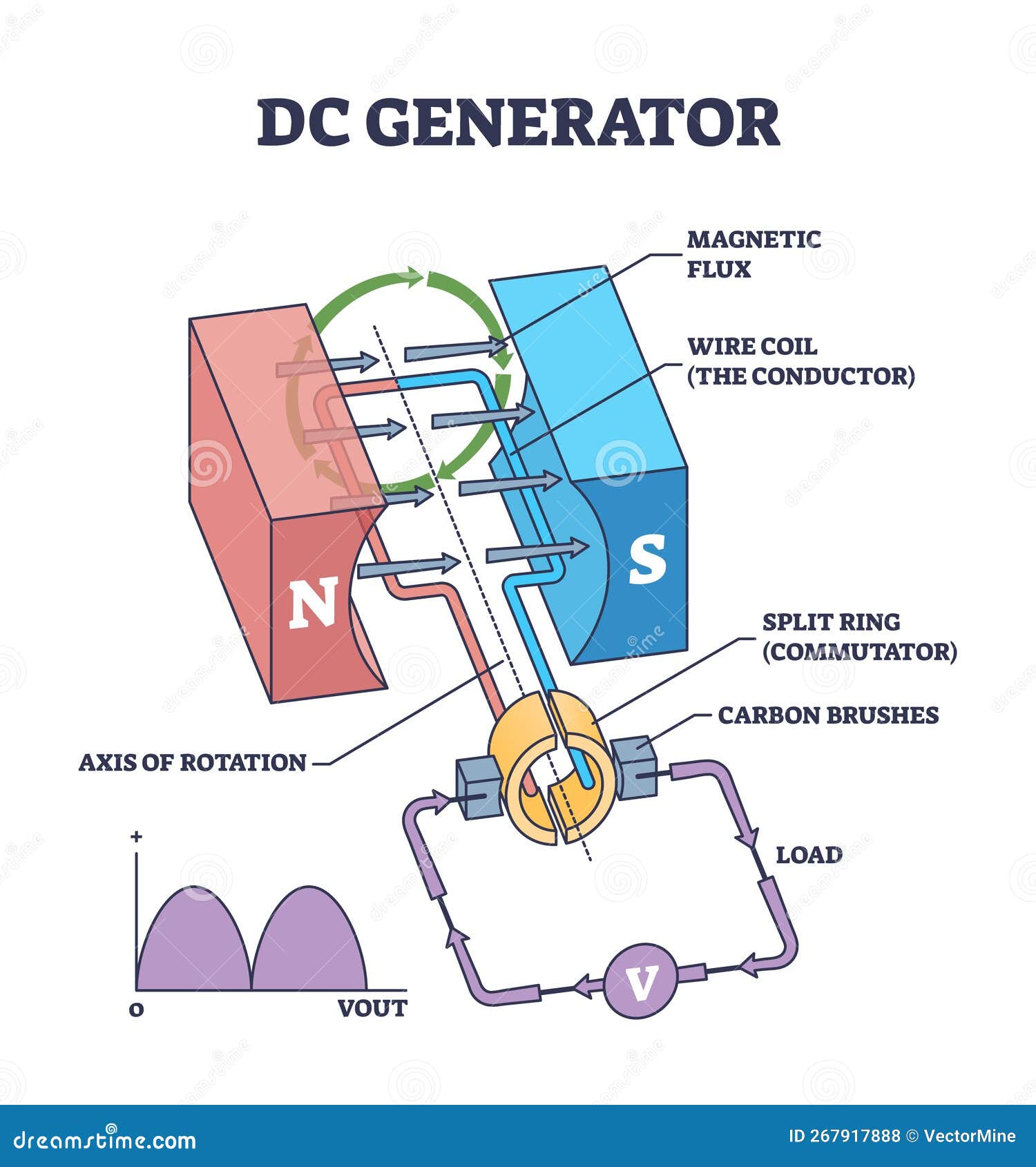
The commutator in a generator works by flipping the connections to the external circuit at the exact moment the current in the internal coil reverses.
Let's see this clever switching mechanism animated.
AC and DC generators (video) - Khan Academy
We'll now watch the second part of the Khan Academy video, which shows the simple but brilliant modification needed to turn an AC generator into a DC generator.
Watch from 06:33 to the end (08:52). Focus on how the 'split ring' commutator causes the brushes to switch contact from one side of the coil to the other every half rotation. Notice how this action ensures the current in the external circuit (the bulb) always flows in the same direction.
To solidify this concept, let's read a clear, concise explanation of the process.
How Does a DC Generator Work? 5 Key Parts and Real-World Uses
The article 'How Does a DC Generator Work?' breaks down the function of each component and provides a great summary of the process.
Read the sections 'What is a DC generator...', 'Breaking down the DC generator...', 'Quick review of electromagnetic induction...', and 'Commutator “magic”...'. This will reinforce what you saw in the video, especially the idea of 'turning AC inside into DC outside'.
So, the key takeaway is that a DC generator still produces AC inside the rotating armature coil. The commutator's job is to ensure that by the time the current reaches the external circuit via the brushes, it has been rectified into a single direction.
4. The Output: Pulsating DC
Is the output of this simple DC generator the same as the flat, steady DC from a battery? No.
Because the induced voltage in the coil is sinusoidal (rising to a maximum and falling to zero), the rectified output is a series of positive "bumps." This is known as pulsating DC. The voltage is always positive, but its magnitude is constantly changing.
For many applications, this is sufficient. However, for electronics that require a smooth DC voltage, this pulsating output needs to be filtered. Real-world DC generators improve this by:
- Using many armature coils wound at different angles.
- Using a commutator with many corresponding segments.
- Adding external filter capacitors to smooth out the ripples.
This is a brief preview, connecting back to capacitors, but for now, the key is to understand that the raw output of a simple DC generator is pulsating, not flat.
Conclusion
In this lesson, we have seen how the principles of electromagnetic induction can be harnessed to convert mechanical energy into electrical energy. By understanding the DC generator, you've also deepened your understanding of the DC motor, as they are two sides of the same coin.
Key Takeaways:
- A DC generator converts mechanical energy into DC electrical energy through electromagnetic induction.
- Lenz's Law explains that the induced current creates a magnetic field that opposes the motion, meaning mechanical work is required to generate electricity (conservation of energy).
- A coil rotating in a magnetic field naturally produces an alternating current (AC).
- The commutator, acting as a mechanical rectifier, reverses the output connections every half-turn to convert the internal AC into external pulsating DC.
- Structurally and fundamentally, a DC generator is almost identical to a DC motor; their primary difference is the direction of energy conversion.
Preview of the Next Lesson:
We've now covered the fundamental principles of converting energy between electrical and mechanical forms with motors and generators. In the next lesson, we will shift our focus to a very practical application of the concepts of power and energy we've built throughout the course: calculating electricity consumption and cost for household appliances.