Recommended resources
The freely available resources this lesson will direct you to.
Hello! Welcome to your final lesson in this course.
In our last lesson, we explored how a DC generator converts mechanical work into electrical energy, rounding out our study of electromagnetic energy conversion. This was the perfect complement to our look at DC motors.
Today, we bring all our foundational concepts—voltage, current, power, and energy—together for a very practical application. This lesson addresses the learning outcome: Calculate electricity consumption and cost for household appliances and reason about what drives high energy usage.
We'll connect the abstract physics of circuits to the numbers on your electricity bill. This will not only prepare you for exam questions on this topic but also give you the tools to reason about your own energy footprint, a skill that's valuable far beyond the classroom.
1. Power vs. Energy: The Fundamental Intuition
To start, we must solidify the difference between two terms that are often confused: power and energy.
- Power (P) is the rate at which energy is used or transferred. Its unit is the Watt (W). Think of it as "how fast" you are using electricity at any given moment.
- Energy (E) is the total amount of work done or heat generated over a period of time. It is what you actually pay for. Energy is calculated as Power multiplied by Time.
A powerful analogy can help build intuition for this.
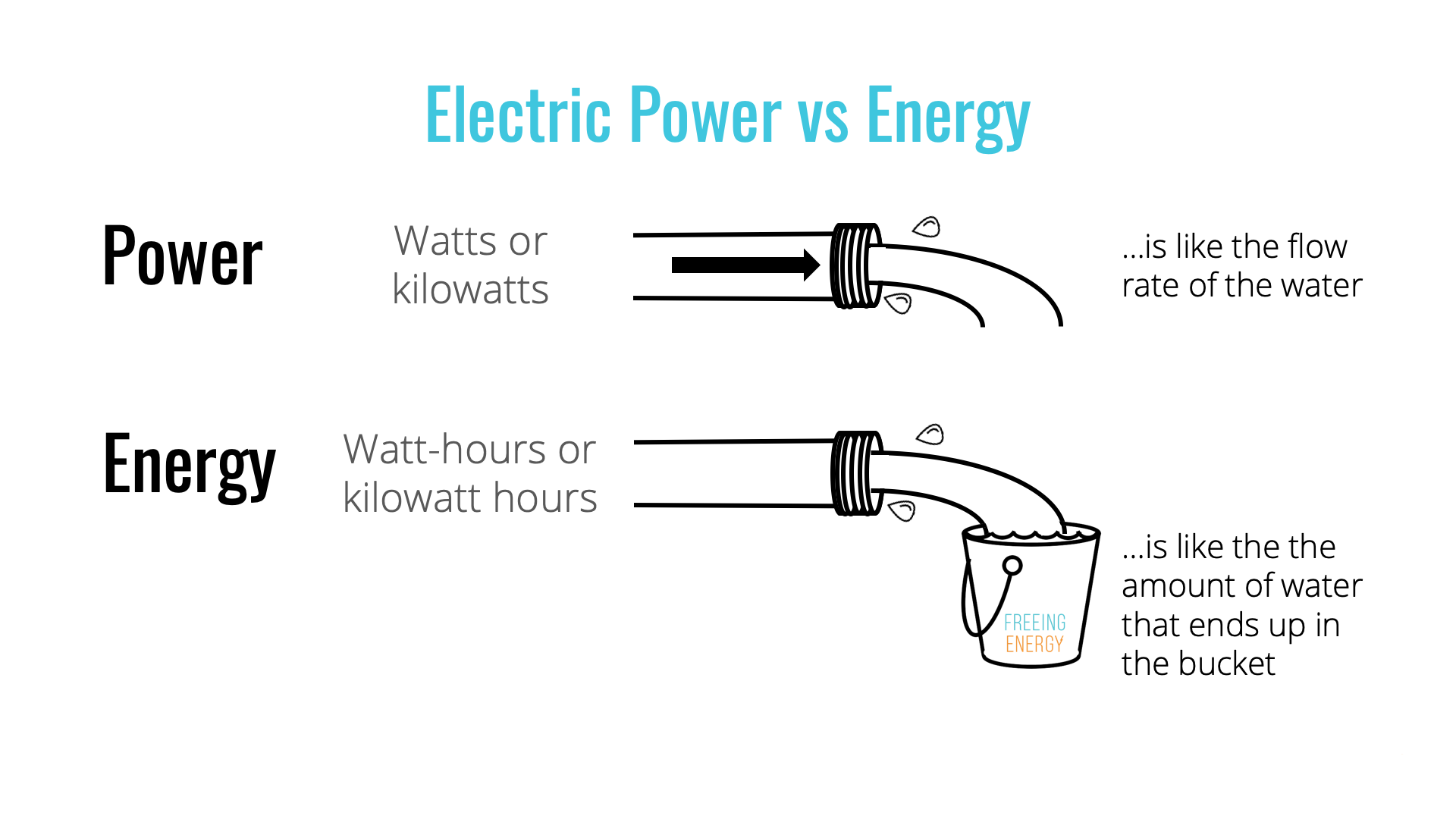
As you can see, a high-power device is like a fully-open hose, releasing a lot of water (energy) per second. A low-power device is like a dripping tap. The final amount of water in the bucket depends on both the flow rate (power) and how long you leave it running (time).
The standard unit for energy is the Joule, but for billing purposes, electricity companies use the kilowatt-hour (kWh).
Since a kilowatt is 1,000 watts and an hour is 3,600 seconds, one kWh is equivalent to 3.6 million Joules ().
Let's watch a short video clip that clearly explains this distinction.
Electric Power and The Cost of Electricity Using kWh
This clip from The Organic Chemistry Tutor makes a very clear distinction between electric power and electric energy, and introduces the relationship E = P x t.
Watch from 00:36 to 01:39. Focus on how power is defined as the rate of energy transfer, while energy is the total amount transferred over time. This is the core concept for this lesson.
2. How to Calculate Energy Consumption
Now that we have the core concept down, let's move to the practical calculation. The formula is a direct expression of the relationship we just discussed:
Energy (kWh) = Power (kW) × Time (hours)
The process involves three simple steps:
- Find the appliance's power rating in Watts (W).
- Convert the power to kilowatts (kW) by dividing by 1,000.
- Multiply by the number of hours the device is used.
The following article explains where to find this information and gives some excellent real-world examples.
How to Calculate Electrical Energy Consumption Easily
The article 'How to Calculate Electrical Energy Consumption Easily' provides a practical guide to finding appliance power ratings and applying the energy formula.
Read the sections 'Key Terms for Calculating Energy Consumption', 'Finding and Decoding Appliance Power Ratings', and 'Putting the Energy Calculation Formula to Work'. Pay attention to the examples provided for the air conditioner, TV, and lights.
To see this process animated with clear, step-by-step calculations, let's watch another helpful video.
What is a kWh - kilowatt hour + CALCULATIONS 💡💰 energy bill
This video from The Engineering Mindset walks through the entire calculation process, including unit conversions for both power and time.
Watch from the beginning to 04:20. This will reinforce the definitions and show you how to handle different scenarios, like converting Watts to kW and calculating consumption for devices running for less than an hour.
3. Calculating the Cost
Once you know the energy consumed in kWh, calculating the cost is straightforward. You just need to find the tariff rate on your electricity bill, which is the price per kWh.
Cost = Energy Used (kWh) × Tariff Rate ($/kWh)
Let's complete the previous video to see this final step in action.
What is a kWh - kilowatt hour + CALCULATIONS 💡💰 energy bill
We'll now see how to convert the calculated kWh into a monetary cost.
Watch from 04:20 to the end (05:38). The video demonstrates how to use the tariff rate and also suggests how you could estimate a monthly bill.
4. Reasoning About High Energy Usage
The calculation is the "how," but your goal is to also understand the "why." What makes an appliance a major contributor to your electricity bill? It boils down to the two factors in our formula: high power or long duration.
High-Power Appliances
These are devices that perform a lot of work quickly, usually by converting electrical energy into heat or kinetic energy.
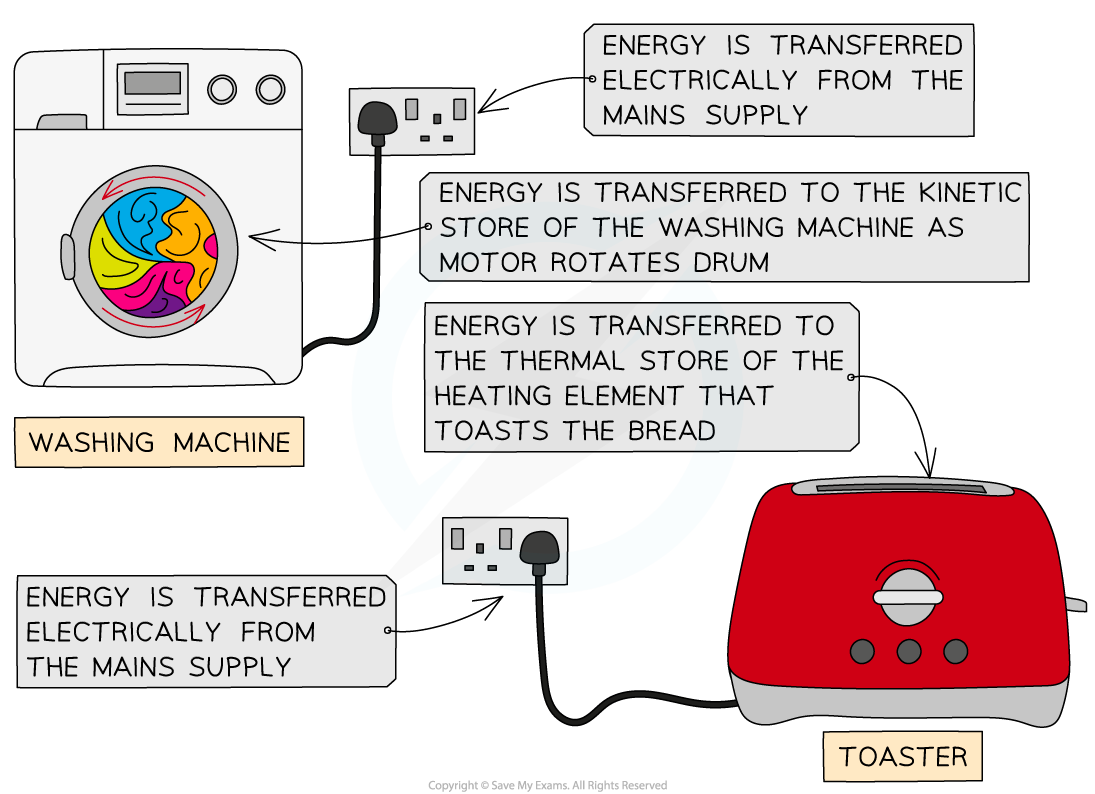
Appliances with heating elements (kettles, ovens, space heaters, hair dryers) and powerful motors (air conditioners, vacuum cleaners) have high wattage ratings. They consume a large amount of energy even if used for a short time.
Long-Duration Appliances
These devices may have a low power rating, but they are on for many hours a day, or even 24/7.
- Examples: Wi-Fi routers, refrigerators (cycling on and off), and devices on standby.
This leads to the concept of "vampire power" or standby power. Many modern electronics draw a small amount of power even when "off." Individually, this is tiny, but collectively it can be significant.
The following reading delves into these nuances, which are key to reasoning about energy usage.
How to Calculate Electrical Energy Consumption Easily
To deepen your reasoning skills, let's look at why your calculations might not match your bill and the impact of standby power.
Read the sections 'Why Are My Calculations Different from My Bill?' and 'What Is Standby Power and How Much Does It Cost Me?'. This will help you understand the limitations of simple estimates and identify hidden sources of energy consumption.
5. Practice and Reflection
Let's put this all together with a problem.
An office has the following devices running for an 8-hour workday:
- A computer and monitor with a combined power rating of 200 W.
- A powerful space heater rated at 1,500 W.
- An LED desk lamp rated at 10 W.
The electricity tariff is $0.20 per kWh.
- Calculate the daily energy consumption (in kWh) for each device.
- Calculate the total daily cost to run these three devices.
- What percentage of the total energy is consumed by the space heater? What does this tell you about where to focus energy-saving efforts?
Solution
-
Energy Consumption (kWh):
- Computer:
- Heater:
- Lamp:
-
Total Cost:
- Total Energy =
- Total Cost =
-
Reflection:
- Percentage for Heater =
- This shows that appliances that generate heat are exceptionally power-hungry. The heater, despite being just one of three devices, accounts for nearly 90% of the energy cost. This demonstrates that identifying and managing high-power devices is the most effective strategy for reducing electricity consumption.
Conclusion
This lesson brings our journey through the world of DC circuits to a practical conclusion. We've seen how the fundamental concepts of power and energy manifest in our daily lives and on our utility bills.
Key Takeaways:
- Power (W) is the rate of energy use; Energy (kWh) is the total amount consumed over time.
- Energy consumption is calculated as Power (kW) × Time (hours).
- Cost is calculated as Energy (kWh) × Tariff Rate ($/kWh).
- High energy usage is driven by two main factors: high-power appliances (like heaters and motors) and devices that run for a long duration (including those on standby).
You have now covered all the topics in this course, from the foundational definitions of voltage and current, through systematic analysis of complex resistor networks, to the principles of motors, generators, and practical energy consumption. You have built a strong foundation of both calculation and intuition.
I wish you the very best of luck on your qualifier exam. You are well-prepared.