Recommended resources
The freely available resources this lesson will direct you to.
Hello! Last time, you connected APQP to the Core Tools and PPAP: APQP organizes the launch work, while PPAP presents applicable product and process evidence for customer approval. This lesson places that work on an automotive program timeline.
By the end, you should be able to identify what each of the five APQP phases produces, when it typically overlaps with other work, and what decision a gate review needs to make. We will use an illustrative automotive textile cover throughout. Its seam position and appearance requirements give us a way to follow one product from concept through production.
Read the timeline as overlapping work
The five phases are often numbered in order, but a program does not finish every activity in one phase before anyone begins the next. Process engineers may investigate manufacturing methods while product design is still changing. Measurement planning can begin before the production equipment is installed. What matters is that decisions are made against sufficiently mature, controlled evidence.
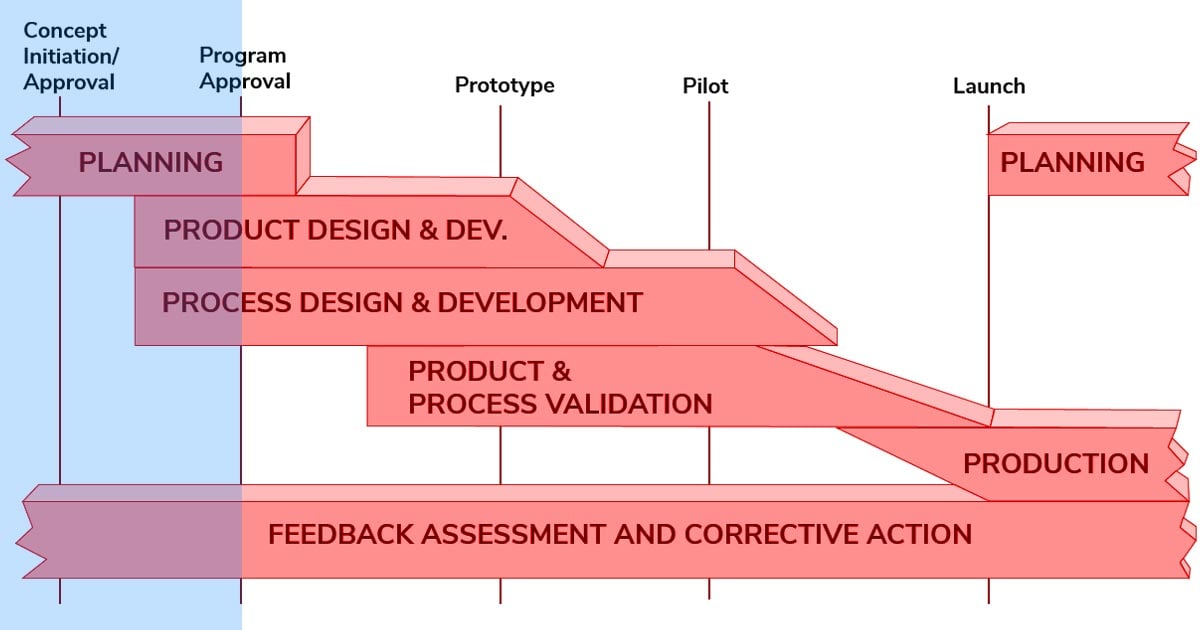
Notice two features of the diagram. Prototype and pilot are different milestones: a prototype helps evaluate a design, whereas a pilot or production trial tests the intended manufacturing process. Also, the line for feedback begins early. Lessons from a prototype or trial should change the plan when necessary, rather than being stored for review after launch.
Watch the first portion of Why Advanced Product Quality Planning (APQP)? from PMC Videos. You saw this resource in the previous lesson; here, concentrate on its phase timeline and the first two sets of outputs.
Why Advanced Product Quality Planning (APQP)?
Revisit Why Advanced Product Quality Planning (APQP)? from PMC Videos to connect the phase names to program milestones and concrete deliverables.
Watch the phase chart, beginning when the presenter says “looking at this chart”; observe the overlap and the feedback line. Continue with planning outputs, introduced as the planning stage, and design outputs, introduced as the second stage. Focus on what the team needs to carry from one phase into the next.
A gate is a decision checkpoint, not another name for a phase or a calendar milestone. At a gate, authorized reviewers compare the required evidence with agreed criteria, identify unresolved risk, and record whether work may proceed, may proceed only under specified conditions, or must stop pending action. A prototype date on a schedule tells you when a build is intended; its gate asks whether the design and controls are ready for that build.
For a short governance perspective, read the specified portions of Advanced Product Quality Planning (APQP): Meaning & Process from QAD. The reading also clarifies why product-design deliverables depend on who owns the design.
Advanced Product Quality Planning (APQP): Meaning & Process
Read QAD’s overview for the distinction between setting up gate governance and producing design-phase evidence.
Under “The 5 Phases of the APQP Process,” start at the “Pre-Planning and Governance” subsection, where the text begins “Before APQP Phase 1 begins.” Read the governance discussion through the opening of “Stage Gates and Governance.” Then find “APQP Phase 2: Product Design and Development.” Read the design outputs, stopping at the end of its output list, immediately before “APQP Phase 3: Process Design and Development.” Pay particular attention to the qualification about product-design responsibility.
Pre-planning can establish scope, owners, and gate rules before Phase 1, but it is not a sixth APQP phase. Likewise, the gate questions below are a practical supplier-program map, not universal approval names or a replacement for a customer’s specified milestones.
From concept to a verified product: Phases 1 and 2
Phase 1 — Plan and define the program
Near concept initiation and program approval, the team determines what it is being asked to deliver and whether its proposed approach is credible. Inputs include customer specifications, expected volume and timing, applicable requirements, and lessons from similar products. Principal outputs include design, reliability, and quality goals; a preliminary bill of materials; a preliminary process flow; an initial list of potentially important characteristics; a product assurance or quality plan; and management support.
For the textile cover, suppose seam position has a specified tolerance and appearance must meet an approved standard. Phase 1 is not where the team claims that production can already hold the tolerance. It is where the team confirms the applicable requirement and revision, identifies what must be evaluated, and plans who will obtain the necessary product and process evidence.
The planning gate asks whether the scope, objectives, ownership, timing, and major assumptions are clear enough to commit resources and advance development. If a required appearance standard has not been supplied, the sensible outcome is not to mark the requirement complete. The team records the gap, its owner, its effect on subsequent work, and the decision needed.
Phase 2 — Product design and development
As the program approaches prototype builds and design maturity, the product-design team works out what the product must be. Where the supplier owns product design, principal outputs typically include drawings and material specifications, design reviews, a DFMEA, design verification planning and results, prototype controls, identified special characteristics, and tooling and gauge requirements. These outputs inform manufacturing feasibility and process design.
A prototype textile cover might establish that a particular seam construction meets fit and appearance requirements. That is useful design evidence, but a successful prototype alone does not demonstrate that the intended production line can repeat the result at the required volume.
The design gate asks whether the product definition and its verification evidence are mature enough to authorize the next planned commitment—perhaps prototype approval, tooling, or a controlled design release. Open design risks, unverified requirements, and drawing changes must be visible in that decision. The exact release point depends on the program; process development may already be well underway.
If the supplier manufactures to a customer-owned design, it should not claim to own a DFMEA it was not responsible for producing. It still needs the released requirements and relevant design-risk information to plan its process. We will examine that responsibility boundary explicitly in the next lesson.
From a proposed process to production evidence: Phases 3 and 4
Phase 3 asks, “How will we make and control this product?” Phase 4 asks, “Did that intended process actually work under representative conditions?” The distinction prevents a common launch error: treating a well-written control plan as proof that its controls are effective.
Watch the remaining phase-specific portion of the PMC Videos presentation. It identifies the deliverables that move from process design into validation and then into production feedback.
Why Advanced Product Quality Planning (APQP)?
Continue Why Advanced Product Quality Planning (APQP)? to distinguish process-planning documents from results obtained during a production trial.
Watch process design, beginning “the prior phase supplies the information needed”; note the flow, PFMEA, pre-launch control plan, and measurement and capability plans. Then watch validation, beginning “at this point our focus shifts”; distinguish planned studies from completed results and note the discussion of PPAP. Finish with production feedback, beginning “phase four project plans are now finished,” for the post-launch role of monitoring and improvement. The presenter also mentions aerospace first-article inspection; do not treat that aerospace milestone as a general automotive APQP requirement.
Phase 3 — Process design and development
Around tooling preparation and pilot readiness, manufacturing turns the product definition into a specified process. Principal outputs include a process flow diagram, plant layout and packaging provisions, PFMEA, pre-launch control plan, work instructions, and plans for measurement-system evaluation and preliminary process-capability studies.
For the textile cover, the flow should describe how material is received, positioned, sewn, inspected, and handled. The PFMEA considers ways the process could create a misplaced seam or an appearance defect. The pre-launch control plan identifies the controls to be used while the process is being established. These documents need to refer to the same process steps and current product characteristics; otherwise, an apparently complete document set can conceal a control gap.
The process-readiness gate asks whether the proposed manufacturing process, equipment, people, instructions, and controls are ready for a meaningful trial. A plan to evaluate a seam-position gauge is appropriate Phase 3 evidence. It is not yet a satisfactory measurement-system result.
Phase 4 — Product and process validation
Near the pilot or significant production run, the team tests the combination of product, tooling, people, materials, measurements, and process controls. Principal evidence includes production-trial results; measurement-system results; preliminary capability or other required process studies; product validation test results; packaging evaluation; a production control plan; and the applicable PPAP package and quality-planning sign-off.
The production trial should use the intended production conditions as required by the program and customer. Its required duration, quantity, rate, and acceptance criteria must come from applicable instructions—not from a generic example. For the textile cover, the team would examine both whether trial parts meet seam-position and appearance requirements and whether the measurement and process evidence support repeatable production.
The validation and launch-readiness gate asks whether that evidence justifies production release. Internal sign-off and customer PPAP approval are distinct decisions: an internal team cannot grant customer approval by declaring its own package complete. If studies fail, validation tests remain open, or required customer approval is missing, the team must resolve the issue or obtain whatever explicit authorization the applicable customer process permits before shipping under those conditions. A planned control is not a substitute for a failed validation result.
After launch: Phase 5 and the gate map
Phase 5 — Production, feedback, assessment, and corrective action
At launch and during early production, the team checks whether the validated plan continues to perform in regular operation. Its outputs are less like a single submission package and more like a controlled record of performance: quality and delivery trends, customer feedback, actions on variation and defects, verified corrective actions, and lessons learned. Findings may require changes to the PFMEA, control plan, instructions, or future program plans.
For example, acceptable pilot-run seam results do not settle the question forever. If seam-position variation rises over successive shifts, the team needs to investigate and control it, even if individual covers have not yet exceeded the drawing limit. Feedback during Phase 5 is also why the diagram shows corrective action spanning the earlier phases: discoveries should inform current decisions as soon as they arise.
Some programs hold a formal post-launch or handover review. Its decision is whether performance is sufficiently stable, open actions have appropriate owners, and the program can leave intensified launch oversight. It does not mean that ordinary production monitoring or corrective-action responsibilities end.
Here is the complete map. Treat the gate questions as representative decisions; the actual names, authority, evidence thresholds, and customer approvals must be set for the program.
| APQP phase | Lifecycle landmark and principal evidence | Representative gate decision |
|---|---|---|
| 1. Plan and define | Concept and program approval; goals, preliminary product and process definitions, initial characteristic list, quality plan | Is the program sufficiently defined and resourced to proceed? |
| 2. Product design | Prototype and design maturity; released or maturing specifications, design-risk and verification evidence where applicable | Is the design sufficiently verified and controlled for the next commitment? |
| 3. Process design | Tooling and pilot preparation; process flow, PFMEA, pre-launch control plan, instructions, study plans | Is the intended process ready for a representative trial? |
| 4. Product and process validation | Pilot, PPAP, and launch preparation; trial and test results, measurement and process studies, production control plan | Does the evidence—and required customer approval—permit production release? |
| 5. Production and feedback | Launch and early production; performance trends, corrective actions, lessons learned | Can heightened launch oversight end without losing control of open risks? |
A defensible gate record states what evidence was reviewed, what remains open, who owns each action, and what decision was authorized. “Proceed with conditions” has meaning only if the conditions, deadlines, and escalation path are explicit. A gate is therefore a means of managing risk across overlapping work—not a claim that every document in a phase will never change again.
Key takeaways
The five APQP phases take a program from defined requirements, through product and process design, to production-based validation and post-launch learning. Their work overlaps, but their evidence serves different purposes: plans describe what will be done; prototype results inform the product design; production trials test the intended process; and launch data show how it performs over time.
Gate reviews turn that evidence into documented decisions. Most importantly, an internal launch decision does not replace required customer PPAP approval, and reaching a milestone date does not demonstrate readiness by itself. Next, you will determine which of these APQP obligations a Tier supplier actually owns when product-design and process-design responsibilities differ.