Recommended resources
The freely available resources this lesson will direct you to.
- Why Advanced Product Quality Planning (APQP)?www.youtube.com
- APQP Full Training: Advanced Product Quality Planning (#coretools)www.youtube.com
- [PDF] Ford Motor Company Customer-Specific Requirements For use with ...www.iatfglobaloversight.org
- International Automotive Task Force IATF 16949:2016www.iatfglobaloversight.org
Hello! In the previous lesson, you mapped the five APQP phases and the evidence needed at each gate. One distinction now becomes decisive: a supplier’s place in the supply chain does not, by itself, tell you who designs the product. A Tier supplier might manufacture to a complete customer drawing, develop a product from performance requirements, or do some of each.
This lesson gives you a way to determine what that supplier must produce, what it must obtain from someone else, and what it must still validate. We will keep using an illustrative automotive textile cover so the responsibility boundary stays concrete.
Start with two different design questions
Product design defines what the part is: its geometry, material, construction, and performance requirements. Manufacturing process design defines how production will consistently make it: the operations, equipment, settings, inspections, and controls.
The IATF guidance provides a useful starting rule. Read FAQ 25, “What constitutes product design responsibility for an organization?”, in the IATF 16949:2016 Frequently Asked Questions document.
International Automotive Task Force IATF 16949:2016
Read the International Automotive Task Force’s answer to FAQ 25 because it draws the product-versus-process responsibility boundary directly.
On p. 23 of 26, find FAQ 25 under clause 8.3, “Design and Development of products and services.” Read the answer. Pay particular attention to what changes when the customer has not supplied a fully defined engineering specification, and what remains the supplier’s responsibility in every case.
A supplier receiving a fully defined engineering specification is generally make-to-print—often called build-to-print—for that part. It is not product-design responsible for the customer’s design. If the specification is not fully defined and the supplier must determine the part’s engineering solution, it has product-design responsibility. In both situations, the supplier is responsible for manufacturing process design.
That rule needs to be applied to the actual scope, not merely to the label on a purchase order. A customer might prescribe the cover’s dimensions and appearance but leave the laminate construction and seam design for the supplier to develop. Conversely, a supplier might choose a sewing-machine setting or fixture while the customer has fully specified the cover. Choosing a process parameter does not, by itself, make the supplier the product designer.
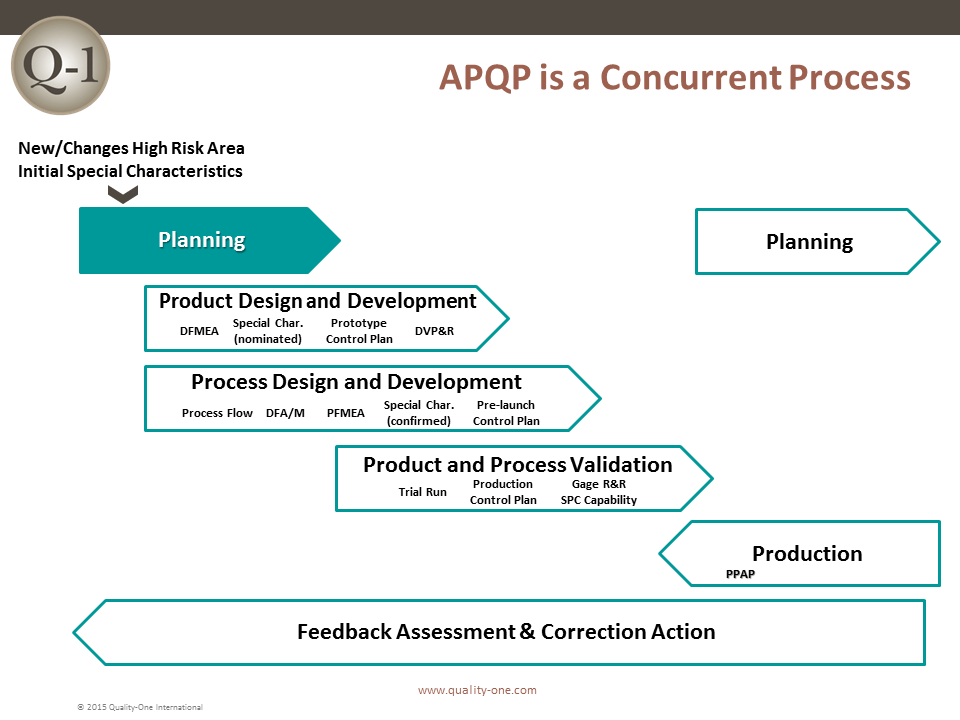
The diagram shows activities, not a rule that every supplier authors every item shown. To determine obligations, you must establish who has authority to define and release each aspect of the product. If that boundary is unclear, record it as an open program issue and obtain an agreed scope; do not quietly treat an incomplete specification as a complete customer design.
Apply the boundary to two textile-cover programs
Suppose a customer supplies a released drawing and specifications that fully define a textile cover’s geometry, approved material, seam construction, appearance, and performance. The supplier is asked to manufacture that defined cover. For this part, the customer owns the product definition. The supplier should obtain and control the applicable design record and revisions, review whether it can manufacture to them, and raise conflicts or proposed changes for customer disposition. It should not claim to have authored the customer’s product DFMEA.
Now suppose the customer specifies fit, an appearance standard, and performance targets, but the supplier selects the fabric construction, backing, and seam design needed to meet them. Those engineering choices are part of the product definition. The supplier must plan and control the product-design work within its responsibility: requirements, design decisions, design-risk analysis, verification or validation evidence, and release through the agreed approval route.
In either program, the supplier must design the manufacturing process. It needs to determine how material will be received and handled, how the cover will be cut and sewn, where defects could arise, how characteristics will be measured, and what controls will prevent or detect nonconforming product. Customer ownership of the drawing does not transfer those process-design duties to the customer.
The supplier also cannot unilaterally turn a manufacturing difficulty into a product change. If a specified seam proves difficult to produce, the appropriate response is to document feasibility concerns and seek an authorized design decision while developing or revising process controls. That keeps product authority and process responsibility distinct.
Translate responsibility into APQP evidence
The previous lesson’s phase map still applies, but the owner and source of product-design evidence change. This table identifies the principal distinction; the exact deliverables and approvals still depend on the applicable program and customer requirements.
| APQP work | Customer fully defines the product | Supplier has product-design responsibility |
|---|---|---|
| Planning | Confirm the released requirements, revisions, timing, feasibility, and needed customer design-risk information. | Confirm the requirements and identify the product-design scope, design objectives, verification plan, timing, and interfaces. |
| Product-design interface | Obtain and review the customer-controlled design record and relevant risk or characteristic information; communicate feasibility concerns. Do not present a supplier-authored customer DFMEA as an obligation. | Develop and control the assigned product definition, design reviews, DFMEA, drawings or specifications, and design verification and validation evidence as applicable. |
| Process design | Design the manufacturing process, including process flow, PFMEA, pre-launch control plan, and instructions, using the customer’s product requirements. | Produce the same process-design evidence, using the supplier’s controlled product-design outputs as inputs. |
| Validation and approval | Demonstrate that production parts meet the customer design and that the intended process works; supply applicable test and PPAP evidence. | Demonstrate product-design compliance and production-process performance; supply applicable design, test, and PPAP evidence. |
| Production feedback | Monitor performance, correct process problems, and escalate issues requiring a customer design change. | Monitor performance and update both product-design and process-design evidence where findings require it. |
Three cautions prevent misreading the table.
First, “I do not own the DFMEA” does not mean “I do not need design-risk information.” A make-to-print supplier needs the relevant failure modes, special characteristics, specifications, and changes to design a suitable process. If information needed to control a risk is missing, requesting it and documenting the gap are APQP actions.
Second, product testing is not identical to product-design ownership. A customer can require a make-to-print supplier to test production parts and submit the results even though the customer owns the design. Determine who performs a test, who evaluates its results, and who approves them from the applicable requirements.
Third, PPAP submission is not a transfer of authorship. A package may include a customer-controlled design record and supplier-generated process evidence. The supplier must keep that package applicable and internally consistent; it must not imply that it created a design analysis it did not own.
See how a customer requirement sharpens the distinction
A customer-specific requirement can add detail beyond the general responsibility rule. The following example is deliberately narrow: it illustrates how one customer treats design responsibility, process risk, and special characteristics. It is not a universal APQP rule for every automotive customer.
[PDF] Ford Motor Company Customer-Specific Requirements For use with ...
Read the selected portions of Ford’s January 2025 PPAP requirements to see how a customer distinguishes design-responsible from build-to-print suppliers while still requiring process-risk and characteristic controls.
On pp. 9–10, in 2.2.4, “Design Failure Mode and Effects Analysis (Design FMEA) if the organization is product design-responsible,” read the design-responsible requirement. Then, on pp. 10–11, find 2.2.6, “Process Failure Mode and Effects Analysis (Process FMEA).” Begin at the paragraph “Special Characteristic traceability for build to print organizations” and read the build-to-print requirement. Continue on p. 11 through “Documentation of Controls for Critical Characteristics”: read controls and traceability, stopping before 2.2.7, “Control Plan.” Focus on the different actions: develop and obtain approval for an owned DFMEA, versus obtain design-risk information and carry it into process controls.
In this customer example, a design-responsible organization has a customer approval requirement for its DFMEA. A build-to-print organization instead obtains relevant DFMEA information to develop its PFMEA and identify special characteristics. Both must address the applicable controls and traceability. The practical lesson is not to copy those particular forms or approval rules into every program. It is to distinguish, for each requirement, whether the supplier must create, obtain, review, use, or submit the evidence.
Consider a customer-identified seam-strength characteristic. If the customer owns the seam design, the manufacturing supplier still has to understand that characteristic, consider how sewing could cause failure, and control the relevant operations and inspections. If the supplier owns the seam design, it must also analyze and verify its design choices. In both cases, a control plan disconnected from the current product requirement would leave an APQP gap.
Include the supply-chain boundary
“Tier” describes a position in a supply chain, not a product-design role. A Tier 1 supplier can be make-to-print; a sub-tier supplier can own the design of a material or component. Determine design responsibility for the item and engineering scope at issue, then determine who manufactures it and who must manage the interface.
The opening of APQP Full Training: Advanced Product Quality Planning (#coretools) from We Improve Consulting provides a brief supply-chain view before the customer-specific example below.
APQP Full Training: Advanced Product Quality Planning (#coretools)
Watch the opening of APQP Full Training: Advanced Product Quality Planning (#coretools) from We Improve Consulting to place Tier suppliers’ planning work in the wider supply chain.
Watch the supply-chain overview. Focus on why an OEM-facing supplier must plan the readiness of the inputs it receives from other suppliers, rather than treating its own production line as the entire APQP scope.
For a concrete contractual example, return to Ford’s requirements. This passage applies to the specified Tier 1 relationship with Ford; it should not be assumed to govern every Tier supplier or customer.
[PDF] Ford Motor Company Customer-Specific Requirements For use with ...
Read this later portion of the same Ford document to see how an OEM-facing supplier’s responsibility can extend to sub-tier planning and part-approval evidence.
On p. 24, within 2.2.18, “Part Submission Warrant (PSW),” find “Sub-tier Supplier Advanced Product Quality Planning.” Start with the requirement to include evidence of approval of sub-tier submissions, then read the sub-tier passage. Focus on the Tier 1 supplier’s duties to require planning and manage approval evidence, not on memorizing Ford’s submission terminology.
A supplier that purchases a backing material, for example, cannot make that material’s readiness disappear from its launch assessment. It needs applicable requirements and evidence from the sub-tier, and it must integrate the material into its own process design and validation. Managing an interface is not the same as claiming to own the sub-tier’s product design. The precise flow-down and approval duties must be checked against the actual customer and purchasing requirements.
Make a defensible responsibility determination
For a real program, start with the current design record, specification, statement of work, change-control arrangement, and applicable customer requirements. Then record a decision for each product or material whose design boundary matters, rather than declaring the entire supplier simply “design responsible” or “not design responsible.”
A concise determination should establish:
- Product definition: Which characteristics are fully specified by the customer, and which engineering decisions remain with the supplier?
- Design authority: Who can release or approve each part of the product definition, and how are changes authorized?
- Process ownership: Which manufacturing processes must the supplier design and control, including relevant sub-tier interfaces?
- Evidence responsibility: Which records must the supplier create, which must it obtain, and which must it review, use, or submit?
- Open information: What design-risk information, special characteristics, approvals, or test responsibilities still need clarification?
The resulting APQP plan should show those responsibilities and the evidence needed at each gate. If a textile-cover drawing is complete but the applicable appearance standard has not been supplied, for instance, the product-design owner may still be clear—but the supplier has an unresolved requirement input. Recording that gap is more accurate than marking feasibility or control planning complete.
Key takeaways
Determine APQP obligations by separating product-design authority from manufacturing process-design responsibility. A fully defined customer specification generally makes the supplier make-to-print for that product; an incompletely defined product requiring the supplier’s engineering solution brings product-design responsibilities into scope. The supplier remains responsible for manufacturing process design in either case.
From there, distinguish evidence the supplier must create from evidence it must obtain and use. Check customer-specific rules, testing and approval duties, and sub-tier interfaces before finalizing the plan. In the next lesson, you will apply that approach to an OEM customer-specific requirement and turn its applicable obligations into a compliance checklist.