Recommended resources
The freely available resources this lesson will direct you to.
- IATF 16949 audits | How do I: Audit Customer Specific Requirements (CSRs) with Managementwww.youtube.com
- APQP Full Training: Advanced Product Quality Planning (#coretools)www.youtube.com
- [PDF] Ford Motor Company Customer-Specific Requirementswww.iatfglobaloversight.org
- [PDF] PPAP & APQP PROCESS SUPPLIER GUIDELINES ... - Tennecowww.tenneco.com
Hello! Last lesson separated product-design authority from manufacturing process-design responsibility. That distinction matters when you read a customer-specific requirement: the same document may contain duties for every supplier, duties only for design-responsible suppliers, and duties triggered by a particular part or launch condition.
This lesson shows you how to turn an OEM requirement into a traceable APQP compliance checklist. We will use an illustrative, make-to-print automotive textile cover and Ford’s October 2024 customer-specific requirements as the worked example. The method transfers to other customers; the particular Ford obligations do not.
First, identify what kind of requirement you are reading
A customer requirement can arrive through a drawing, a statement of work, a purchasing condition, or a customer-specific requirement (CSR). These sources work together, but they are not interchangeable.
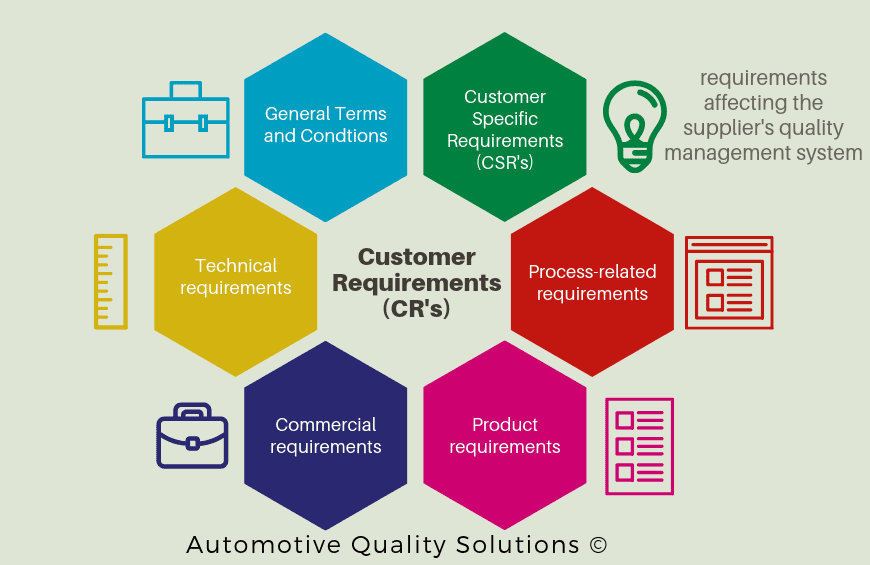
For this lesson, the CSR is the source you will extract from. The drawing and program documents supply facts needed to decide whether each CSR clause applies. For example, a clause concerning a customer-designated critical characteristic cannot be classified confidently until you have checked the current drawing.
The short OEM-matrix example in APQP Full Training: Advanced Product Quality Planning (#coretools), from We Improve Consulting, shows why this is more than making a list of document names.
APQP Full Training: Advanced Product Quality Planning (#coretools)
Watch the OEM APQP-matrix example to see how a customer can specify required documents by program stage and indicate where customer approval is needed.
Watch the matrix example. Focus on the difference between “this deliverable is required” and “this deliverable needs a customer decision.” Treat the matrix as an illustration of how to read requirements, not as the checklist for the Ford example below.
An auditable checklist preserves that distinction. A row such as “PFMEA — complete” loses the source clause, its trigger, the required acceptance, and the evidence that proves completion.
Extract the obligation before assigning the work
Read each relevant clause as a conditional statement. Identify who must do what, under which circumstances, by when, and with what record or approval. The operative words matter: shall states a requirement; if or for can limit its scope; should does not automatically become an unconditional mandate.
Use these fields when extracting a clause:
| Field | Question the checklist must answer |
|---|---|
| Source | Which controlled document, revision, clause, and page establish the obligation? |
| Trigger and applicability | What program, part, design role, characteristic, or event makes it apply? |
| Action | Must the supplier create, obtain, review, use, submit, or retain something? |
| Evidence and acceptance | What record proves completion, and is customer acceptance or approval required? |
| Timing and owner | At what milestone or event is it due, and who will coordinate it? |
| Disposition | Is it applicable, conditional pending a fact, or not applicable with a reason? Is the evidence complete? |
Applicability is not completion. “Applies; awaiting customer information” is a useful checklist result. “Not applicable” is defensible only when its trigger has been checked and ruled out. Likewise, “no customer-specific requirement for this section” does not cancel a requirement from the underlying standard, drawing, or another applicable customer document.
Start the Ford example with the program-level obligations. In Ford’s Customer-Specific Requirements (October 2024), read the APQP record-retention passage and the “8.1 Operational planning and control” subsection, then the feasibility provision under “8.2.3.1.3 Organization manufacturing feasibility.”
[PDF] Ford Motor Company Customer-Specific Requirements
Read these passages to distinguish a recurring program submission from a retained final record, and to find the trigger for a documented feasibility review.
On pp. 19–20, find “APQP” among the record-retention provisions. Read final-record retention. Then, in “8.1 Operational planning and control” on p. 20, begin at the “Statement of Work” paragraph starting “Appropriate to the organization’s responsibilities.” Continue through the Schedule A rules, noting separately what a notification letter specifies and what applies to New Tooled End Items when no letter arrives. On pp. 21–22, locate “8.2.3.1.2 Customer-designated special characteristics” to see how Ford identifies critical-characteristic parts; do not assume the example textile cover has that designation. Immediately afterward, under “8.2.3.1.3 Organization manufacturing feasibility,” read the feasibility trigger. Note the requirement for both initial and final documented feasibility at the specified timing.
Suppose the cover is a New Tooled End Item, manufactured using newly installed cutting equipment. The drawing fully defines the product, so the supplier is make-to-print. It does not carry Ford’s inverted-delta designation. Those are scenario facts, not conclusions drawn from the CSR.
Two planning rows now become clear. Schedule A is applicable because this is a New Tooled End Item: even without a notification letter, the supplier must complete it at each program milestone and retain the final version as specified. The new manufacturing equipment triggers the documented initial and final feasibility reviews. The checklist should still record the actual program milestone dates and determine whether a notification letter adds submission instructions; neither a guessed date nor “monthly” by itself captures the full clause.
Follow the requirement into process evidence and approval
The previous lesson established that a make-to-print supplier still designs its manufacturing process. Ford’s CSR makes that boundary concrete: some design-risk information must be obtained from Ford and carried into supplier-created process evidence. Other clauses impose obligations on every relevant launch, while customer acceptance depends on design responsibility or the part’s designation.
Read “8.3.2.1 Design and development planning — supplemental” and its FMEA, special-characteristic, and control-plan provisions on pp. 23–25.
[PDF] Ford Motor Company Customer-Specific Requirements
Read this section to separate universal process obligations, make-to-print information flow, and conditional customer acceptance.
On p. 23, under “8.3.2.1 Design and development planning — supplemental,” read from the acceptance provisions. Identify which documents require Ford acceptance for an inverted-delta component and which requirement applies when the supplier is design responsible. On p. 24, continue through “Foundation FMEAs,” “FMEA Information Flow And Linkage,” and “Reverse FMEA Process (RFMEA).” Read the linked requirements; focus on the distinction between a foundation FMEA, the part FMEA, and evidence of a reverse-FMEA event on a new launch. On p. 25, find “Special Characteristic traceability for build to print organizations.” Read the information flow through the “Control Plans” and “Special Characteristic Traceability” paragraphs. Then, under “Pre-Launch Control Plans,” read the pre-launch rule. Look for the required SCCAF approval and the distinction between using a pre-launch plan and transitioning to the production plan.
For the example cover, “make-to-print” does not justify writing “DFMEA: N/A” and stopping there. Ford’s provision calls for the supplier to obtain relevant DFMEA information, including potential special characteristics, to develop its PFMEA and identify special characteristics. The supplier documents those characteristics on the Special Characteristics Communication and Agreement Form (SCCAF), including controls at sub-tiers where applicable, and obtains Ford approval. If that information has not arrived, the row is applicable and open, not complete.
Conversely, do not add “Ford acceptance of supplier DFMEA” as an applicable row for this fully customer-defined cover. Ford’s cited DFMEA-acceptance requirement addresses design-responsible organizations. Nor should you mark inverted-delta PFMEA and control-plan acceptance as applicable without the part designation. Record that trigger as checked against the current drawing. Ford also reserves the right to require acceptance for other parts, so a later customer instruction would require reassessment.
Finally, read the product-approval subsection, “8.3.4.4 Product approval process,” on p. 29.
[PDF] Ford Motor Company Customer-Specific Requirements
Read this passage to identify the approval route and the supplier’s responsibility for applicable sub-tier approval evidence.
In “8.3.4.4 Product approval process” on p. 29, begin at “Production Part Approval Process” and read the PPAP requirement. Continue to “Submission of Sub-tier supplier PPAP” for the permitted summary of sub-tier component approvals. Stop before “Organization initiated changes”; detailed change control comes later in the course.
This final passage is a reminder not to mistake the checklist for the submission. The checklist controls whether the applicable evidence and approvals are ready; the PPAP process governs their approval route.
Build a checklist that can support a gate decision
Here is an illustrative extraction for the make-to-print, New Tooled End Item textile cover described above. “Program owner” entries are proposed coordination assignments, not roles prescribed by Ford. Checkpoints must be replaced with dates from the actual program and customer instructions.
| Source | Applicable obligation or checked trigger | Evidence and checkpoint | Proposed owner; current disposition |
|---|---|---|---|
| Ford CSR, §8.1, p. 20 | Meet the applicable statement(s) of work; establish which govern this program. | Controlled statement-of-work list and review before the planning gate. | Program lead; open until scope is confirmed. |
| Ford CSR, §8.1, p. 20 | Complete Schedule A for each program milestone for this New Tooled End Item; follow any notification-letter submission instructions, including updates after a significant APQP-status change. | Dated Schedule A records and submission evidence at the required milestones. | Program lead; applicable. Confirm notification letter and dates. |
| Ford CSR, APQP retention, pp. 19–20 | Retain the final Schedule A with the PPAP record for the life of the part, production and service, plus one year. | Final controlled Schedule A and retention rule, checked at PPAP-file closure. | Quality; applicable. |
| Ford CSR, §8.2.3.1.3, p. 22 | Document initial and final manufacturing feasibility for the new equipment, with the appropriate organizations, at Ford’s specified timing. | Completed feasibility forms, decisions, and participants at both reviews. | Manufacturing engineering; applicable. Dates to confirm. |
| Ford CSR, §8.3.2.1, pp. 24–25 | Obtain Ford DFMEA information relevant to this build-to-print part; use it to develop PFMEA and identify special characteristics. | Information request/receipt record and trace to current PFMEA. | Quality and process engineering; open pending information. |
| Ford CSR, §8.3.2.1, p. 25 | Document applicable special characteristics, including sub-tier-controlled ones, on the SCCAF and obtain Ford approval. | Current approved SCCAF and trace into the control plan and evidence workbook. | Quality; applicable. Characteristic review open. |
| Ford CSR, §8.3.2.1, pp. 24–25 | Maintain foundation and part FMEAs in alignment with applicable control plans and instructions; complete and retain evidence of a reverse-FMEA event for the new launch after equipment installation and operation. | Controlled FMEAs, linkage review, and reverse-FMEA event record before process-validation closure. | Process engineering; applicable. |
| Ford CSR, §8.3.2.1, p. 25 | Have a control plan for the part and use a pre-launch/safe-launch plan during the period stated by Ford, before transition to the production plan. | Approved-for-use plan revisions, use records, and transition evidence at the applicable milestones. | Quality; applicable. |
| Ford CSR, §8.3.2.1, p. 23 | Trigger check: inverted-delta component PFMEA and control plan require Ford Engineering and STA acceptance. | Current drawing/designation check; acceptance evidence if the designation applies or Ford otherwise requests acceptance. | Quality; not triggered on the stated drawing, subject to recheck. |
| Ford CSR, §8.3.2.1, p. 23 | Trigger check: supplier DFMEA requires Ford Engineering acceptance when the supplier is design responsible. | Agreed design-responsibility scope; DFMEA acceptance record only if that scope changes. | Program lead; not applicable under the stated make-to-print scope. |
| Ford CSR, §8.3.4.4, p. 29 | Follow AIAG PPAP and Ford Global Phased PPAP for production parts and applicable sub-tier component approvals. | PPAP plan, required approval evidence, and sub-tier approval summary at submission. | Quality; applicable. |
Notice what the last two trigger-check rows accomplish. They preserve the source requirement without falsely assigning work. If the drawing is revised to add an inverted-delta designation, or the supplier takes on product-design responsibility, those rows can be reopened and their consequences planned. A checklist that simply deletes “N/A” items has no reliable way to show what was checked.
Before using this example on a real program, verify the controlled CSR revision, the current drawing and designation, the actual statement of work, New Tooled End Item status, notification letter, program timing, and any customer instructions that alter approval expectations. Then check each completed row against its record: document title and revision, part or program identity, approval where required, and the milestone it supports. Marking a document “complete” when customer approval is still pending would give a misleading gate status.
Key takeaways
To extract an APQP obligation, retain its source, trigger, required action, evidence, timing, and approval condition. Apply each clause to verified program facts rather than assuming that every listed deliverable applies equally to every supplier. In the Ford example, make-to-print status changes who authors the DFMEA, but it does not remove the need to obtain design-risk information or develop controlled process evidence.
Your checklist should make unresolved inputs and conditional requirements visible. In the next module, you will use customer requirements and lessons learned to define measurable program objectives and critical-to-quality requirements—the next step in turning compliance obligations into a workable launch plan.