Recommended resources
The freely available resources this lesson will direct you to.
Hello! This course follows an automotive supplier program from customer requirements through design, manufacturing validation, approval, and post-launch improvement. In this first lesson, you will build a map of the system before examining its individual documents and decisions.
The central question is: How does a supplier show that a product meets its requirements and that the intended production process can keep making it reliably? APQP organizes that work; the other Core Tools help perform it; PPAP presents evidence for customer approval. IATF 16949 and applicable customer requirements shape what the supplier must do.
One launch, several different roles
Advanced Product Quality Planning (APQP) is the cross-functional planning framework for a new or changed product and its manufacturing process. It brings customer requirements, engineering, purchasing, manufacturing, quality, and logistics into a coordinated plan. Its value is not a completed set of forms: it is finding requirements and risks early enough to influence the design and the production process.
Start with the overview in Why Advanced Product Quality Planning (APQP)? from PMC Videos. Watch the selected passages rather than the full video; they establish the roles of the tools and the relationship between APQP and PPAP.
Why Advanced Product Quality Planning (APQP)?
Watch Why Advanced Product Quality Planning (APQP)? from PMC Videos for a visual introduction to the launch framework and its approval evidence.
Watch the Core Tools for the distinct purposes of APQP, FMEA, MSA, SPC, and PPAP. Continue with APQP's purpose, focusing on prevention and cross-functional work, then the phase overview to see how activities overlap. Finally, skip to APQP and PPAP for the distinction between doing the planning work and presenting evidence of its results. Treat the examples of PPAP contents as an overview; the applicable submission requirements must be confirmed for each program.
A useful distinction is between a management-system requirement and a program approval. IATF 16949 sets automotive quality-management-system expectations. The Automotive Core Tools provide structured methods that support those expectations. APQP coordinates the methods across a launch. PPAP is the product-and-process approval process through which a supplier presents the evidence required by its customer. A supplier’s quality-system certification, by itself, does not approve a particular part; likewise, approval of a part does not end the supplier’s ongoing responsibility to control its process.
How the Core Tools connect
The commonly named five Core Tools are APQP, FMEA, MSA, SPC, and PPAP. A control plan is also a central APQP deliverable: it specifies how product and process characteristics will be controlled and what to do when a control signals trouble. These are connected activities, not five independent files to finish at the end of a project.
Read Quality Core Tools from Quality-One for its account of those connections. Pay particular attention to how a characteristic identified as important in design becomes something the manufacturing process must make, measure, and control.
Quality Core Tools | Quality-One
Read Quality-One's Quality Core Tools to understand what each method contributes and why information must pass between them.
Under “Introduction to Quality Core Tools” and “What are the Quality Core Tools,” read the expectations and list, ending at the five-tool list. Under “Why Use Quality Core Tools,” read the tool linkages. Then, under “How to Apply Quality Core Tools,” read the worked linkage. Focus on the transfer from a design concern to a process risk and then to a control—not on memorizing every document name.
Here is the connection in practical terms:
- FMEA (Failure Mode and Effects Analysis) asks how a product design or manufacturing process could fail, what the effects would be, and how risk will be addressed. Design FMEA (DFMEA) and process FMEA (PFMEA) address different responsibilities.
- A control plan turns relevant process risks and product characteristics into specified production controls: methods, frequency, responsibility, and reactions when results are unacceptable.
- MSA (Measurement Systems Analysis) checks whether a measurement or inspection system is suitable for the decision being made. Untrustworthy measurements weaken both inspection results and process studies.
- SPC (Statistical Process Control) uses process data to monitor variation and assess whether a process is behaving predictably. Where required, capability studies also provide evidence about performance relative to specifications.
- PPAP (Production Part Approval Process) brings together the applicable records and results so the customer can evaluate whether the supplier understands the requirements and can produce conforming parts using the intended production process.
These activities overlap. A team need not wait for a finished DFMEA before discussing process risks, nor should it postpone measurement planning until a production trial. The important discipline is traceability: the requirement, identified risk, chosen control, measurement method, validation result, and submitted evidence should tell a consistent story.
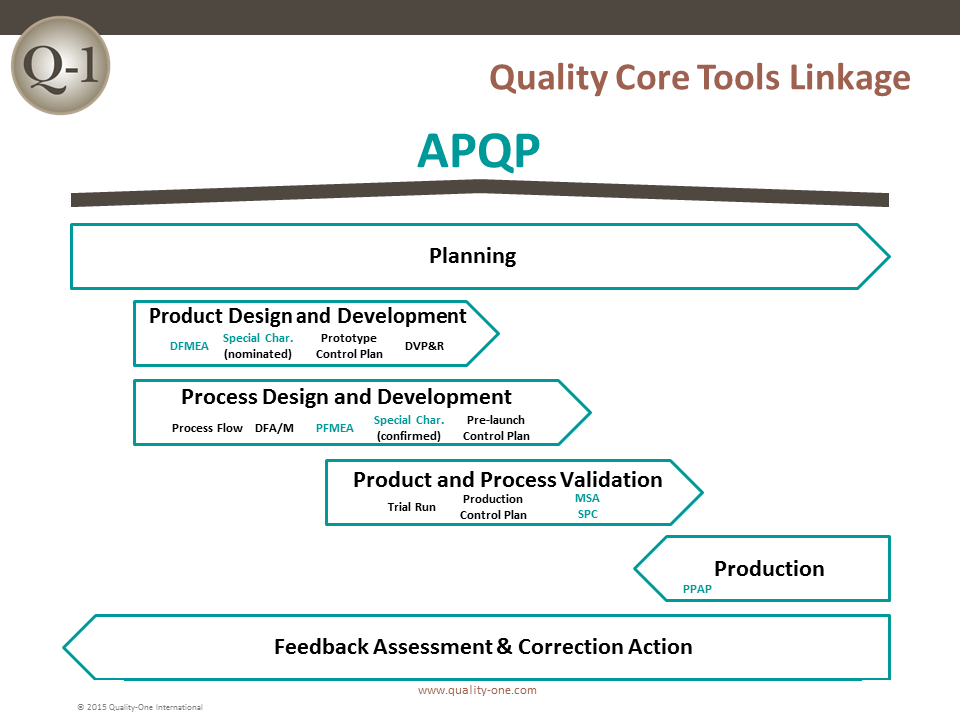
Follow a requirement through a supplier launch
Consider an illustrative automotive textile cover with a specified seam-position tolerance. The drawing gives the acceptance limit; the team’s task is to establish how the cover will meet it repeatedly at production volume.
During planning, the team confirms the drawing revision, intended volume, timing, and any customer-designated special characteristics. It records who owns the cover design and who owns the stitching process. That ownership matters: a supplier responsible only for manufacturing still needs the design requirements and relevant risk information, but it should not pretend to own a product-design analysis it was not authorized to perform.
During design and process development, the team considers the effect of a misplaced seam on fit or appearance. Process planning identifies potential causes—such as fabric positioning or fixture wear—and chooses prevention or detection controls. The process flow, PFMEA, and control plan should agree on where those controls occur. If seam position is designated a special characteristic by the customer or through the applicable design and risk process, the team carries that designation consistently into the relevant manufacturing documents. A characteristic is not automatically “special” merely because it appears in this example.
During validation, a representative production trial tests the combined product and process. The team assesses the suitability of its seam-position measurement method, examines the product results, and evaluates process performance using the analyses required for the program. If results reveal unstable variation or a measurement method that cannot support a reliable decision, a completed report is not proof of readiness: the underlying issue needs action and further evidence.
During PPAP, the customer receives or reviews the applicable package under the agreed submission arrangement. That package may include the drawing, process flow, PFMEA, control plan, measurement-system results, dimensional or test results, process studies, and samples, as required. PPAP is evidence generated by APQP, not a substitute for APQP. The customer’s approval status and other agreed conditions govern release; production monitoring and corrective action continue after launch.
For a short explanation of why PPAP follows from planning and validation, consult APQP | Advanced Product Quality Planning from Quality-One.
APQP | Advanced Product Quality Planning | Quality-One
Read Quality-One's APQP | Advanced Product Quality Planning for the cross-functional purpose of APQP and its explicit connection to PPAP.
Under “What is Advanced Product Quality Planning (APQP),” read the APQP definition. Later, near the end of “How to Implement Advanced Product Quality Planning (APQP),” begin at the paragraph about section inputs, outputs, and management gateway reviews. Read through the PPAP link, including the subsection “How is APQP related to PPAP?” Look for the requirement that trial-run evidence represent the intended production conditions.
Where customer-specific requirements fit
IATF 16949 and Core Tool methods do not tell a supplier every detail of every customer program. Customer-specific requirements (CSRs) and program-specific documents supply applicable additional instructions. Depending on the customer and contract, these can affect items such as required APQP reporting, characteristic designations, trial-run conditions, PPAP submission content or level, approval steps, and change notification. The exact obligation must be read from the current applicable documents; it should not be inferred from a generic diagram or example.
For a launch team, this creates a practical order of work:
- Establish the applicable requirements: the management-system framework, current customer requirements, contract and program instructions, specifications, and drawing revisions.
- Translate them into owned APQP activities and evidence: identify who will perform each task, by when, and what record will demonstrate completion.
- Check consistency before submission: confirm that the characteristics, risks, controls, production-trial conditions, and PPAP evidence refer to the same approved product and process.
- Obtain the required customer decision rather than assuming that an internally complete package authorizes shipment.
If two instructions appear inconsistent, record the conflict and obtain clarification through the agreed customer channel. Do not silently choose the easier interpretation. This is particularly important for a Tier supplier: obligations depend not just on the component, but also on which organization owns product design, process design, and customer submission.
Key takeaways
APQP is the framework for planning and coordinating a launch. FMEA helps expose risk; control plans define production controls; MSA establishes confidence in measurement; and SPC supports evaluation and monitoring of process behavior. PPAP assembles the applicable evidence for customer approval. IATF 16949 provides quality-management-system expectations, while customer-specific and program requirements determine important details of how a particular launch must be executed and approved.
In the next lesson, you will place these activities more precisely within the five APQP phases, identify their principal deliverables, and see what a gate decision must establish before the program proceeds.