Recommended resources
The freely available resources this lesson will direct you to.
Welcome back. In our last lesson, we tackled accruals, which are adjustments for business activities that have already occurred, even though cash hasn't been exchanged yet. This covered situations where work was done before payment.
Today, we address the opposite scenario: deferrals. These are adjustments for transactions where cash is exchanged in advance of the service being performed or the expense being fully used. This is a common and critical part of the period-end closing process.
Our learning outcome for this lesson is to prepare adjusting entries for prepaid expenses and deferred revenues. In Moroccan accounting, you will come to know these intimately as charges constatées d'avance and produits constatés d'avance. Mastering deferrals is essential for correctly applying the principle of accrual accounting (principe de spécialisation des exercices), ensuring that revenues and expenses are recognized in the period they truly belong to.
1. Prepaid Expenses: Charges Constatées d'Avance
A prepaid expense occurs when a company pays for a good or service before it actually uses or consumes it. Even though cash has been paid, the amount is not yet an expense. Instead, it is an asset because it represents a future economic benefit.
Common examples for a Moroccan SME include:
- Paying an annual insurance premium in advance.
- Paying for a six-month office lease upfront.
- Purchasing office supplies that will be used over several months.
- Paying for an annual subscription to accounting software.
As this future benefit is "consumed" over time, we must make an adjusting entry to gradually move the cost from the asset account on the balance sheet to an expense account on the income statement.
How Prepaid Expenses Work | Adjusting Entries
To begin, let's get a clear conceptual overview of prepaid expenses. This video from Accounting Stuff explains the core idea and why an adjustment is necessary.
Watch the section from 01:07 to 01:32 to understand the definition of a prepaid expense.
Recording and Adjusting Prepaid Expenses
There are two ways to handle the initial recording of a prepayment, which affects the adjusting entry. For your foundational knowledge, it's important to understand both.
Method 1: Recording as an Asset (The "Balance Sheet Approach")
This is the conceptually pure method. When the payment is made, it is recorded entirely as an asset.
- Initial Entry: Debit
Prepaid [Expense Name](Asset), CreditCash. - Adjusting Entry (at end of period): Debit
[Expense Name]Expense, CreditPrepaid [Expense Name]for the portion that has expired or been used.
Method 2: Recording as an Expense (The "Income Statement Approach")
In practice, for simplicity, some companies initially record the entire payment as an expense. This requires an adjusting entry at period-end to move the un-used portion back into an asset account.
- Initial Entry: Debit
[Expense Name]Expense, CreditCash. - Adjusting Entry (at end of period): Debit
Prepaid [Expense Name](Asset), Credit[Expense Name]Expense for the portion that has not yet expired.
Let's watch how this plays out in a detailed example. The video uses the second method (initial recording as an expense) and shows how to correct it and make the subsequent adjustments. This is a very practical scenario.
How Prepaid Expenses Work | Adjusting Entries
This detailed walkthrough demonstrates the full cycle for a prepaid insurance policy, from the initial (shortcut) entry to the period-end adjustments. Pay close attention to how the cost is transferred from an expense to an asset, and then gradually expensed each month.
Watch from 02:01 to 09:09. Focus on: The initial journal entry (02:01 - 04:19). The first adjusting entry to create the 'Prepaid Expense' asset at year-end (04:19 - 06:15). The monthly adjusting entries that recognize the expense as it is incurred (06:15 - 09:09).
Application in the Moroccan Context
In Morocco, prepaid expenses are referred to as Charges Constatées d'Avance (CCA). The asset account used is 3491 - Charges constatées d'avance. The adjusting entry is typically made at the end of the financial year to remove the portion of the expense that relates to the following year.
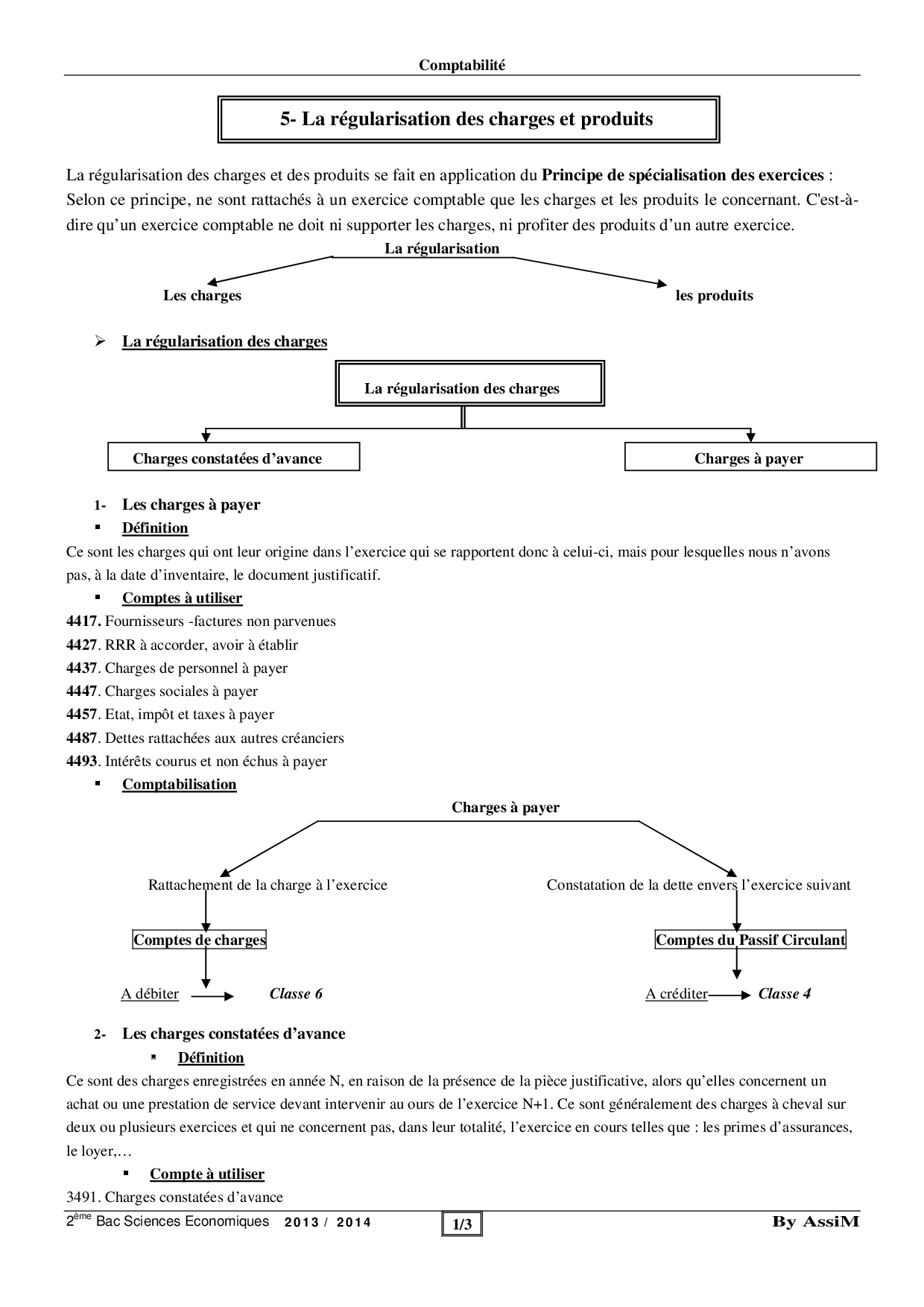
Example: Prepaid Insurance in Morocco
Let's assume "Tech Solutions SARL," a Moroccan SME, pays its annual insurance premium of 24,000 DH (HT) on September 1, 2024. The policy covers the period from September 1, 2024, to August 31, 2025. The company's financial year ends on December 31, 2024.
The initial entry on September 1, 2024 (using the common expense method):
| Date | Account | Account No. | Debit (DH) | Credit (DH) |
|---|---|---|---|---|
| Sep 1, 24 | Primes d'assurances (Insurance Premiums) | 6134 | 24,000 | |
| Banque (Bank) | 5141 | 24,000 | ||
| Paiement prime assurance annuelle |
At December 31, 2024, an adjustment is needed.
-
Calculate the expired portion (Expense for 2024):
- Months in 2024: Sep, Oct, Nov, Dec = 4 months.
- Monthly cost: 24,000 DH / 12 = 2,000 DH/month.
- Expense for 2024: 4 months * 2,000 DH = 8,000 DH.
-
Calculate the unexpired portion (Prepaid Asset for 2025):
- Months in 2025: Jan to Aug = 8 months.
- Prepaid amount: 8 months * 2,000 DH = 16,000 DH.
-
Prepare the Adjusting Entry on December 31, 2024:
We need thePrimes d'assurancesaccount to have a final balance of 8,000 DH for 2024. It currently has a debit of 24,000 DH. We must credit it for 16,000 DH and move this amount to the asset account.
| Date | Account | Account No. | Debit (DH) | Credit (DH) |
|---|---|---|---|---|
| Dec 31, 24 | Charges constatées d'avance | 3491 | 16,000 | |
| Primes d'assurances | 6134 | 16,000 | ||
| Régularisation assurance 8 mois sur 2025 |
After this entry, the Primes d'assurances (Expense) account has a balance of 8,000 DH, and the Balance Sheet shows a new asset, Charges constatées d'avance, of 16,000 DH.
On January 1, 2025, a reversing entry (contre-passation) is made to move the expense back into 2025, where it belongs. This simplifies bookkeeping in the new year.
| Date | Account | Account No. | Debit (DH) | Credit (DH) |
|---|---|---|---|---|
| Jan 1, 25 | Primes d'assurances | 6134 | 16,000 | |
| Charges constatées d'avance | 3491 | 16,000 | ||
| Contre-passation écriture de régularisation |
2. Deferred Revenues: Produits Constatés d'Avance
Deferred revenue (or unearned revenue) is the mirror image of a prepaid expense. It occurs when a company receives cash from a customer for goods or services that have not yet been delivered or performed. This cash receipt creates a liability—an obligation to provide the service or good in the future.
Common examples include:
- A software company receiving payment for a one-year subscription.
- A landlord receiving several months of rent in advance.
- A consulting firm receiving an advance payment before a project starts.
As the company delivers the service or the time passes, it "earns" the revenue. An adjusting entry is needed to move the appropriate amount from the liability account on the balance sheet to a revenue account on the income statement.
Deferred Revenue Explained | Adjusting Entries
Let's first understand the concept of deferred revenue. This short clip from Accounting Stuff defines it clearly.
Watch from 00:49 to 01:16 for a concise definition of deferred, unearned, or prepaid revenue.
Now, let's see how the journal entries work.
Deferred Revenue Explained | Adjusting Entries
This example of an airline ticket sold in advance is a perfect illustration of deferred revenue. The video shows how the initial cash receipt creates a liability, and how revenue is only recognized when the service (the flight) is provided.
Watch the detailed example from 04:41 to 09:49. Focus on: The initial entry to record cash and the 'Deferred Revenue' liability (04:41 - 07:11). The adjusting entry to recognize half the revenue when the first part of the service is done (07:36 - 08:50). The final entry to recognize the remaining revenue once the service is complete (08:50 - 09:49).
Application in the Moroccan Context
In Morocco, deferred revenues are called Produits Constatés d'Avance (PCA). They are recorded in the liability account 4491 - Produits constatés d'avance. The logic is identical to that of Charges Constatées d'Avance: at year-end, any revenue that has been recorded but belongs to the next year must be removed from the income statement and "parked" in this liability account.
The following resource provides a fantastic, practical example directly from the Moroccan Chart of Accounts.
4491. Produits constatés d'avance
This resource, 'Produits constatés d'avance', explains the concept and provides a full walkthrough of an example within the Moroccan accounting system. It is a perfect practical guide.
Read the entire page, focusing on the 'Exemple' section. Pay attention to: The scenario of the annual maintenance contract. The calculation to determine the portion of revenue belonging to the next year. The adjusting entry at year-end (Étape 1). The reversing entry at the start of the next year (Étape 2).
As you read in the example:
- A company bills 120,000 DH for a 12-month contract starting October 1, 2024.
- At December 31, 2024, 9 months of the service (and revenue) belong to 2025.
- The portion to be deferred is calculated:
120,000 * (9/12) = 90,000 DH. - The adjusting entry on Dec 31, 2024, is a Debit to the revenue account (
7124 - Ventes de services...) and a Credit to4491 - Produits constatés d'avance. - This is followed by a reversing entry on Jan 1, 2025.
This process ensures that only 30,000 DH (for Oct, Nov, Dec) is reported as revenue in 2024, and the remaining 90,000 DH is correctly reported as revenue in 2025 when it is earned.
Test your understanding!
An SME in Agadir, with a year-end of December 31, 2024, performs the following transactions:
- On November 1, 2024, it pays 9,000 DH for a 3-month advertising campaign that runs from November 1 to January 31, 2025. The entire amount was debited to
6144 - Publicité, publications, relations publiques. - On December 1, 2024, it receives 15,000 DH from a client as an advance for a service that will be fully delivered in February 2025. The full amount was credited to
7124 - Ventes de services au Maroc.
Prepare the necessary adjusting entries on December 31, 2024.
Show answer
1. Adjusting Entry for Prepaid Advertising (CCA):
- Total cost: 9,000 DH for 3 months = 3,000 DH/month.
- Expense for 2024 (Nov, Dec): 2 months * 3,000 = 6,000 DH.
- Portion to defer to 2025 (Jan): 1 month * 3,000 = 3,000 DH.
| Date | Account | Account No. | Debit (DH) | Credit (DH) |
|---|---|---|---|---|
| Dec 31, 24 | Charges constatées d'avance | 3491 | 3,000 | |
| Publicité, publications, relations publiques | 6144 | 3,000 | ||
| Régularisation publicité de Janvier 2025 |
2. Adjusting Entry for Deferred Revenue (PCA):
- Amount received: 15,000 DH.
- Service performed in 2024: 0.
- Portion to defer to 2025: All 15,000 DH.
| Date | Account | Account No. | Debit (DH) | Credit (DH) |
|---|---|---|---|---|
| Dec 31, 24 | Ventes de services au Maroc | 7124 | 15,000 | |
| Produits constatés d'avance | 4491 | 15,000 | ||
| Régularisation avance client service 2025 |
Conclusion
You have now completed the two sides of adjusting entries that deal with timing differences: accruals (activity before cash) and deferrals (cash before activity). Understanding these is non-negotiable for accurate financial reporting.
Key Takeaways:
- Deferrals are required when cash is paid or received before an expense is fully incurred or revenue is fully earned.
- Prepaid Expenses (Charges constatées d'avance): A payment that creates a future benefit. It is an Asset. The adjusting entry recognizes the portion of the asset that has been "used up" during the period as an expense.
- Deferred Revenues (Produits constatés d'avance): A payment received that creates a future obligation. It is a Liability. The adjusting entry recognizes the portion of the liability that has been "fulfilled" during the period as revenue.
- In Moroccan practice, these adjustments are made at year-end and typically reversed on the first day of the next period.
Preview of the Next Lesson:
We have adjusted for services, interest, and other short-term items. But what about long-term assets like buildings, vehicles, and machinery? These assets are also "used up" over time, but in a different way. In our next lesson, we will learn how to calculate and record depreciation expense for fixed assets, another crucial period-end adjustment.