Recommended resources
The freely available resources this lesson will direct you to.
Welcome back. In our previous module, we focused on recording the daily flow of business transactions, culminating in our last lesson on how to organize and file the physical and digital source documents that support those entries. This established the foundation for a reliable and auditable accounting system.
Now, we shift our focus from daily entries to a critical process that takes place at the end of an accounting period: adjusting the accounts. This is where we ensure that the financial statements reflect the true economic reality of the period, not just the flow of cash.
Today’s lesson addresses the first and most fundamental type of adjustment. Our learning outcome is to apply the matching principle to prepare adjusting entries for accrued revenues and accrued expenses. These entries, known as accruals, are essential for creating accurate financial statements and are a core competency for any accountant.
1. The "Why": The Matching Principle
In our first module, we established that modern accounting, including Moroccan GAAP, uses the accrual basis. This means transactions are recorded when the underlying economic event occurs, regardless of when cash is paid or received.
The guiding rule for applying the accrual basis to revenues and expenses is the matching principle.
This document from Toronto Metropolitan University, 'AFA 100: Adjusting Entries', provides a clear and concise definition of the matching principle. Understanding this is the key to understanding why we need adjusting entries.
Read the section 'Importance of Adjusting Entries'. Focus on the definition of the matching principle and the example given to illustrate why timing differences create a problem that adjusting entries solve.
As the document explains, the matching principle dictates that expenses incurred to generate revenue must be recorded in the same accounting period as that revenue. For example, the cost of goods sold is recorded in the same period as the sale of those goods.
However, many business activities don't align neatly with the exchange of cash or an invoice within a single month.
- An employee works the last week of December, but won't be paid until January.
- A company provides a service in March, but doesn't send the bill until April.
Without a specific intervention, the expense (salary) or the revenue (service) would be recorded in the wrong period, violating the matching principle. Adjusting entries are this intervention. They are internal journal entries made at the end of a period to bring the accounts up to date.
Today, we focus on accruals, which are adjustments for economic activities that have occurred but for which no cash has yet changed hands.
2. Accrued Expenses: Charges à Payer
An accrued expense is an expense that the business has incurred (benefited from) but has not yet paid for or recorded. These are unrecorded expenses and unrecorded liabilities. Common examples in a Moroccan SME include:
- Salaries earned by employees in the last days of a month, but paid in the next.
- Interest on a loan that has accumulated but is not yet due for payment.
- Utility services (electricity, water, internet) used in one month, but the bill arrives in the next month.
To understand how to record these, let's watch a detailed example.
A Complete Guide to Adjusting Entries
This section of the 'A Complete Guide to Adjusting Entries' video from Accounting Stuff provides an excellent, step-by-step walkthrough of an accrued utility expense. It clearly shows the 'why', the journal entry, and the impact on the accounts.
Watch the section on Accrued Expenses from 26:03 to 37:50. Pay close attention to the logic: why an adjustment is needed at the end of each month before the bill arrives, and how the journal entries correctly place the expense in the period it was incurred.
The Adjusting Entry for Accrued Expenses
As the video demonstrated, the process is logical. At the end of the period (e.g., December 31), we identify any expenses we've used but haven't recorded. We then prepare an adjusting entry:
- DEBIT the relevant Expense account (e.g.,
Salaries Expense,Utilities Expense). This increases the expense on the Income Statement for the current period, satisfying the matching principle. - CREDIT a Payable (liability) account (e.g.,
Salaries Payable,Accrued Expenses). This creates a liability on the Balance Sheet, showing the company's obligation to pay in the future.
In Moroccan accounting terminology, these are called Charges à Payer. The liability is typically recorded in a subdivision of account class 4, such as:
- Account 4437 - Rémunérations dues au personnel (for salaries)
- Account 4417 - Fournisseurs - Factures non parvenues (Suppliers - invoices not yet received)
Example: Accrued Salaries
Let's say a company's financial year ends on December 31. Employees have worked the last three days of December, earning a total of 15,000 MAD. They will be paid on January 5.
On December 31, an adjusting entry is required to record the salary expense for December:
| Date | Account | Account No. | Debit (MAD) | Credit (MAD) |
|---|---|---|---|---|
| Dec 31 | Rémunérations du personnel (Salaries Expense) | 6171 | 15,000 | |
| Rémunérations dues au personnel (Salaries Payable) | 4437 | 15,000 | ||
| To accrue for salaries earned in December |
This entry correctly includes 15,000 MAD of salary expense in the December income statement and shows a 15,000 MAD liability on the December 31 balance sheet.
Test your understanding!
A Moroccan SME has a loan with interest payable on March 31. The company's year-end is December 31. As of Dec 31, the company has incurred 5,000 MAD of interest expense on the loan that has not been paid or recorded.
What is the adjusting entry required on December 31?
Show answer
| Date | Account | Account No. | Debit (MAD) | Credit (MAD) |
|---|---|---|---|---|
| Dec 31 | Intérêts des emprunts et dettes (Interest Expense) | 6311 | 5,000 | |
| Intérêts courus et non échus à payer (Accrued Interest Payable) | 4493 | 5,000 | ||
| To accrue for interest expense incurred. |
This entry correctly reports the 5,000 MAD interest expense for the year and the corresponding liability on the balance sheet.
3. Accrued Revenues: Produits à Recevoir
An accrued revenue is the mirror image of an accrued expense. It is a revenue that has been earned by providing goods or services, but the cash has not yet been received, and no invoice has been sent. These are unrecorded revenues and unrecorded assets (receivables).
A common example is a consulting or service company that completes a project for a client at the end of one month but only prepares and sends the invoice in the following month.
Let's return to our video guide for another excellent explanation.
A Complete Guide to Adjusting Entries
This final section from the Accounting Stuff video explains Accrued Revenue (also called unbilled revenue). It uses a clear web development example to walk through the adjusting entry and its effect on the accounts.
Watch the section on Accrued Revenue from 37:50 to 45:31. Note the symmetry with accrued expenses: you are recognizing revenue that has been earned and creating an asset (a receivable) instead of a liability.
The Adjusting Entry for Accrued Revenues
At the end of the period, we identify any revenues we've earned but haven't recorded. The adjusting entry is:
- DEBIT a Receivable (asset) account (e.g.,
Accounts Receivable,Interest Receivable). This creates an asset on the Balance Sheet, reflecting the amount owed to the company. - CREDIT the relevant Revenue account (e.g.,
Service Revenue,Interest Revenue). This increases revenue on the Income Statement for the current period.
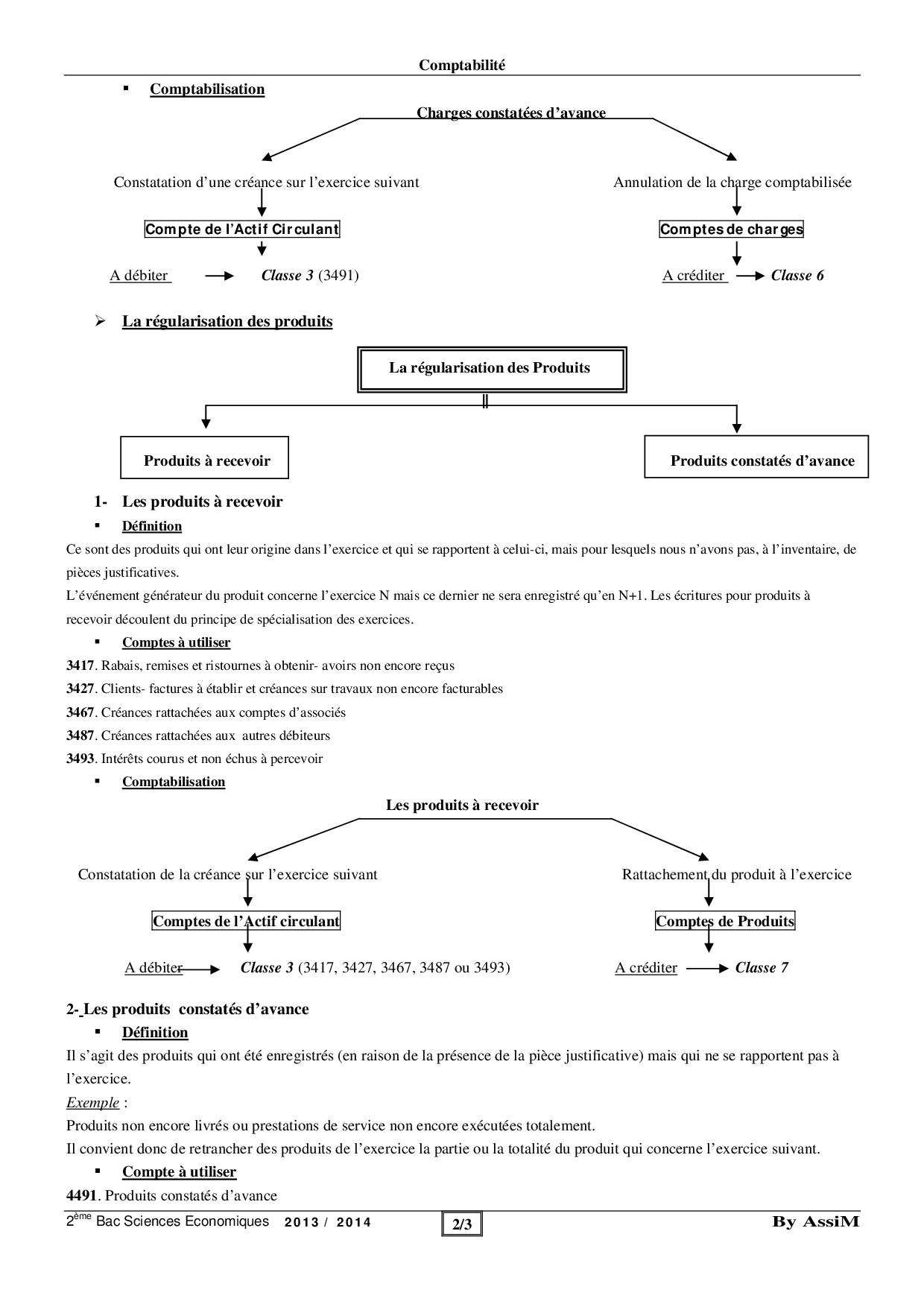
In Moroccan accounting, these are known as Produits à Recevoir. The asset created is often recorded in a specific client account: Account 3427 - Clients - factures à établir (Clients - invoices to be issued).
This image illustrates the concept and the journal entry flow within the Moroccan chart of accounts.
Example: Accrued Service Revenue
Imagine an accounting firm that provides 20,000 MAD worth of advisory services to a client in December. Due to holidays, the invoice will only be sent on January 10.
On December 31, the firm must make an adjusting entry to recognize this revenue:
| Date | Account | Account No. | Debit (MAD) | Credit (MAD) |
|---|---|---|---|---|
| Dec 31 | Clients - factures à établir (Clients - invoices to be issued) | 3427 | 20,000 | |
| Ventes de services au Maroc (Sales of services in Morocco) | 7124 | 20,000 | ||
| To accrue for services rendered in December |
This entry correctly includes the 20,000 MAD of revenue in the December income statement and creates a receivable on the December 31 balance sheet, providing a true picture of the company's performance and financial position.
Conclusion
Today we have taken a significant step into the period-end closing process. By understanding and applying adjustments for accruals, you ensure that a company's financial statements adhere to the matching principle and provide a faithful representation of its activities.
Key Takeaways:
- The Matching Principle: This is the core reason for adjusting entries. It demands that expenses be recognized in the same period as the revenues they help generate.
- Accrued Expenses (Charges à Payer): These are expenses incurred but not yet recorded or paid. The adjustment is a Debit to an Expense and a Credit to a Payable (Liability).
- Accrued Revenues (Produits à Recevoir): These are revenues earned but not yet recorded or invoiced. The adjustment is a Debit to a Receivable (Asset) and a Credit to a Revenue account.
- Purpose: The goal of these entries is to ensure that the Income Statement and Balance Sheet are accurate for the period, even when the timing of cash flow differs from the timing of the business activity.
Preview of the Next Lesson:
We have just handled cases where the business activity happens before the cash changes hands. In our next lesson, we will tackle the opposite scenario: deferrals. We will learn how to prepare adjusting entries for prepaid expenses (charges constatées d'avance) and deferred revenues (produits constatés d'avance), where cash is paid or received in advance of the actual expense or revenue being recognized.