Recommended resources
The freely available resources this lesson will direct you to.
Welcome back to our module on period-end adjustments. In the last two lessons, we explored adjusting entries for accruals and deferrals—transactions where the timing of cash flow doesn't match the timing of business activity. You learned how to handle prepaid expenses (charges constatées d'avance) and deferred revenues (produits constatés d'avance) to correctly apply the principle of accrual accounting (principe de spécialisation des exercices).
Today, we will tackle another essential adjusting entry, but this one deals with long-term assets. When a company buys a vehicle, machinery, or computer, it doesn't expense the full cost immediately. Instead, it spreads that cost over the asset's useful life. This process is called depreciation, or amortissement in French.
Our learning outcome for this lesson is to calculate and record depreciation expense for fixed assets using the straight-line method. This is a fundamental skill for any accountant, as it impacts both the income statement and the balance sheet every single accounting period.
1. The "What" and "Why" of Depreciation
Before we calculate anything, let's establish the core concepts. What exactly are we doing when we depreciate an asset?
Depreciation is the systematic allocation of the cost of a tangible fixed asset over its estimated useful life. It is an application of the matching principle (principe de spécialisation des exercices), which states that expenses should be recognized in the same period as the revenues they help generate. Since a machine or a delivery truck helps your company generate revenue for several years, we must "expense" a portion of its cost each of those years.
It is crucial to understand that accounting depreciation is a cost allocation process, not a valuation process. It does not attempt to reflect the asset's true market value, which might fluctuate.
To get a solid grasp of these foundational ideas, please watch the beginning of the following video.
DEPRECIATION BASICS! With Journal Entries
This video from Accounting Stuff provides an excellent introduction to depreciation. It explains why we depreciate assets in accrual accounting and defines key terms like 'fixed asset' and 'capitalization'.
Watch the section from 00:22 to 02:45. Focus on the explanation of why depreciation is necessary to match expenses to the periods in which the asset is used.
2. Calculating Straight-Line Depreciation
There are several methods to calculate depreciation, but the most straightforward and widely used is the straight-line method (méthode de l'amortissement linéaire). This method spreads the cost of the asset evenly over its useful life, resulting in the same depreciation expense each year.
The Formula
To calculate the annual depreciation expense, you need three pieces of information:
- Cost (Valeur d'Origine or VO): The full acquisition cost of the asset, including purchase price, taxes, transport, and installation costs.
- Salvage Value (Valeur Résiduelle): The estimated residual value of an asset at the end of its useful life. In Moroccan practice, for tax and simplicity purposes, the salvage value is often assumed to be zero. We will use this assumption unless stated otherwise.
- Useful Life (Durée de vie utile): The estimated period over which the asset will be used by the business.
The formula for annual straight-line depreciation is:
Let's see a simple example of this calculation.
How to Calculate Straight Line Depreciation Method
This short video from Accounting University demonstrates how to apply the straight-line formula with a clear, simple example.
Watch from 00:53 to 02:45. Pay attention to how the cost, salvage value, and useful life are plugged into the formula to find the annual expense.
The Moroccan Context: Prorata Temporis
In practice, businesses acquire assets throughout the year, not just on January 1st. For the first year of an asset's life, you must calculate depreciation only for the portion of the year you actually owned and used it. This is the prorata temporis rule (time-proportionate).
In Morocco, depreciation is typically calculated from the date of commissioning (date de mise en service) until the end of the financial year (usually Dec 31). The calculation is based on the number of days, often using a commercial year of 360 days.
Example:
An asset is purchased and put into service on May 15, 2024.
- Number of days of use in 2024: (30-15) days in May + 30 days/month * 7 months (Jun-Dec) = 15 + 210 = 225 days.
- First Year's Depreciation =
Annual Depreciation * (225 / 360)
The remaining depreciation for the days not used in the first year (360 - 225 = 135 days) will be taken in the final year of the asset's life.
3. Recording the Depreciation Journal Entry
Now that we know how to calculate the expense, how do we record it? The adjusting entry for depreciation involves two new accounts:
- Depreciation Expense (Dotation aux amortissements): This is an expense account that appears on the Income Statement (Compte de Produits et Charges - CPC). It reduces the company's profit for the period.
- Accumulated Depreciation (Amortissements de...): This is a special account called a contra-asset account. It is an asset account with a normal credit balance. On the Balance Sheet (Bilan), it is subtracted from the asset's original cost to show the asset's Net Book Value (Valeur Nette d'Amortissement - VNA).
Using a contra-asset account is important because it allows the company's financial statements to show both the original cost of the asset and the total amount of depreciation charged against it to date.
The journal entry is always the same:
- Debit: Depreciation Expense
- Credit: Accumulated Depreciation
The video below explains this entry and the use of T-accounts to visualize the effect.
DEPRECIATION BASICS! With Journal Entries
Let's return to the Accounting Stuff video to see exactly how to record the depreciation journal entry and understand the role of the 'Accumulated Depreciation' account.
Watch from 03:55 to 08:59. This section is critical. Focus on why you credit 'Accumulated Depreciation' instead of the asset account directly, and how the Net Book Value is calculated.
Moroccan Accounting Entry
In the Moroccan Chart of Accounts (Plan Comptable Général Marocain), the entry uses specific account numbers. For a piece of industrial equipment, for example:
| Date | Account | Account No. | Debit | Credit |
|---|---|---|---|---|
| Dec 31, 24 | Dotations d'exploitation aux amort. des immob. corp. | 6193 | XXX | |
| Amortissements du matériel et outillage | 2833 | XXX | ||
| Constatation de la dotation de l'exercice |
The 28xx account number will change depending on the type of asset being depreciated (e.g., 2834 for matériel de transport, 2835 for mobilier, matériel de bureau).
4. The Depreciation Schedule (Plan d'Amortissement)
To keep track of an asset's depreciation over its entire life, accountants prepare a Depreciation Schedule, known in French as a Tableau d'Amortissement or Plan d'Amortissement. This table provides a year-by-year summary.
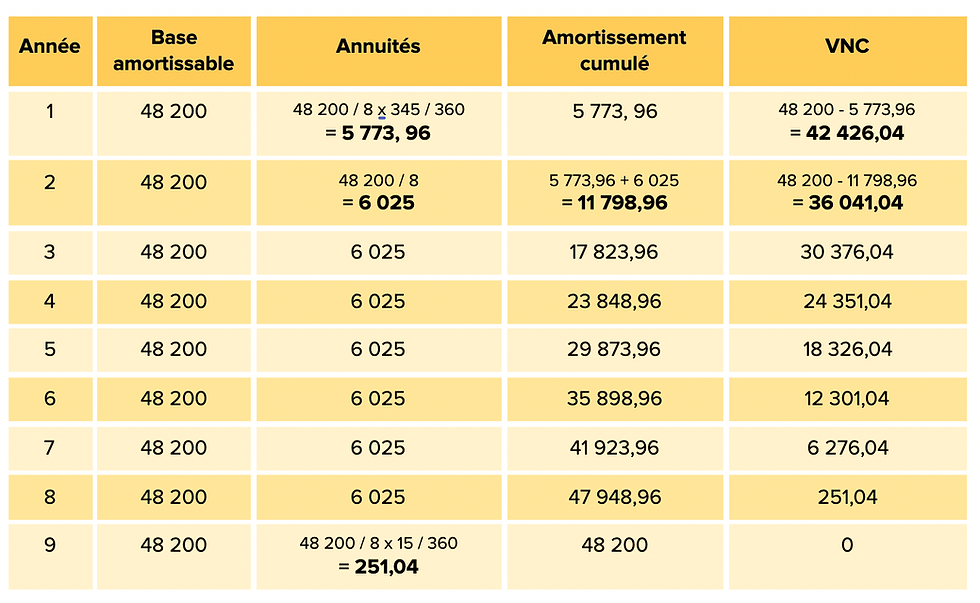
The key columns are:
- Années (Years): The accounting periods.
- Valeur d'Origine (Original Cost): The depreciable base, which remains constant.
- Annuité (Annual Expense): The depreciation expense for that year.
- Amortissement Cumulé (Accumulated Depreciation): The sum of all depreciation from prior years plus the current year.
- VNA (Valeur Nette d'Amortissement): The Net Book Value (
VNA = VO - Amortissement Cumulé). At the end of the asset's life, the VNA will be zero (or equal to the salvage value).
Let's tie all these concepts together with a complete Moroccan exercise.
Amortissement linéaire - Exercice et Corrigé
This document contains a perfect, concise exercise that applies all the concepts we've discussed: calculating the rate, applying the prorata temporis rule for the first year, building the full depreciation schedule, and recording the Moroccan journal entry.
Please study 'Exercice 1' and its 'Solution' carefully. Trace how the rate (20%) and the first-year annuity (3,125) are calculated based on a 225/360 day period. Then, review the depreciation table and the final journal entry.
Test your understanding!
"Services Express SARL", a Moroccan SME, purchased a new delivery van on October 1, 2024. The company's financial year ends on December 31.
- Cost (VO): 240,000 DH
- Useful Life: 5 years
- Salvage Value: 0 DH
Your task:
- Calculate the depreciation expense for the year 2024.
- Prepare the adjusting journal entry for December 31, 2024, using the correct Moroccan account numbers.
Show answer
1. Calculation of Depreciation for 2024:
- Annual Depreciation:
(240,000 DH - 0) / 5 years = 48,000 DH per year. - Prorata Temporis Calculation: The van was used from October 1 to December 31, which is 3 months (Oct, Nov, Dec).
- In months:
3 / 12 - In days (more common fiscally): 3 months * 30 days/month = 90 days. We'll use the days method:
90 / 360.
- In months:
- Depreciation Expense for 2024:
48,000 DH * (90 / 360) = 12,000 DH.
2. Adjusting Journal Entry for December 31, 2024:
| Date | Account | Account No. | Debit (DH) | Credit (DH) |
|---|---|---|---|---|
| Dec 31, 24 | Dotations d'exploitation aux amort. des immob. corp. | 6193 | 12,000 | |
| Amortissements du matériel de transport | 2834 | 12,000 | ||
| Dotation aux amortissements, exercice 2024 |
Conclusion
Mastering depreciation is a significant step forward in your accounting training. You've learned not just the theory but also how to apply it in a practical, Moroccan context.
Key Takeaways:
- Depreciation (Amortissement) is the process of allocating an asset's cost over its useful life, in line with the matching principle.
- The straight-line method provides a constant depreciation expense each year.
- The formula is
(Cost - Salvage Value) / Useful Life. - In the first year, the prorata temporis rule must be applied to calculate depreciation only for the period the asset was in service.
- The adjusting entry involves a Debit to an expense account (Dotation aux amortissements,
619x) and a Credit to a contra-asset account (Amortissements de...,28xx). - The asset's Net Book Value (VNA) is its original cost minus its accumulated depreciation.
Preview of the Next Lesson:
We will continue our exploration of period-end adjustments. So far, we've dealt with deferrals, accruals, and depreciation of tangible assets. But what about financial assets, specifically amounts owed to us by clients (créances clients) that we might never collect? In the next lesson, we will learn how to prepare an adjusting entry for estimated bad debts, introducing the concept of provisions.