Recommended resources
The freely available resources this lesson will direct you to.
Welcome back. In our previous lesson, we addressed a key period-end adjustment: depreciation. You learned how to systematically allocate the cost of a long-term asset over its useful life, using the straight-line method. This introduced the important concept of a contra-asset account (Amortissements) to reduce the book value of an asset without directly crediting the asset account itself.
Today, we continue our exploration of adjusting entries by focusing on another crucial asset: Accounts Receivable (Créances Clients). When a business sells on credit, there is always a risk that some customers will not pay. Accounting principles require us to anticipate and account for this risk.
Our learning outcome for this lesson is to prepare an adjusting entry for estimated bad debts using the allowance method. This method is required under both international standards and Moroccan GAAP and is essential for presenting a company's financial position accurately.
1. The "Why": Prudence and Matching Principles
When a company makes a credit sale, it records revenue and an account receivable. But what if that receivable is never collected? It would be misleading to keep showing the full amount as an asset and to recognize revenue from a sale that ultimately generated no cash.
This is where the allowance method (méthode des provisions) comes into play. It is based on two fundamental accounting principles:
- The Matching Principle (Principe de spécialisation des exercices): The cost associated with a bad sale (the bad debt) should be recorded as an expense in the same period the sale was made, not in a future period when the account is finally deemed uncollectible.
- The Principle of Prudence (Principe de prudence): This principle dictates that assets and profits should not be overstated. By anticipating potential losses from uncollectible accounts, we ensure that Accounts Receivable on the balance sheet reflects a more realistic value—the amount we actually expect to collect.
To learn the core logic of the allowance method, please watch the following video. It introduces the key accounts and the initial journal entry to record an estimate.
Accounting for Bad Debts (Allowance Method)
This video from 'The Accounting Prof' clearly explains why we must account for bad debts and introduces the fundamental journal entry for the allowance method.
Watch from the beginning to 03:04. Focus on the two key accounts introduced: Bad Debt Expense and Allowance for Doubtful Accounts. Notice the similarity between the 'Allowance' account and the 'Accumulated Depreciation' account you learned about in the last lesson.
As the video explained, we use two main accounts:
- Bad Debt Expense: An expense account on the Income Statement. In Moroccan accounting, this is the Dotation aux provisions pour dépréciation des créances (Account 619x).
- Allowance for Doubtful Accounts: A contra-asset account that is subtracted from Accounts Receivable on the Balance Sheet. In Morocco, this is called the Provision pour dépréciation des clients et comptes rattachés (Account 394x).
The net amount, Accounts Receivable - Allowance for Doubtful Accounts, is called the Net Realizable Value of the receivables.
2. The "How": Estimating Uncollectible Amounts
The bad debt expense is recorded via an adjusting entry at the end of the accounting period. Since we don't know for sure which specific customers won't pay, we must estimate the total amount. There are several ways to do this. We will focus on the two most common methods.
Allowance For Doubtful Accounts Explained with Examples
This video from 'The Financial Controller' provides a practical overview of different methods used to estimate the allowance for doubtful accounts.
Watch from 01:33 to 05:03. This will introduce you to the 'percentage of credit sales' method and the more detailed 'accounts receivable aging' method.
Let's recap the two main estimation approaches:
- Percentage of Sales Method: The company estimates bad debt expense as a percentage of its total credit sales for the period. For example, based on history, a company might estimate that 1% of all credit sales will become uncollectible. This method is simple and strongly adheres to the matching principle.
- Aging of Accounts Receivable Method: This is a more refined, balance-sheet-focused approach. The company creates an "aging schedule" that categorizes all outstanding receivables by how long they have been due (e.g., current, 1-30 days past due, 31-60 days past due, etc.). A higher percentage of uncollectibility is applied to older debts. The result is the total estimated uncollectible amount that should be the ending balance in the allowance account.
The aging method is generally preferred as it provides a more accurate valuation of receivables at the balance sheet date.
To see a detailed example of an aging schedule calculation, please review the following text.
Accounts Receivable and Bad Debts Expense
This article from AccountingCoach provides a detailed breakdown of how to use an aging report to calculate the required balance for the Allowance for Doubtful Accounts.
Read the section titled 'Aging of Accounts Receivable'. Focus on the table that multiplies the receivable totals in each age category by an estimated percentage of uncollectibility to arrive at a total required allowance.
3. Recording the Adjusting Entry in a Moroccan Context
Now, let's put this into practice using the Moroccan Chart of Accounts (PCGM). The goal of the adjusting entry is to make the balance in the Provision account (3942) equal to the total estimated uncollectible amount we calculated (e.g., from our aging schedule).
The adjusting journal entry to record the creation or increase of a provision is:
| Date | Account | Account No. | Debit | Credit |
|---|---|---|---|---|
| 31/12 | Dotations d'expl. aux prov. pour dépréciation des créances | 61964 | XXX | |
| Prov. pour dépréciation des clients et comptes rattachés | 3942 | XXX | ||
| Constatation de la provision pour clients douteux |
The image below shows this exact journal entry in a T-account format, which is a great way to visualize the transaction.
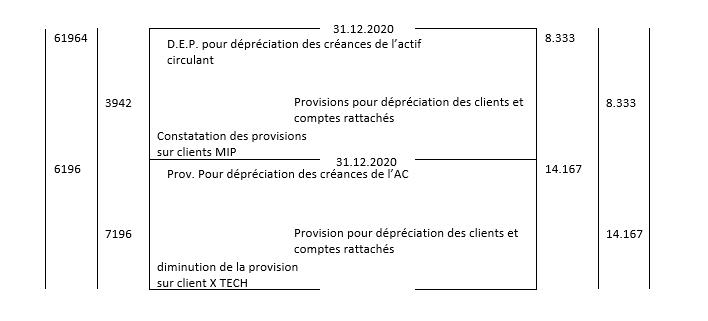
An extremely important point: The amount you record in this journal entry (XXX) is the amount needed to adjust the existing balance in account 3942 to the new required balance.
- Scenario 1: No previous provision. If the existing balance in account 3942 is zero and your aging schedule estimates 15,000 DH are uncollectible, your adjusting entry will be for 15,000 DH.
- Scenario 2: Insufficient existing provision. If account 3942 has a credit balance of 10,000 DH from last year, but your new estimate is 15,000 DH, you need to increase the provision. Your adjusting entry will be for 5,000 DH (15,000 - 10,000).
- Scenario 3: Excessive existing provision. If account 3942 has a balance of 20,000 DH, but your new estimate is only 15,000 DH, you need to decrease the provision. This is done with a "reversal" or "reprise" entry (Debit 3942, Credit 7196 - Reprises sur provisions), which we will cover in more detail later.
4. Completing the Cycle: The Write-Off
While our focus today is on the adjusting entry for the estimate, understanding what happens next is crucial for context. When a specific customer's account is confirmed to be uncollectible (e.g., due to bankruptcy), the company will write off the receivable.
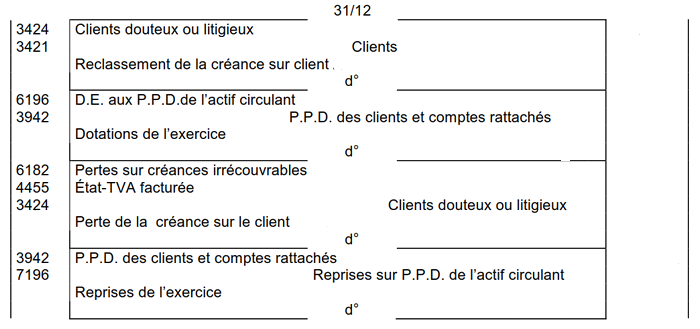
This process involves several steps in Moroccan accounting:
- Reclassify the client: The client is moved from a general client account (3421) to a doubtful client account (3424).
- Write off the debt: When the loss is certain, the doubtful client account is credited to remove the receivable. An expense account, Pertes sur créances irrécouvrables (6182), is debited. The VAT previously recorded on the sale is also reversed.
- Reverse the provision: Since the specific provision for this now-written-off client is no longer needed, it is reversed through a Reprise sur provision (7196) account.
This full cycle is shown in the journal entries below.
Test your understanding!
At its year-end on December 31, 2024, "Atlas Distribution SARL" prepares an aging schedule of its accounts receivable.
| Aging Category | Balance (DH) | Estimated % Uncollectible |
|---|---|---|
| Current | 150,000 | 1% |
| 1-30 days past due | 40,000 | 5% |
| 31-90 days past due | 20,000 | 20% |
| Over 90 days past due | 10,000 | 50% |
| Total | 220,000 |
Before the adjustment, the Provision pour dépréciation des clients (account 3942) has a credit balance of 3,500 DH.
Your Task:
- Calculate the total required balance for the Provision for Doubtful Accounts as of December 31, 2024.
- Prepare the necessary adjusting journal entry for December 31, 2024.
Show answer
1. Calculate Required Provision Balance:
- Current: 150,000 * 1% = 1,500 DH
- 1-30 days: 40,000 * 5% = 2,000 DH
- 31-90 days: 20,000 * 20% = 4,000 DH
- Over 90 days: 10,000 * 50% = 5,000 DH
- Total Required Provision Balance: 1,500 + 2,000 + 4,000 + 5,000 = 12,500 DH
2. Prepare the Adjusting Journal Entry:
The company needs the balance in account 3942 to be 12,500 DH. It currently has a balance of 3,500 DH. Therefore, the adjustment needed is:
12,500 DH (Required) - 3,500 DH (Existing) = 9,000 DH
| Date | Account | Account No. | Debit (DH) | Credit (DH) |
|---|---|---|---|---|
| 31/12/24 | Dotations d'expl. aux prov. pour dépréciation des créances | 61964 | 9,000 | |
| Prov. pour dépréciation des clients et comptes rattachés | 3942 | 9,000 | ||
| Ajustement de la provision pour créances douteuses |
After this entry, the balance in account 3942 will correctly be 12,500 DH.
Conclusion
You have now learned how to apply the allowance method to account for estimated bad debts, a critical skill for ensuring financial statements are prudent and accurate. This process directly impacts both the Balance Sheet (by stating receivables at their net realizable value) and the Income Statement (by matching expenses to revenues).
Key Takeaways:
- The allowance method (méthode des provisions) is used to estimate and record bad debt losses in the period the related sales occur.
- Estimates are often based on an aging of accounts receivable, where older debts are considered more likely to be uncollectible.
- The adjusting entry involves debiting an expense account (Dotation aux provisions, 61964) and crediting a contra-asset account (Provision pour dépréciation, 3942).
- The amount of the adjustment is what's needed to bring the provision account's balance to the newly calculated total estimate.
Preview of the Next Lesson:
We will continue our work on period-end procedures by tackling another essential reconciliation task: the bank reconciliation. You will learn how to compare the company's cash records with the bank statement, identify discrepancies, and prepare the necessary adjusting entries to ensure the cash balance is reported correctly.