Recommended resources
The freely available resources this lesson will direct you to.
- RAG vs. Fine Tuningwww.youtube.com
- Transfer Learning: Pre-training and Fine-tuning for NLP - Interactivembrenndoerfer.com
- A Newbie-Friendly Guide to Transfer Learningwww.v7labs.com
- What is Transfer Learning?www.youtube.com
- Fine Tuning vs Transfer Learningyoutube.com
- An Introduction to Transfer Learning in NLP and HuggingFacegitnation.com
Hello! Welcome back to our course on AI Engineering.
In our last lesson, you saw how powerful and convenient Hugging Face pipelines are for using pre-trained models "as-is" on common tasks like sentiment analysis. While this is great for general-purpose problems, you'll often face situations where you need a model to perform well on a unique, specialized dataset—perhaps for classifying specific legal documents, medical reports, or customer support tickets. An off-the-shelf model may not have the nuanced understanding required for these tasks.
This brings us to a crucial concept in modern AI: transfer learning. Today's lesson will explain what transfer learning is and introduce its most common application in NLP, fine-tuning. We'll focus on the theory—the "what" and "why"—to build a solid foundation. Our goal is to explain the concept of transfer learning in NLP and when fine-tuning is appropriate.
This knowledge is the bridge between simply using models and truly adapting them to solve specific, real-world problems.
What is Transfer Learning?
At its core, transfer learning is the idea of taking the knowledge a model has gained from being trained on a large, general dataset and applying it to a new, often smaller, and more specific task. Instead of training a model from scratch with random weights—which requires vast amounts of data and computational power—we start with a model that already has a foundational understanding of language.
The Hugging Face video below provides an excellent introduction to this idea.
This video from Hugging Face introduces the core concept of transfer learning, its benefits, and how it's applied in NLP.
Watch the video from the beginning until 03:14. Pay close attention to: The definition of transfer learning (00:05). The performance difference compared to training from scratch (00:40). How pre-training works in NLP using self-supervised objectives like masked language modeling (01:24). The practical process of replacing the model's 'head' for a new task (02:32).
As the video explained, the process for modern Transformer models typically involves two stages:
-
Pre-training: A large model (like BERT or GPT) is trained on a massive corpus of text (e.g., the entire internet). Its objective is not a specific task but a self-supervised one, such as predicting masked words (
Masked Language Modeling) or predicting the next word. This forces the model to learn grammar, semantics, facts about the world, and contextual relationships—a general "understanding" of language. This step is unsupervised because the labels (the masked words) are part of the input data itself. -
Fine-tuning: We take this pre-trained model, replace its final layer (the "head") with a new one designed for our specific task (e.g., a classification layer), and continue training it on our smaller, labeled dataset.
This two-stage process is visualized below.

Transfer Learning Techniques: Feature Extraction vs. Fine-Tuning
When you adapt a pre-trained model, you have two main strategies. The terms can sometimes be used interchangeably, which can be confusing, so let's define them clearly. Transfer Learning is the overall concept, and Feature Extraction and Fine-Tuning are two specific techniques to achieve it.
Transfer Learning vs Fine Tuning: Key Differences for ML Engineers
This article provides clear definitions and a helpful comparison table to distinguish between feature extraction and fine-tuning.
Read the sections 'Why Getting Transfer Learning vs Fine Tuning Right Saves Training Time' and 'Feature Extraction vs Fine-Tuning: Core Differences'. Focus on the table that compares the two methods across different aspects.
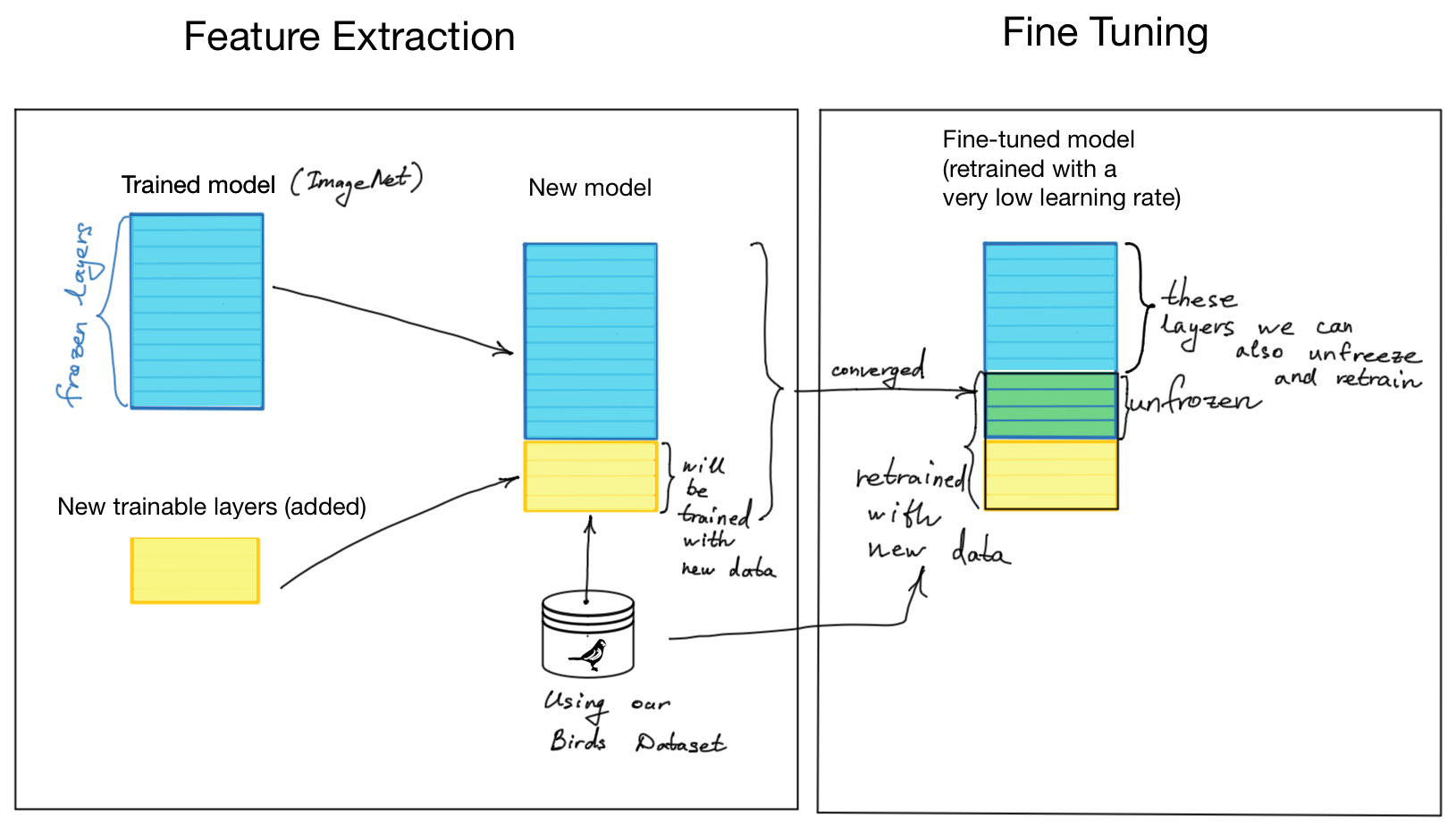
Let's summarize the key differences, which are also shown in the image below.
-
Feature Extraction:
- What it is: You treat the pre-trained model's main body (the Transformer layers) as a fixed feature extractor. You freeze these layers, meaning their weights will not be updated during training.
- What you train: You only train the new head that you added (e.g., the classification layer).
- Analogy: This is like using a powerful, pre-built engine without modifying its internal components. You're just attaching a new transmission (the head) to it.
-
Fine-Tuning:
- What it is: You not only train the new head but also unfreeze some or all of the layers in the pre-trained model's body.
- What you train: You update the weights of both the new head and the unfrozen parts of the body, typically using a very low learning rate to avoid drastically altering the valuable pre-trained knowledge.
- Analogy: This is like taking that pre-built engine and carefully adjusting some of its internal components to optimize it for a specific type of racing.
When is Fine-Tuning Appropriate?
Now for the most critical question for an AI engineer: which technique should you choose? The decision depends on two main factors: the size of your dataset and its similarity to the data the model was pre-trained on.
The following resource provides excellent guidance on this.
Transfer Learning vs Fine Tuning: Key Differences for ML Engineers
This article includes a clear decision matrix that will help you decide when to use feature extraction versus fine-tuning.
Read the section 'Fine Tuning vs Transfer Learning: Accuracy, Data, Compute Trade-offs'. Pay close attention to the table under the subheading 'When fine tuning vs transfer learning performs better'.
Here is a summary of the decision-making process based on the resources:
| Your Dataset Size | Your Data vs. Pre-training Data | Best Approach | Rationale |
|---|---|---|---|
| Small | Similar | Feature Extraction | The pre-trained features are already relevant. Fine-tuning risks overfitting on the small dataset and losing the general knowledge. |
| Large | Similar | Fine-Tuning | You have enough data to adjust the model's weights without overfitting. This can lead to better performance by specializing the model. |
| Small | Different | Partial Fine-Tuning | This is the trickiest case. The pre-trained features may not be fully relevant. Fine-tuning only the top few layers of the model's body can help it adapt to new features without overfitting. |
| Large | Different | Full Fine-Tuning | You have enough data to significantly adapt the model's weights to the new domain. In some extreme cases with massive datasets, training from scratch might even be an option. |
As a general rule of thumb, it's often best to start with feature extraction. It's faster, less computationally expensive, and less prone to overfitting. If the performance isn't sufficient, you can then proceed to fine-tune.
A Word of Caution: The Downsides
Transfer learning is incredibly powerful, but it's not a silver bullet. You should be aware of a key challenge: bias transfer.
If the original data used for pre-training contained biases (e.g., gender, racial, or geographical biases), the model will learn them. When you fine-tune this model, those biases are transferred to your new application. It is crucial to be aware of this and to evaluate your final model for fairness.
The same Hugging Face video we started with also contains a short but important segment on the biases that can be transferred from pre-trained models.
Watch the segment from 03:14 to 03:57. This will give you concrete examples of how biases can manifest in both computer vision and NLP models.
Conclusion
In this lesson, we've laid the theoretical groundwork for adapting large pre-trained models to your specific needs. This is a fundamental skill that separates basic use of AI from sophisticated application development.
Key Takeaways:
- Transfer Learning reuses knowledge from a model pre-trained on a large, general dataset to improve performance and data efficiency on a new task.
- The process involves a pre-training step (learning general language) and a fine-tuning step (adapting to a specific task).
- The two main adaptation techniques are:
- Feature Extraction: Freezing the model body and only training a new head. It's fast and safe for small datasets.
- Fine-Tuning: Unfreezing and retraining parts of the model body. It offers higher performance but requires more data and compute.
- The choice between these techniques depends on your dataset size and its similarity to the pre-training domain.
- Be mindful that pre-trained models can carry biases, which will be transferred to your fine-tuned model.
Preview of the Next Lesson
Now that you understand what fine-tuning is and when to use it, it's time to put theory into practice. In our next lesson, you will learn how to fine-tune a pre-trained Transformer model on a custom dataset using the Hugging Face Trainer API, a powerful tool designed to make the training process streamlined and efficient.