Recommended resources
The freely available resources this lesson will direct you to.
Hello. Last lesson used interviews, reviews, and sales calls to infer what a buyer wants to achieve and what they fear might go wrong. Now you’ll place those goals and risks along a campaign journey. The central question is not simply where do people drop off? It is what would need to seem true to this buyer for the next action to make sense?
You’ll build a map from exposure through click and engagement to purchase. It will connect the events you can measure with psychological steps you can only infer—and keep those two kinds of knowledge separate.
Map a buyer’s progress, not just a funnel
An analytics funnel tells you that some people clicked an ad and fewer purchased. A journey map adds a point of view: whose decision is this, what are they trying to do, what do they encounter, and what questions arise along the way?
Read the definition and the “Key Components” portion of Nielsen Norman Group’s Journey Mapping 101. It provides a useful structure without requiring every campaign to follow the same set of stages.
Nielsen Norman Group distinguishes a person's journey from a simple record of interactions. Read this to establish the elements your campaign map needs.
In “Definition: Journey Map,” read the definition. Then, in “Key Components of a Journey Map,” read the five elements and continue through the questions at the end of “Opportunities.” Pay particular attention to “Actor,” “Scenario + Expectations,” “Journey Phases,” and “Actions, Mindsets, and Emotions.” Notice that an action and the buyer’s interpretation of that action occupy different places on the map.
Start with one actor in one situation. “Everyone reached by the campaign” is too broad: a first-time shopper facing a delivery deadline and a repeat shopper replacing a familiar item may see the same ad but undertake different decisions. In B2B, the person researching a service and the person approving its purchase may need separate maps. Their actions connect, but their questions need not match.
The printer-supplies map below illustrates what happens when a journey includes more than channel touchpoints. Look across a single column: the buyer is doing something, having an experience, and facing a particular risk. Then look across the risk row: what feels uncertain can change as the decision progresses.
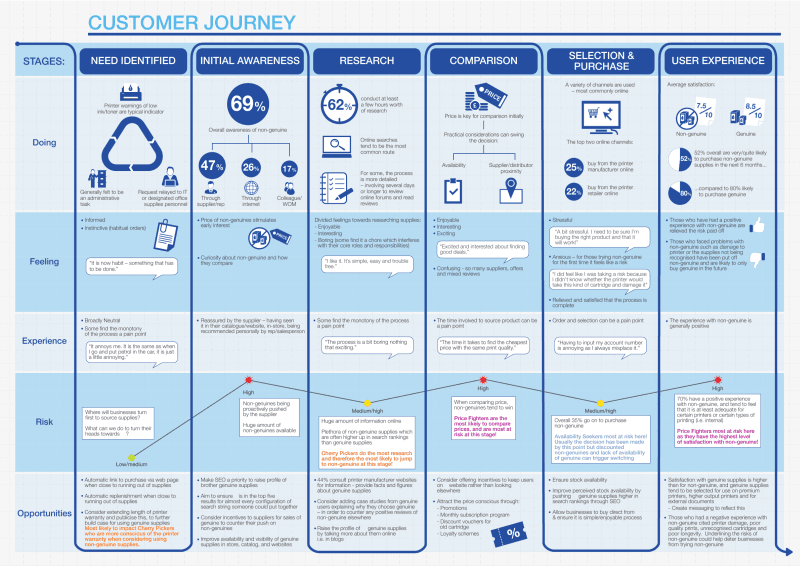
For your purposes, four headings are enough: exposure, click, engagement, purchase. They are landmarks for investigation, not a claim that every buyer passes through four orderly mental states. Nor does an ad impression prove that its intended recipient actually noticed the ad.
The psychological work between landmarks
Suppose the buyer has a goal already in view. At exposure, a campaign cue must first be noticed or encountered, then recognized as potentially relevant to that goal. A search result promising “reliable lead-quality reporting” may mean something to a buyer under pressure to explain sales outcomes; the same result may be ignored by someone researching creative production. The important psychological step is not awareness of the brand in the abstract. It is the buyer’s provisional judgment: This might help with my situation.
A click is a decision to inspect, not a decision to buy. The ad, subject line, or search snippet offers a preview of the information behind it. The buyer judges whether learning more seems worth the time and effort. A highly clickable claim can fail here if it attracts curiosity about something the destination cannot deliver.
After the click, engagement means encountering and using information that matters to the decision. One buyer checks specifications; another reads a case study, watches an explanation, or asks a sales representative about implementation. Their working question may shift from Is this relevant? to Could this work in my circumstances, and can I trust the evidence? Engagement need not mean a long session. A buyer might find the one delivery fact they need in seconds. Conversely, prolonged browsing can signal confusion rather than growing confidence.
At purchase, the buyer accepts the remaining trade-off and takes the consequential action—placing an order or approving an agreement, depending on the offer. Wanting the outcome is not the same as being ready to commit. Price, timing, fit, delivery, credibility, and the consequences of a wrong choice can all become more concrete at this point.
These are possible questions, not thoughts automatically caused by a stage. Google’s Marketing in the Messy Middle is helpful here because it describes buyers exploring options and evaluating them repeatedly rather than marching toward checkout.
Read the report’s short recap of its “messy middle” model to avoid turning your four campaign landmarks into a rigid theory of decision-making.
In the Introduction subsection “Revisiting the messy middle” (printed pp. 8–9), find the paragraph beginning “In our model, the messy middle sits between the twin poles of trigger and purchase.” Read the exposure description. Then read the looping mindsets in the following paragraph. Notice that this report uses “exposure” for background perceptions of a category—not merely a logged ad impression.
That distinction matters in campaign analysis. A buyer can arrive at a product page with years of prior experience, leave to compare alternatives, return through email, and purchase later. Some repeat purchases require almost no fresh evaluation. Your map should make room for those paths even if your reporting dashboard displays a neat funnel.
Build a map around a specific decision
Consider a B2B buyer deciding whether to replace a service that generates plenty of reported leads but leaves the sales team questioning their quality. From the previous lesson, a defensible working diagnosis might be: the buyer wants results they can explain internally while avoiding a costly, disruptive switch.
A campaign-level map for the person leading that evaluation could look like this:
| Landmark | What you might observe | Psychological step to investigate |
|---|---|---|
| Exposure | A relevant search result or professional-feed ad is served. | Does the buyer recognize their lead-quality problem in the message, or see another generic promise of “more leads”? |
| Click | They open an ad offering an explanation of how lead quality is assessed. | Do they expect useful evidence behind the claim? |
| Engagement | They inspect the method, a case example, and setup requirements; they may return later or speak to a representative. | Can they tell whether the proposed results would be credible and whether implementation is manageable for their team? |
| Purchase | The authorized decision-makers approve and sign an agreement. | Does the expected improvement justify the cost, disruption, and accountability that come with switching? |
The third column is deliberately phrased as questions. The click does not prove the buyer believed the claim; opening a case example does not prove they found it persuasive. A sales-call statement such as “Show me how you distinguish a qualified opportunity from a lead” would support a more specific inference. If the buyer instead asks repeatedly about access and onboarding, the map may need to give implementation risk greater weight.
Now contrast an ecommerce campaign for a carry-on bag. A shopper who needs it for an upcoming trip may notice an ad because it specifies airline-size compatibility. They may click expecting dimensions, then engage with measurements, photos, reviews, and delivery dates. At checkout, the decisive questions may concern arrival time and return terms. A second shopper might click the identical ad to browse styles, compare several bags over weeks, and care little about immediate delivery. The same observed click can sit in different journeys because the situation and goal differ.
Google’s report separates the information buyers may seek while exploring what is available from the details they seek while evaluating a narrower choice. This is a useful distinction for deciding what the destination of a campaign click should help the buyer do.
Return to Google’s report for the connection between a buyer’s current question and the information supplied by a website.
In Chapter 3, “Boosting confidence in the messy middle,” examine the information-needs diagram on printed p. 44. Then, on p. 45, start at the paragraph beginning “A brand’s owned content plays a particularly important role.” Read the comparison and finish the evaluation paragraph at “right for our needs.” Focus on why a broad view of available options and a close check of a preferred option call for different information. Treat these as tendencies to investigate, not fixed rules for every category or B2B sale.
A map therefore needs more than a column labelled “content.” Name the question the content could answer. For the service buyer, a clear account of measurement methods may help evaluate credibility; a list of service categories may help them explore what is available. For the bag shopper, a style collection may support exploration, while exact dimensions and delivery terms support evaluation. The page should make good on the expectation that brought the buyer there.
Keep observations and inferences separate
You already work with event data, so the tempting shortcut is to assign a psychological state to each event name. Resist it. “Page viewed,” “video started,” and “add to cart” record actions under particular tracking definitions. They do not record understood the claim, trusted the seller, or felt safe purchasing.
Watch these two portions of CXL’s Conversion Optimization Course. They connect the promise made before a click to the destination, then show what analytics can and cannot establish about the journey.
Conversion Optimization Course by CXL
In CXL’s “Conversion Optimization Course,” watch for the distinction between finding a drop-off and explaining it.
In the heuristic-analysis portion, watch ad alignment for why the destination should match the expectation set before the click. Then skip to the digital-analytics portion and watch drop-offs and correlations. Focus on the lecturer’s question about whether buyers used site search because they already intended to buy or whether search helped them decide. The same ambiguity applies to almost any engagement event.
Imagine an illustrative campaign recording 10,000 ad impressions, 300 clicks, 120 visits with an interaction involving a size guide or reviews, and 18 orders. Those figures locate observable transitions; they do not establish that 120 people needed reassurance or that guide use caused a purchase. Some purchasers may have known their size already. Others may have consulted an external review you cannot see. First check that impression, click, site-event, and order counts are defined consistently, and that orders agree with transaction records. Then use buyer accounts, support questions, or observed site use to investigate why particular transitions were difficult.
A compact working map can keep four fields beside each landmark:
- Observed action: What happened, under what measurement definition?
- Buyer question: What might they be trying to resolve in this situation?
- Evidence: Which interview passage, review, call, or behavior supports that interpretation?
- Alternative explanation: What else could produce the same action or drop-off?
That last field protects you from an attractive but unearned story. A low click rate might reflect weak relevance, but also limited visibility or an audience unlike the one you intended. A departure after reading pricing might indicate objection to cost—or simply that the buyer found the information they came for and will discuss it elsewhere. Mark unresolved interpretations as hypotheses rather than filling every cell with invented certainty. Use customer data and recordings only with appropriate permission and privacy safeguards.
Key takeaways
A campaign journey map connects observable actions to the changing questions a particular buyer may need to resolve. Exposure can establish possible relevance; a click expresses willingness to inspect; engagement can help a buyer explore or evaluate; purchase requires accepting the remaining trade-off. Buyers may repeat, skip, or leave these landmarks, so the map is a research tool rather than a script for their minds.
Next, you’ll sharpen this diagnosis by asking whether motivation, ability, or the timing of a prompt is limiting a specific target behavior.