Recommended resources
The freely available resources this lesson will direct you to.
Hello. Last lesson connected observable campaign events—exposure, click, engagement, purchase—to the questions a buyer might be trying to resolve. A drop-off tells you where a target action did not happen, but not why. This lesson gives you a more precise diagnosis: at the moment you wanted the action, was the buyer insufficiently motivated, was the action too difficult, or was there no useful prompt at the right time?
The distinction matters in campaign work. More persuasive copy will not fix a broken checkout; a smoother checkout will not make an unwanted offer valuable; and another reminder may accomplish little if it arrives after the buyer’s decision window has closed.
Define the behavior before diagnosing it
The Fogg Behavior Model proposes that a behavior occurs when motivation, ability, and a prompt coincide at the same moment. Watch BJ Fogg explain the model in this short portion of Tiny Habits to Change Your Life, hosted by Jim Kwik. Listen for his distinction between the model and a literal mathematical equation.
Tiny Habits to Change Your Life with Dr. BJ Fogg & Jim Kwik
In Tiny Habits to Change Your Life, BJ Fogg explains the three conditions his behavior model asks you to examine.
Watch the model. Focus on why wanting to do something, being able to do it, and receiving a prompt must come together for a particular action—not merely exist at different points in a buyer’s journey.
The model is often written : behavior, motivation, ability, prompt. Treat this as a diagnostic mnemonic, not a formula into which you can insert scores from GA4. Its first discipline is to name a behavior precisely. “Convert” is too vague. “Submit a request for a service consultation after reviewing the scope” and “complete a bag purchase on a phone before the delivery cutoff” are behaviors you can investigate at specific moments.
Fogg’s diagram places motivation on the vertical axis and ability—how easy the action is—on the horizontal axis. The curved action line conveys a useful trade-off: a strongly motivated person may undertake a difficult action, while an exceptionally easy action may require little motivation. A prompt is more likely to work when the person is in a position to act.
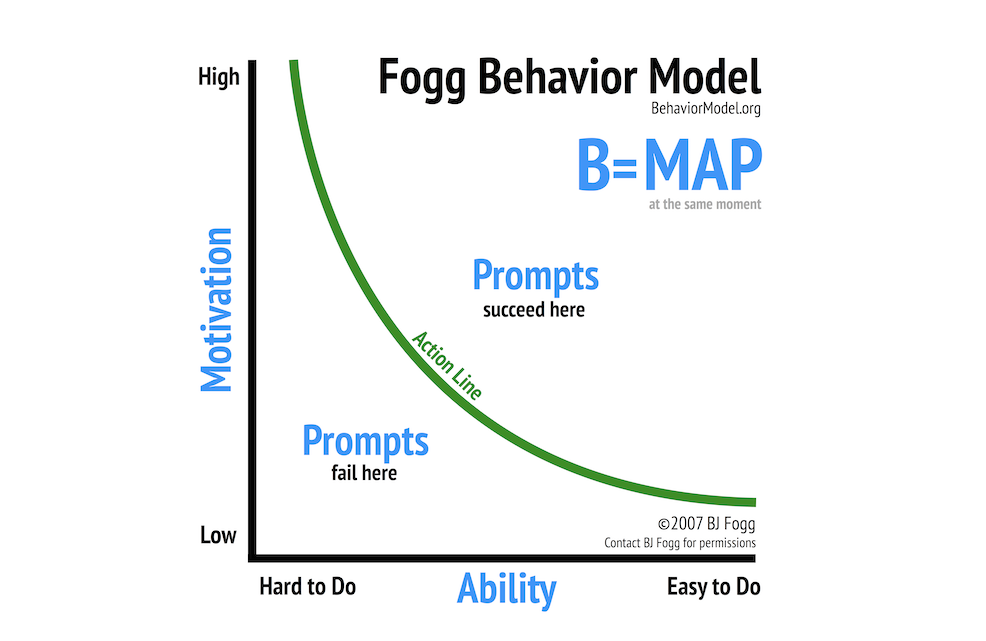
The line is a conceptual aid, not a measured threshold for an individual shopper or a guarantee of conversion. It also prevents a common campaign mistake: interpreting every failure to act as a need for a louder prompt. If buyers cannot complete the action, or have little reason to want it, increasing reminder frequency does not address the limiting condition.
What each condition means in a buying situation
For a fuller explanation, read Jason Hreha’s The Fogg Behavior Model: B = MAP at The Behavioral Scientist. The sections on simplicity and prompt types are especially useful for separating problems that can look identical in a funnel report.
The Fogg Behavior Model: B = MAP
Read Jason Hreha’s explanation of the three components to give the model a practical diagnostic vocabulary.
In “The Three Components,” start under “Motivation: The Energy Behind Behavior” at the components. Continue through “Ability: The Simplicity Chain,” “Prompt: The Trigger to Act,” and “The Action Line.” Stop before “Tiny Habits: The Applied Method.” Pay particular attention to the six sources of difficulty and to how a spark, facilitator, or signal addresses a different situation.
Motivation is the buyer’s reason to perform this action now, not a general interest in the product category. A prospective service buyer can strongly want better lead quality yet have little reason to book a 45-minute sales call before understanding what the service includes. A shopper can like a bag yet not want to buy it today because the trip is months away. Motivational questions concern the expected benefit, the perceived costs and risks, and the urgency or relevance of acting at this moment.
Ability concerns whether the buyer can perform the action under their current circumstances. Fogg uses the term broadly: time, money, physical or mental effort, fit with social expectations, and disruption to routine can all make an action harder. In marketing, ability problems include a form that is unusable on mobile, unclear shipping requirements, a request for information the buyer does not have, or a B2B approval step outside the researcher’s authority.
The categories require care. Price can be an ability barrier when a buyer cannot afford the purchase or lacks spending authority. It can be a motivation barrier when they could pay but do not believe the offer warrants the cost. Similarly, “I need to speak to my team” might mean the buyer cannot authorize the purchase alone, or that they are unconvinced the proposal will withstand scrutiny. The words alone do not settle the diagnosis.
A prompt is a cue to perform the action. An ad’s call to action, an available booking button, or a requested reminder can serve as a prompt. But timing is part of its usefulness. A prompt for a service contract while the buyer is still defining requirements may arrive too early; a delivery reminder after a shopper has already missed the cutoff arrives too late. A prompt can also be present but poorly matched to the buyer’s situation. “Book a call” does not help someone who needs a scope summary to share internally.
Hreha distinguishes three useful prompt forms: a spark supplies a reason to act when motivation is low; a facilitator helps someone act when difficulty is high; and a signal reminds someone who already wants to act and can do so. Do not treat these as labels for every ad format. They are ways to ask what a prompt would need to accomplish for this buyer at this moment.
The same drop-off can support three diagnoses
Suppose a campaign attracts qualified visitors to a service page, but few request a consultation. It is tempting to rewrite the call to action immediately. First, specify the behavior: the prospective buyer submits a consultation request after inspecting the service page. Then consider competing explanations.
A motivation-limited buyer may understand the offer and find the form easy, but not see why a consultation is worth the time. Perhaps the page promises “more leads” while their actual concern is proving lead quality to an internal stakeholder. Evidence might come from sales calls in which buyers ask what they would learn on a first call, or from interviews indicating that the proposed conversation feels premature. The appropriate response may be to explain the call’s purpose and decision value—not to make its button larger.
An ability-limited buyer may want the consultation but be unable to arrange it readily. A long form asks for figures they do not have, the scheduler offers unsuitable times, or the person doing the research is not yet ready to involve the budget owner. These are different difficulties; each calls for a different response. A shorter form could address unnecessary effort, while a concise scope document might help a researcher secure an internal conversation. Neither guarantees a signed agreement. Making an intermediate action easier should not be confused with making the ultimate purchasing decision easier.
A prompt-limited buyer may have a reason to talk and a straightforward way to book, yet encounter no suitable invitation when they are ready. Perhaps the consultation option is shown only at the top of a long page, before the buyer has read the methodology, and is absent when they reach the implementation details. Perhaps a buyer asks for a follow-up after an internal meeting, but receives an automated message before that meeting. A better-timed, permission-based invitation addresses a different problem from either rewriting the value proposition or simplifying the form.
Now take an ecommerce campaign for a carry-on bag. A high add-to-cart rate and low order rate likewise permit several explanations. Buyers may lose motivation when delivery dates make the bag unsuitable for an imminent trip. They may lack ability if checkout fails with their preferred payment method or asks for an address in a format they cannot enter. Or willing, able buyers may have postponed ordering until payday or until confirming travel plans, while the reminder arrives after the delivery deadline. The aggregate drop-off cannot choose among these accounts.
Notice the importance of the target behavior. A size-guide view, a cart addition, and a completed purchase are not interchangeable successes. If a faster cart button raises cart additions but does not help people confidently place suitable orders, it has not solved the purchase problem.
Use evidence to locate the limiting condition
Your existing tracking can tell you where to investigate, but—as in the previous lesson—it cannot read a buyer’s mind. Diagnose in a sequence that keeps observations separate from interpretations.
-
Specify the person, action, and moment. “A first-time mobile visitor completes an order after checking delivery eligibility” is more useful than “customers abandon checkout.” For B2B, distinguish the researcher’s action from an authorized buyer’s approval; one person may be motivated and able to request information but unable to sign.
-
Check whether the action was actually possible. Verify that the page loaded, controls worked, stock was available, and the buyer could meet stated requirements. Inspect the experience on the devices and paths contributing to the drop-off. If the action was impossible, a motivational explanation is unnecessary for those cases. Technical checks can reveal an ability barrier, though they cannot establish that it explains every non-purchase.
-
Investigate what the buyer was trying to accomplish. Calls, interviews, reviews, support messages, and appropriately obtained observations can help distinguish “I do not see the value” from “I want this but cannot complete the step.” Ask what information or capability would have changed the decision. Interpret answers alongside actual behavior: a stated objection may be one of several constraints.
-
Inspect the prompt in context. Was there a clear invitation? Did the buyer plausibly encounter it? Did it appear after enough information to make the action sensible, and while the action remained feasible? An email sent is not an email noticed; a button rendered is not necessarily a button seen. Check the timing against buying windows, prior requests, and frequency, not simply whether a message was delivered.
A concise diagnosis should preserve uncertainty. For example: “Mobile shoppers who select express delivery appear willing to order, but some cannot complete payment; checkout errors are a stronger current explanation than low purchase motivation. Delivery doubts may still affect other shoppers.” That statement is more useful than “checkout friction causes abandonment” because it identifies the group, the evidence, and the remaining alternative.
When conditions overlap, identify the most immediate, remediable bottleneck without assuming it is the only one. A buyer may have moderate motivation, a cumbersome approval process, and a poorly timed follow-up. Making approval materials easier to share might help more than sending another prompt, but you would still want to know whether the resulting proposal addresses their underlying concern.
Finally, a diagnosis should serve the buyer’s decision, not merely the next tracked event. Removing necessary disclosures to make purchase “easier” is not a sound ability improvement. Inventing scarcity to raise motivation, or repeatedly prompting someone who has declined, does not create a better-informed choice. Useful interventions make a worthwhile action clearer, feasible, and available at an appropriate moment.
Key takeaways
For any target behavior, ask three distinct questions: Does the buyer have a sufficient reason to do it now? Can they do it in their actual circumstances? Is a useful prompt present when those conditions coincide? The Fogg Behavior Model helps organize those questions; the action line illustrates why motivation and ease can partly compensate for one another. Neither the model nor a funnel drop-off tells you which condition is limiting without further evidence.
In the next lesson, you’ll examine a different diagnostic problem: when buyers rely on a quick heuristic cue instead of evaluating the evidence most relevant to their decision.