Recommended resources
The freely available resources this lesson will direct you to.
Hello. Last lesson distinguished fast, relatively automatic responses from effortful evaluation—and noted that a click or sale cannot tell you, by itself, what the buyer was thinking. This lesson asks a different question: what was the buyer trying to accomplish, and what did they think could go wrong?
You’ll use interviews, reviews, and sales-call evidence to make defensible inferences about both. That matters whether you are writing an ecommerce product page or discussing a B2B service proposal: the same offer can look attractive to one buyer and risky to another because their situations differ.
Start with the progress the buyer wants
A buyer’s goal is rarely just “buy a product” or “hire an agency.” Those describe the transaction, not its purpose. A more useful account includes the situation, the desired change, and the conditions under which that change would count as worthwhile.
In this excerpt from The ultimate guide to JTBD, Bob Moesta explains the Jobs-to-be-Done idea: people bring products into their lives to make progress in a particular circumstance. Watch the first segment for the distinction between product category and buyer goal; the later segments show why attraction to a new solution does not necessarily produce a purchase.
The ultimate guide to JTBD | Bob Moesta (co-creator of the framework)
In “The ultimate guide to JTBD,” Bob Moesta speaks with Lenny’s Podcast about investigating the circumstances behind a purchase rather than assuming a product feature explains it.
Watch the buyer's job for the contrast between similar products serving different purposes. Then watch four forces, focusing on what draws someone toward change and what holds them back. Finally, in the interview discussion, watch decision stories for why a recent purchase narrative can reveal combinations of motives that a list of stated preferences misses.
Consider two people viewing the same running shoe. One wants a dependable replacement before an upcoming event; another wants to resume running without aggravating a recurring fit problem. Both might mention “comfort,” but it means something different in each decision. For the first buyer, reliable delivery and familiarity may matter most. For the second, fit evidence and the possibility of returning a failed purchase may be decisive. A shared adjective is not yet a shared goal.
The Jobs-to-be-Done interview cheat sheet offers two useful views of a decision: a timeline from first thought through purchase and use, and four forces that can drive or resist a change.
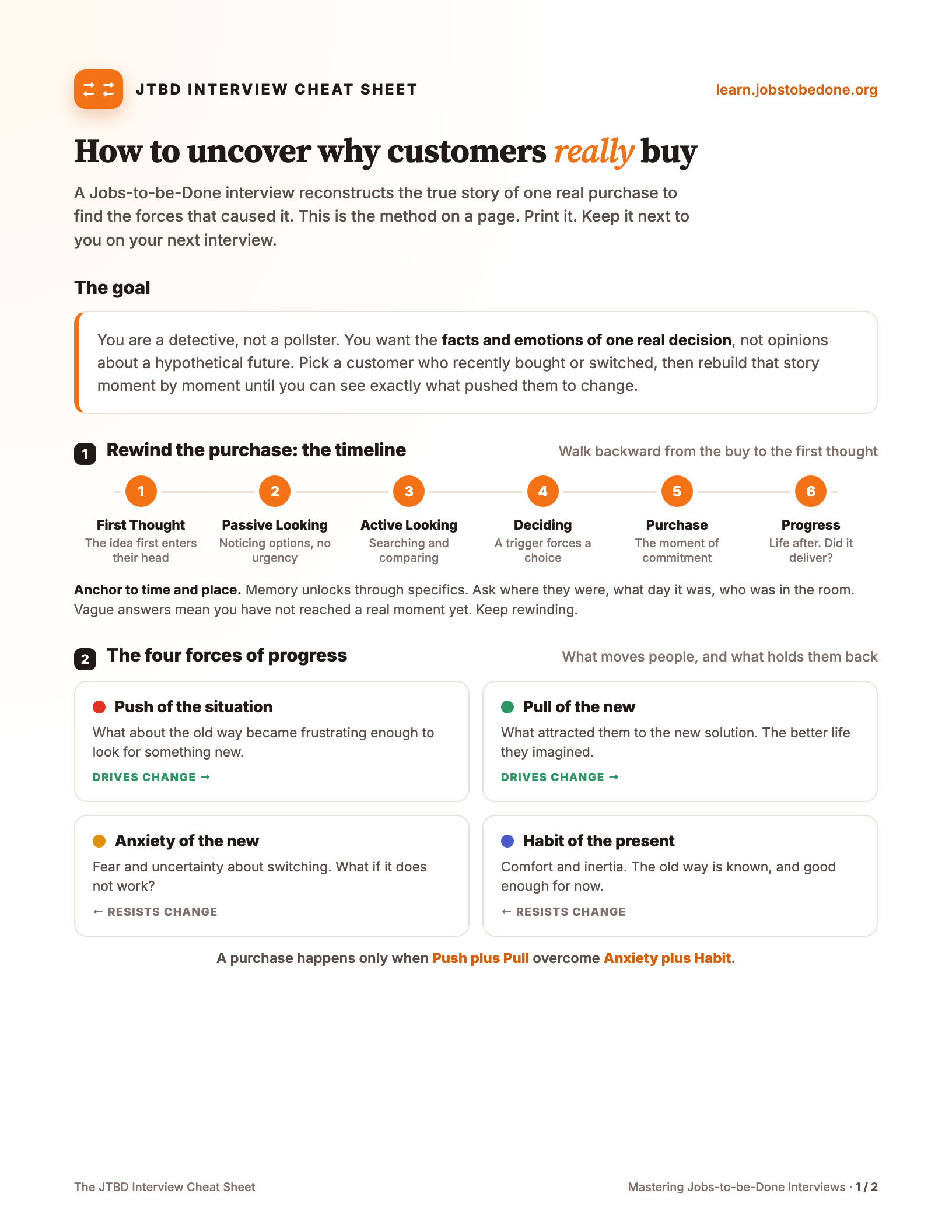
Treat the four forces as prompts for investigation, not as a formula that assigns numerical scores to feelings:
- Push: What happened that made the current arrangement less acceptable?
- Pull: What improvement did the buyer expect from an alternative?
- Anxiety: What did the buyer fear might happen if they chose it?
- Habit: What made the existing arrangement easier to keep?
For a B2B service buyer, the push might be difficulty explaining recent sales results; the pull might be a more dependable way to connect campaign work to commercial outcomes. Anxiety could concern disruption, unproven claims, or the ability to justify a new contract internally. Habit might be the established working relationship and the effort of briefing someone new. You cannot know which of these mattered most from the contract value or the final decision alone.
Perceived risk is specific to the buyer’s goal. It may concern money, performance, time, reputation, or the effort of switching. A buyer might also see risk in staying with the current option. Labeling every objection “price sensitivity” loses that distinction: “I can’t justify this cost without clearer evidence” points to a different concern from “We do not have the budget.”
Get from general opinions to a real decision
If you ask, “Would this offer appeal to you?” you invite a prediction. If you ask about a recent purchase, renewal, rejection, or switch, you have events to investigate. The aim is not to catch the buyer out; it is to understand what was happening when the choice became consequential.
The following portions of AltexSoft’s Customer Interviews for Product Discovery demonstrate open-ended questions, non-leading follow-ups, and attention to recent behavior.
Customer Interviews for Product Discovery
AltexSoft’s “Customer Interviews for Product Discovery” provides practical guidance for hearing a buyer’s account without supplying the answer for them.
Watch open questions for how to invite a full account and probe vague answers without suggesting a preferred response. Continue with recent behavior for why questions about what someone actually did are preferable to guesses about what they might do later.
A useful conversation can begin close to the decision and work backward: “Tell me about the last time you chose a provider.” Then locate the first sign that a change might be needed, what else the buyer considered, when comparison became serious, what nearly stopped the choice, and what happened afterward. Ask for concrete moments: “What had happened that week?” “What did you check before deciding?” “Who else needed to be comfortable with the decision?” These questions leave room for an answer you did not anticipate.
Follow-ups matter especially when a buyer gives a neat explanation. “We wanted better reporting” could mean they could not see which campaigns generated sales, could not trust the existing figures, or could not explain the figures to a decision-maker. Those possibilities imply different goals and risks. Ask what they needed the reporting to let them do, and what would have happened if it remained unchanged.
Interviews are not the only source. In a review, a passage such as “I ordered early because I couldn’t risk it arriving after the event” gives stronger evidence of a time-sensitive goal than a five-star rating does. In a sales call, “We tried a similar service last year and spent months getting access set up” identifies a possible implementation risk. Preserve the buyer’s wording and its context before translating it into a psychological interpretation.
Infer carefully: observation, interpretation, alternative
Qualitative evidence requires interpretation, but an interpretation should remain traceable to what someone said or did. Nielsen Norman Group’s article Analyze Qualitative Data: Thematic Analysis describes how to code passages, compare them, and assess whether an apparent theme fits the data.
Analyze Qualitative Data: Thematic Analysis - NN/G
Read Nielsen Norman Group’s “Analyze Qualitative Data: Thematic Analysis” to see how individual remarks become provisional codes and, with comparison, better-supported themes.
In “What Is a Thematic Analysis?”, read the definitions, ending at the two characteristics of a theme. In “Code Types: Descriptive and Interpretive,” read the code comparison, through the interview example’s interpretive-code rationale. In “Steps to Conduct a Thematic Analysis,” focus on “Step 3: Code the Text Based on What It’s About,” from the paragraph beginning “As you are coding” to the note that interpretive codes may become easier to assign later: initial coding. Then read “Step 4: Create New Codes that Encapsulate Potential Themes,” from “Look across all the codes” through its three guiding questions: candidate themes. Finish with “Step 6: Evaluate Your Themes for Good Fit,” from its opening advice about involving others through the three questions testing support: checking fit.
Suppose a prospect says in a sales call, “Our last provider reported plenty of leads, but the sales team spent weeks finding out which ones were real.” A descriptive code might be lead-quality verification. An interpretive code might be needs results that can withstand internal scrutiny. The latter is useful, but it is an inference: the prospect has not yet said that internal scrutiny is the chief reason for seeking change.
A compact record keeps those levels separate:
| Evidence | Plausible inference | What remains uncertain |
|---|---|---|
| “Sales spent weeks finding out which leads were real.” | The buyer may want more trustworthy lead qualification and less verification work. | Was the larger concern wasted staff time, unreliable reporting, or accountability for spend? |
| “We tried a similar service last year, and setup took months.” | Implementation time may be a perceived risk. | Is that risk still decisive, and what part of setup caused it? |
The next move is to look for confirming and disconfirming detail. Did the buyer describe a moment when questionable leads caused a decision to be delayed? Did they ask about setup before discussing price? Did another buyer with a similar complaint still choose the incumbent because changing systems felt riskier? Such differences may reveal distinct goals rather than noise to average away.
This is also why a theme should not be built from the most vivid quotation alone. Compare accounts within a comparable buying situation, include lost or undecided buyers where possible, and retain exceptions. Reviews disproportionately represent people motivated to post; sales calls contain objections shaped by a live negotiation; interviews rely on imperfect memory. None is a direct reading of the buyer’s mind. Together, they can strengthen or challenge an inference. If you use client call recordings or customer records, obtain appropriate permission and remove identifying details from analysis notes.
Turn an insight into a usable buyer diagnosis
A practical diagnosis can be written in one sentence:
In [specific situation], the buyer is trying to [desired outcome] while avoiding [feared consequence]; the current alternative remains attractive because [reason to stay].
For an ecommerce purchase, that might read: “Before an upcoming run, the buyer is trying to replace worn shoes in time while avoiding a poor fit and a difficult return; the familiar model remains attractive because they already know its sizing.” For a B2B service choice: “Facing a contract decision, the buyer is trying to produce sales results they can explain internally while avoiding an expensive, disruptive switch; the incumbent remains attractive because the team knows its process.”
These are working hypotheses, not ready-made campaign claims. Each should have supporting passages attached, plus a note about what would change your mind. A landing page emphasizing “fast setup” will miss the mark if the real concern is whether results are credible. Conversely, a detailed performance case study may not resolve a buyer’s worry that implementation will consume their team’s time. Better diagnosis precedes better messaging.
The strongest insight usually includes a trade-off. Buyers may want improvement but refuse a particular cost of obtaining it. Hearing that trade-off helps you distinguish a feature they like from a goal they will act on—and a vague hesitation from a risk they need resolved.
Key takeaways
Infer a buyer’s goal from the circumstance and outcome they are working toward, not merely the product they named. Identify perceived risks on both sides of a decision: what might go wrong if they change, and what they stand to lose if they do not. Ground each inference in specific qualitative evidence, keep it distinct from the buyer’s actual words, and test it against alternative explanations and other accounts.
Next, you’ll use these diagnoses to map the psychological steps between exposure, click, engagement, and purchase—without assuming that a buyer carries the same belief or concern through every stage.