Recommended resources
The freely available resources this lesson will direct you to.
Introduction
Welcome to the fifth module of our course. In the previous module, we built a comprehensive toolkit for engaging with your work by managing your external world. We covered designing your environment, using body-doubling, identifying your peak focus windows, and using work-rest intervals like the Pomodoro technique to sustain attention. These are powerful strategies for directing your focus.
However, as a CIO in a high-pressure environment, you know that even the most perfectly structured workday can be derailed not by an external distraction, but by an internal one: a wave of frustration from a project setback, a spike of anxiety after a critical email, or the general overwhelm that can build during a demanding day.
This brings us to our new focus: managing your internal state. This lesson directly addresses the learning outcome: Recognize the impact of emotional dysregulation on productivity and apply a technique to manage work-related frustration or anxiety. We will explore why individuals with ADHD often experience emotions more intensely, how this "emotional dysregulation" impacts productivity, and introduce a set of practical, evidence-based techniques to regain control in the moment.
Part 1: The "Why" Behind Intense Emotions in ADHD
A common but often misunderstood aspect of ADHD is its significant impact on emotional regulation. It’s not just about attention; it's also about the intensity and speed of emotional responses.
To start, let's turn to one of the world's leading experts on ADHD, Dr. Russell Barkley. He provides a foundational understanding of what he calls "emotional incontinence."
Emotional Dysregulation & ADHD
In this clip from 'Emotional Dysregulation & ADHD,' Dr. Barkley explains why emotional dysregulation is a core feature of ADHD, linking it directly to the brain's difficulties with inhibition and self-control.
Please watch from the beginning to 04:25. Pay close attention to his description of the four steps of emotional self-regulation and how ADHD disrupts each one.
Dr. Barkley's model shows that the issue isn't a lack of willpower, but a neurologically-based difficulty with the executive functions that manage emotions.
The Brain's "Gas Pedal" and "Brakes"
To build on this, let's look at the specific brain mechanisms involved. Your background in engineering and systems thinking will appreciate this more granular view. Emotional regulation involves a delicate balance between the brain's threat-detection system (the amygdala, or "gas pedal") and its rational, planning center (the prefrontal cortex, or "brakes"). In ADHD, this balance is often tipped.
The Neuroscience of ADHD and Emotional Dysregulation
The video 'The Neuroscience of ADHD and Emotional Dysregulation' from Therapy in a Nutshell offers an excellent analogy for what's happening in the brain.
Please watch from 00:52 to 04:27. This segment clearly explains the roles of the prefrontal cortex and the amygdala, the concept of 'short emotional latency,' and why emotions can feel like they 'flood the system' so quickly.
The Impact on Productivity: The "Shutdown Spiral"
When these intense emotional reactions occur at work, they can be incredibly disruptive. A single stressful email or minor piece of negative feedback can derail focus for hours. This phenomenon is sometimes called the "shutdown spiral."
Emotional Dysregulation & Overwhelm: The Shutdown Spiral
This article, 'Strategies to improve focus and organization ADHD at work,' clearly describes how emotional dysregulation manifests in a professional setting.
Please read the section titled 'Emotional Dysregulation & Overwhelm: The Shutdown Spiral.' As you read, reflect on whether these patterns—such as intense frustration, sensitivity to criticism, or rumination over small mistakes—resonate with your own experiences.
This spiral is a significant hidden cost of ADHD in the workplace, turning what should be a minor hiccup into a major productivity roadblock.
Part 2: A Framework for Intervention
Now that we understand the "what" and "why," we can move to the "how." How can we intervene when we feel an emotional storm brewing? Dr. Barkley provides a useful framework by breaking down an emotional response into five distinct stages. Understanding this sequence allows us to see the different points where we can apply a strategy.
Emotional Dysregulation & ADHD
Let's return to Dr. Barkley's video. He outlines a five-step model that acts as a roadmap for managing emotional responses.
Please watch from 08:06 to 10:25. Focus on the five steps: Situation, Provocative Event, Appraisal, Response, and Consequence. Think of this as a process flow diagram for an emotion.
This model shows us that we can intervene proactively (by changing the situation), in the moment (by changing our attention or appraisal), or reactively (by changing the consequences). For this lesson, we will focus on the most critical in-the-moment interventions: managing your attention and appraisal.
Part 3: In-the-Moment Techniques for Emotional Regulation
The goal of these techniques is not to suppress emotion, but to create enough space between the trigger and your reaction to allow your prefrontal cortex—your rational "brakes"—to come back online.
1. The Foundational Skill: The Pause
Every effective strategy begins with a pause. This is the single most important skill. It buys your brain the crucial seconds it needs.
A simple script can be powerful. Instead of reacting instantly in a meeting or on a Slack thread, you can use:
- "Let me take a moment to process that."
- "That's an interesting point. I need a minute to think it through."
This is the "Buffer Pause" in action, a technique for preventing impulsive communication when you feel an emotional spike.
2. The 3-Step Reset for Overwhelm
When you feel that wave of frustration or anxiety rising, you need a simple, discreet, and repeatable protocol. This technique from the Heal-Thrive article is designed for exactly that.
The 3-Step Reset for Overwhelm
This article offers an extremely practical and easy-to-remember technique that you can use at your desk without anyone noticing.
Please read the short section 'The 3-Step Reset for Overwhelm.' Commit these three steps to memory: Pause, Breathe, Refocus.
Let's break it down:
- Pause & Ground: Plant both feet on the floor. This brings your awareness back to your body (a practice known as interoceptive awareness).
- Breathe: The 4-in, 2-hold, 6-out pattern of paced breathing is important. A longer exhale activates the parasympathetic nervous system, which has a calming effect.
- Refocus: Ask yourself, "What is the very next, smallest step?" This shifts you from emotional overwhelm to concrete, manageable action.
3. The Physical Shift: Move a Muscle, Move a Thought
The ADHD brain is often tightly linked to the body. Sometimes, thinking your way out of an emotional state is ineffective. A physical change can be a much faster way to reset the system.
In the "Neuroscience of ADHD" video (at 23:25), the presenter introduces the mantra: "Move a muscle, move a thought."
This could mean:
- Getting up to get a glass of water.
- Walking to a different room for a minute.
- Doing a few simple stretches at your desk.
The act of physical movement helps to reintegrate the different parts of the brain and break the loop of emotional hyperfocus.
4. The Cognitive Reframe: Challenge the Appraisal
Remember Dr. Barkley's model? The "appraisal" stage is where your brain assigns meaning to an event. We can intervene here by consciously questioning our initial, automatic thoughts.
Let's say a colleague gives blunt feedback on your proposal.
- Automatic Thought (Amygdala): "They think my work is terrible. This is a disaster."
- Cognitive Reframe (Prefrontal Cortex):
- Name the emotion: "I am feeling defensive and anxious."
- Generate alternatives: "Is it possible they were just being direct and not personal? Could this feedback actually improve the project? Maybe they are having a stressful day."
This practice, drawn from Cognitive Behavioral Therapy (CBT), helps you shift from a catastrophic interpretation to a more balanced and realistic one.
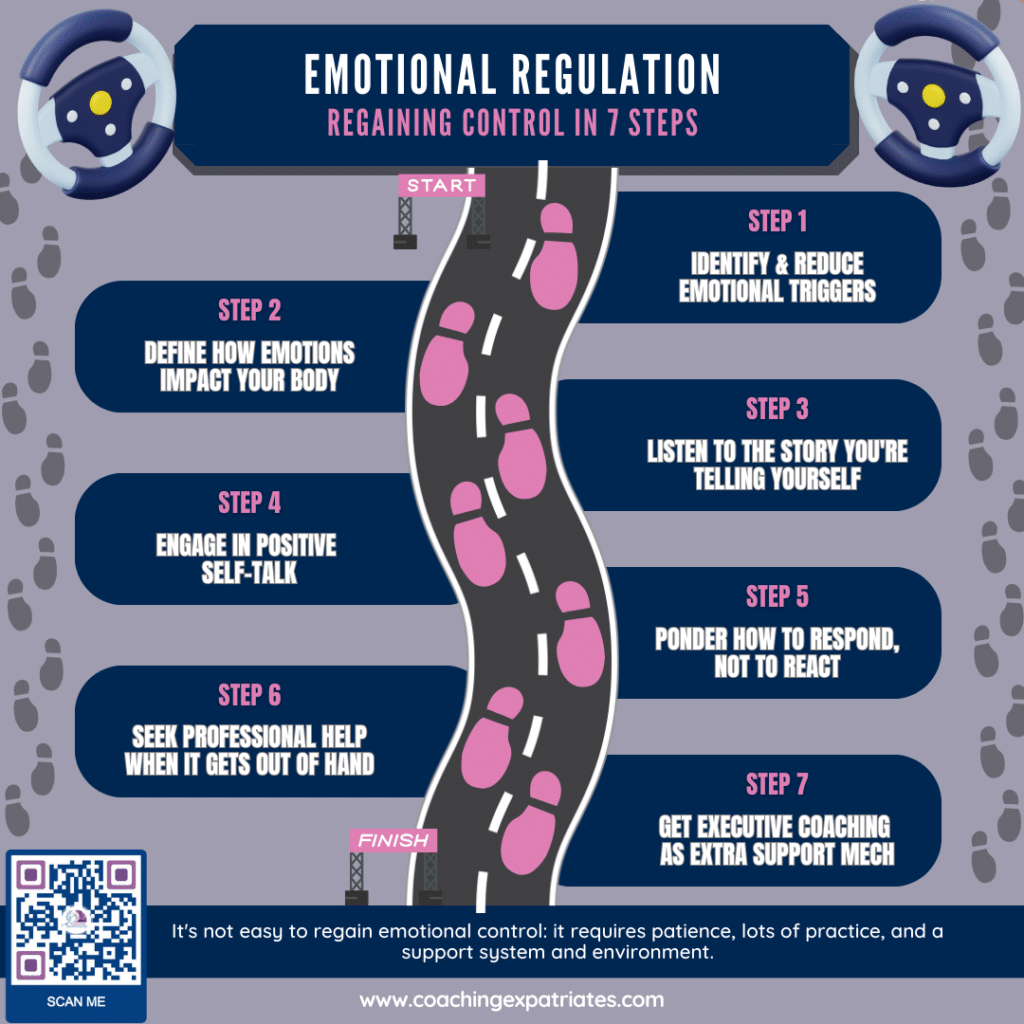
Your Action Plan: Build an "Emotional First-Aid Kit"
Theory is useful, but practice is what builds skill. Your task is to assemble a personalized "Emotional First-Aid Kit"—a short, written list of 2-3 go-to strategies you can use when you feel dysregulated at work. The client story of "David" in the Heal-Thrive article, who developed an "Emotional grounding plan," is a great real-world example of this.
Review the strategies below and choose the ones that feel most practical for you.

Instructions:
- Select 2-3 techniques from this lesson that you find most compelling. Examples include:
- The 3-Step Reset (Pause, Breathe, Refocus).
- The "Move a Muscle" rule (e.g., walk to the window).
- The Cognitive Reframe (list 2 alternative explanations for a negative event).
- A "Buffer Pause" script for emails/Slack ("Let me review this and get back to you.").
- A specific piece of music you can listen to for a 5-minute reset.
- Write them down on a sticky note for your monitor or in a digital note that's easily accessible. The key is to externalize the plan so you don't have to rely on your working memory during a stressful moment.
- For the next week, practice using one of these techniques the next time you notice a spike of work-related frustration or anxiety. The goal is not perfection, but simply to practice the act of pausing and choosing a deliberate response.
Conclusion
Today we've shifted our focus inward, exploring the critical and often challenging area of emotional regulation in ADHD. You've learned that experiencing intense emotions is not a personal failing but a neurological reality rooted in the structure of the ADHD brain. Most importantly, you now have a framework and a set of concrete, actionable tools to manage these emotions in the moment.
Key Takeaways:
- Emotional dysregulation is a core component of ADHD, stemming from difficulties with the executive functions that act as the brain's "brakes."
- In a high-pressure work environment, this can lead to a "shutdown spiral," where minor setbacks derail productivity for extended periods.
- You can intervene by creating a pause between an emotional trigger and your reaction.
- Simple, discreet techniques like the 3-Step Reset (Pause, Breathe, Refocus), a physical movement, or a quick cognitive reframe can help you regain control and allow your rational brain to come back online.
Preview of the Next Lesson:
Today we focused on managing acute, in-the-moment emotional spikes. But what happens when the pressure is sustained over time? The next lesson will build directly on this foundation by helping you to "Identify your personal signs of cognitive overwhelm and hyperfocus-induced burnout." We will explore how to recognize the more subtle, cumulative effects of mental and emotional exertion before they lead to complete exhaustion.