Recommended resources
The freely available resources this lesson will direct you to.
- What is a Pomodoro and How Can it Help with ADHD?www.youtube.com
- Why People with ADHD Procrastinate (And 4 Brain-Based Ways to Get Started)www.youtube.com
- Managing Distractions With The Pomodoro Technique For ADHDlifeskillsadvocate.com
- The Pomodoro Technique: Time Management for the ADHD Brainwww.adhder.net
Introduction
Welcome back. In our last lesson, you created a system to identify your personal peak focus windows by combining a physiological method (your body's temperature cycle) with subjective energy tracking. The goal was to align your most demanding work with your brain's natural rhythm. This answers the question of when to do your deep work.
Now, we shift our focus to how you can maintain focus and manage your energy within those critical work blocks. Simply scheduling the time is half the battle; sustaining attention through demanding tasks like portfolio analysis or strategic planning is the other half.
This lesson addresses the learning outcome: Apply the Pomodoro technique or similar work-rest intervals to manage focus on demanding tasks. We'll explore this popular time management strategy, understand the neuroscience that makes it particularly effective for the ADHD brain, and, most importantly, learn how to adapt it to fit your specific needs and the varied demands of your roles as a CIO, musician, and entrepreneur.
Part 1: What is the Pomodoro Technique and Why Does it Work?
At its core, the Pomodoro Technique is a system of working in focused, timed intervals separated by short, deliberate breaks. But why is this simple structure so powerful for managing ADHD? It directly addresses challenges with task initiation, sustained focus, and time perception.
Let's start with a quick, engaging overview from the "How to ADHD" channel.
What is a Pomodoro and How Can it Help with ADHD?
This video, 'What is a Pomodoro and How Can it Help with ADHD?', provides a clear and concise definition of the technique and immediately frames it within the context of ADHD-related challenges.
Please watch the first minute (00:00 - 01:06). Pay attention to the core definition of a 'pomodoro' and how it provides clear signals to start, stay focused, and take a break.
As the video highlights, the timer acts as an external cue to begin work, which helps overcome the "initiation friction" you've mentioned. It also provides a container for your focus: your only job is to work on the intended task until the timer goes off.
The Science of Timed Intervals
To satisfy your interest in the "why," let's connect this practical tool to the underlying neuroscience. The effectiveness of timers for the ADHD brain is rooted in the dopamine reward system.
Dr. Tracey Marks explains how creating urgency and challenge can help activate this system.
Why People with ADHD Procrastinate (And 4 Brain-Based Ways to Get Started)
In this clip from her video 'Why People with ADHD Procrastinate,' Dr. Marks explains how to manufacture the motivation that the ADHD brain often needs.
Please watch from 04:44 to 05:23 and then from 06:38 to 07:23. Notice how she connects using a timer to creating urgency and challenge, and then explicitly introduces the Pomodoro Technique as a system built on this principle.
The Pomodoro Technique essentially "gamifies" work. It introduces several elements that are highly motivating for the ADHD brain:
- Urgency: The countdown timer creates a deadline.
- Challenge: "Can I stay focused for this one interval?"
- Novelty: The regular switch between work and rest breaks up the monotony of a long task.
- Reward: The completion of an interval and the subsequent break provide a small, frequent dopamine hit, reinforcing the effort.
For a deeper look at the evidence and the specific neurobiological benefits, the following article provides an excellent summary.
The Pomodoro Technique: Time Management for the ADHD Brain
The article 'The Pomodoro Technique: Time Management for the ADHD Brain' from ADHDEr.net synthesizes research on why this method is so effective.
Please read the sections 'The Science Behind Why It Works for ADHD' and 'Neurobiological Benefits.' Focus on how the technique addresses 'time blindness' and supports dopamine regulation, working memory, and stress reduction.
Part 2: Implementing the Pomodoro Technique
Now that we understand the principles, let's look at the mechanics. The "classic" Pomodoro method, as developed by Francesco Cirillo, follows a simple structure.
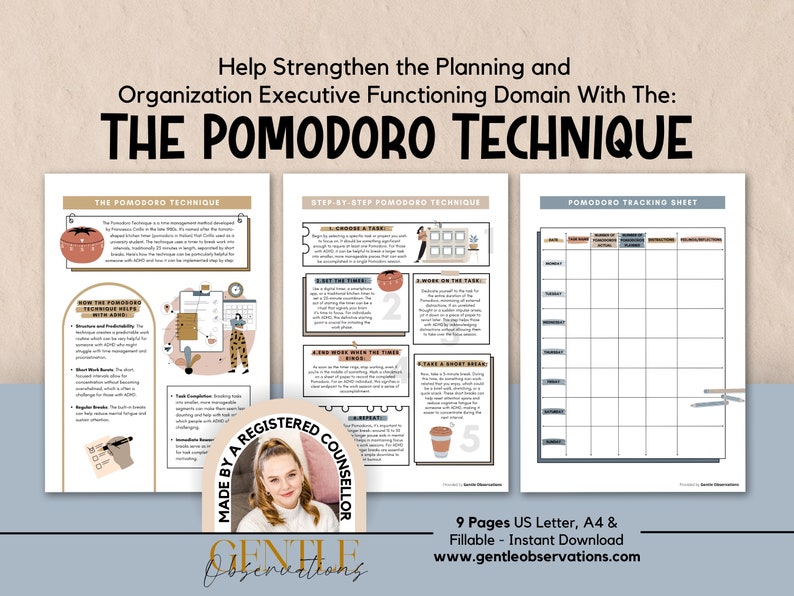
The traditional steps are:
- Choose a task.
- Set a timer for 25 minutes. This focused work interval is one "Pomodoro."
- Work on the task without interruption until the timer rings.
- Take a short break (usually 5 minutes).
- Repeat the cycle.
- After four Pomodoros, take a longer break (15-30 minutes).
This is the starting template. However, as with any tool, its true power lies in adapting it to your specific needs.
Part 3: Personalizing the Pomodoro Technique
A rigid 25/5 structure may not be optimal for every person or every task. Your work as a CIO involves a mix of activities—from quick administrative tasks to deep, complex problem-solving. A musician's creative session has different demands from a financial analysis. Personalization is therefore essential for making this technique sustainable.
The article "Managing Distractions With The Pomodoro Technique For ADHD" provides excellent, practical guidance on how to make these adjustments.
Managing Distractions With The Pomodoro Technique For ADHD
This article from Life Skills Advocate is a treasure trove of practical tips for adapting the Pomodoro technique. We'll use it to explore customization.
First, read the section 'How do you choose the right Pomodoro interval for ADHD?'. Pay close attention to the table that offers suggestions based on common challenges. Then, read 'What should you do during Pomodoro breaks if you have ADHD?' and 'How do you handle distractions and interruptions during a Pomodoro?'. These sections provide concrete strategies for common failure points.
Let's summarize and build on these key areas of personalization:
1. Customizing Your Intervals
The 25/5 ratio is a suggestion, not a rule.
- For tasks with high initiation friction: Start with shorter intervals (e.g., 10-15 minutes) to make the barrier to entry as low as possible.
- For deep analytical work: Once you're in a state of flow, you might prefer longer intervals (e.g., 45-50 minutes) to avoid being pulled out of your concentration. The key is to find a rhythm that feels challenging but not draining.
- The "Wrap-up Buffer": As the article suggests, giving yourself a 2-minute buffer when the timer ends allows you to finish your thought or jot down the next step, making the transition smoother and less jarring.
2. Choosing the Right Tasks
Pomodoro is not a universal solution. It's most effective for certain types of work.
- High Effectiveness: Administrative tasks, email management, reading technical documents, and project planning. These tasks require sustained attention but are easily broken down.
- Moderate Effectiveness: Programming, data analysis, or writing. The time pressure can sometimes enhance focus, but it can also interrupt complex thought processes.
- Challenging: Deep creative work (like music composition) or high-stakes problem-solving that requires building a complex mental model over an extended period. Interruptions here can be very costly.
3. Managing Breaks and Distractions
- Productive Breaks: Your break should be a reset, not another rabbit hole. Get up, stretch, get water, or look out a window. Avoid scrolling on your phone, as apps are designed to capture your attention and make it hard to return to work.
- The "Parking Lot": When an unrelated thought or task pops into your head during a Pomodoro, don't act on it. Quickly write it down on a "parking lot" pad of paper or in a digital note to deal with later. This acknowledges the thought without derailing your focus.
- Handling External Interruptions: As a CIO, interruptions are inevitable. Use clear, brief scripts like: "I'm in a focus block for the next 15 minutes. Can I get back to you at 3:30?" This respects the other person while protecting your time.
Part 4: The Hyperfocus Challenge and Alternatives
One of the most common concerns with the Pomodoro technique is that the timer will interrupt a valuable state of hyperfocus. For tasks that benefit from this deep immersion, such as debugging complex code or getting lost in a musical arrangement, a strict timer can be counterproductive.
Strategy: Treat the timer as a check-in, not a hard stop. When it goes off, ask yourself: "Is this a good moment to pause, or is my momentum too valuable to break?" If you're in a deep flow state, you can choose to reset the timer and continue.
An Alternative: The Flowtime Technique
For tasks where Pomodoro feels too rigid, the Flowtime technique offers a more flexible alternative. Instead of pre-defined intervals, you work on a task for as long as you can maintain focus, then record the time and take a break. This method honors your natural concentration cycles.

Consider using a hybrid approach:
- Pomodoro for structured, administrative, or less-engaging tasks.
- Flowtime for creative, strategic, or deep problem-solving work.
Your Action Plan: A Two-Day Pomodoro Experiment
To put this into practice, let's design a small experiment to run over the next two days.
-
Day 1: Structured Task
- Select a Task: Choose a task from your workload that fits the "High Effectiveness" category (e.g., clearing your inbox, planning your week, reviewing a standard report).
- Schedule It: Block out a 90-minute session in your calendar, preferably during one of the peak focus windows you identified last week.
- Run the Experiment: Use a starting interval of 20 minutes of work and 4 minutes of break. Use a physical or simple digital timer.
- Complete 3-4 cycles. During the breaks, physically get up and move away from your desk.
.
-
Day 2: Moderately-Complex Task
- Select a Task: Choose a task that requires more thought but can still be broken down (e.g., drafting a memo, researching a new investment, debugging a part of a mixing project).
- Schedule It: Again, block out a 90-minute session.
- Run the Experiment: This time, try a longer interval of 40 minutes of work and 8 minutes of break. Use the "wrap-up buffer" concept: when the timer goes off, give yourself 1-2 minutes to finish your sentence or note your next step.
- Complete 2 cycles.
-
Reflect: At the end of each day, ask yourself:
- How difficult was it to start the first interval?
- How easy was it to get back to work after a break?
- Did the interval length feel too short, too long, or just right for the task?
- What distractions came up, and how did I handle them?
This experiment isn't about perfect execution; it's about collecting data on what works for you.
Conclusion
Today, we've deconstructed the Pomodoro technique, moving from its basic definition to the nuanced art of personalizing it for the ADHD brain. You now have a powerful tool for structuring your work sessions to improve initiation, sustain focus, and manage your cognitive energy.
Key Takeaways:
- The "Why": The Pomodoro technique works by creating urgency, providing regular dopamine-based rewards, and giving your prefrontal cortex planned resets, which directly supports the ADHD brain's executive functions.
- Start with the Classic, then Adapt: Use the 25/5 model as a starting point, but don't hesitate to customize intervals based on the task and your energy levels.
- One Size Doesn't Fit All: Match the technique to the task. Use structured Pomodoros for routine work and consider more flexible approaches like Flowtime for deep, creative thinking.
- Breaks are Non-Negotiable: The breaks are as important as the work sprints. Use them to reset physically and mentally, and be mindful of "break-traps" like social media.
Preview of the Next Module:
You now have a robust toolkit for managing your external world: your physical environment (Lesson 4.1), your social context (Lesson 4.2), your energy rhythms (Lesson 4.3), and your moment-to-moment focus (this lesson).
In our next module, "Managing Energy and Emotional State," we will turn our attention inward. Even with the best systems, productivity can be derailed by internal factors like frustration, anxiety, or overwhelm. Our next lesson will focus on recognizing the impact of emotional dysregulation and applying techniques to manage it effectively in a professional context.