Recommended resources
The freely available resources this lesson will direct you to.
- Healthy Habits for Adults with ADHD: How to Make Meaningful Changes Stick (w/ Michele Novotni, PhD)www.youtube.com
- How Atomic Habits Changed my Life Forever with ADHDwww.youtube.com
- Habit Stacking: A Simple Way To Build Consistent Routineslifeskillsadvocate.com
- ADHD and visual cues: How to build habits that stick - Tiimo Appwww.tiimoapp.com
Introduction
Welcome back! In our last lesson, we built a crucial reactive tool: a personalized 'reset protocol' to pull you out of moments of overwhelm and burnout. Think of it as your emergency response system. You now have a pre-defined procedure to stabilize, externalize, and triage when your cognitive resources are maxed out.
Today, we shift from defense to offense. A good system isn't just about managing crises; it's about designing your life to prevent them. This lesson focuses on building the proactive, sustainable infrastructure for your daily routines. Our learning outcome is to design and implement habit stacks by linking new desired behaviors to existing routines.
Instead of relying on willpower or memory—both of which are finite resources, especially for the ADHD brain—you will learn to engineer behavioral chains that run on autopilot. This is how we build consistency and reduce the daily friction that leads to overwhelm in the first place.
Part 1: Why Habits are Your Most Valuable Asset
As a CIO and engineer, you're constantly managing complex systems and allocating limited resources for maximum output. Your brain's executive function works in a similar way. It has a finite daily budget of energy for decision-making, planning, and task initiation. For people with ADHD, this budget is often smaller and consumed more quickly.
A useful metaphor for this is the "Spoon Theory." To understand why automating routines is so critical, let's hear Dr. Michele Novotni explain this concept.
Healthy Habits for Adults with ADHD: How to Make Meaningful Changes Stick (w/ Michele Novotni, PhD)
In this segment from 'Healthy Habits for Adults with ADHD,' Dr. Novotni introduces the 'Spoon Theory' as a way to conceptualize the mental energy required for tasks. She explains why turning behaviors into habits is a powerful strategy to conserve this energy.
Please watch from 02:53 to 07:50. As you watch, focus on the core ideas: The Concept of 'Spoons': How it represents your daily units of focused mental energy. The Double Whammy for ADHD: Starting with fewer spoons and having tasks cost more spoons. The Benefit of Habits: How automating a task drastically reduces its 'spoon cost,' freeing up cognitive resources for more important work.
The key takeaway is that every decision you avoid making about a routine task (e.g., "What should I do first?" "Where are my keys?") saves you "spoons." By turning essential behaviors into habits, you're not being rigid; you're being efficient. You are automating the mundane to free up your high-level cognitive capacity for the work that truly matters—strategic planning, creative problem-solving, and leading your team.
Part 2: The Engineering of Habit Stacking
Habit stacking is a technique popularized by James Clear in his book Atomic Habits. It's a simple but powerful method for engineering new behaviors into your life. The core principle is to anchor a new habit you want to build onto a pre-existing habit that is already automatic.
The formula is simple:
After/Before [Current Habit], I will [New Habit].
This works by leveraging the existing neural pathways of your established routines. The current habit acts as a reliable trigger, or "cue," for the new one, removing the need to remember to do it.
To explore this concept further, let's look at two resources. First, a concise article that lays out the science and the structure.
Habit Stacking: A Simple Way To Build Consistent Routines
This article, 'Habit Stacking: A Simple Way To Build Consistent Routines,' provides a clear definition, the core formula, and a brief explanation of the neuroscience behind why it's so effective.
Please read the sections 'What is Habit Stacking?', 'The Science of Habit Formation', and 'Setting Up Habit Stacking'. This will give you a solid theoretical foundation for the technique.
Now, let's see how this plays out in a real-world context for someone with ADHD.
How Atomic Habits Changed my Life Forever with ADHD
In 'How Atomic Habits Changed my Life Forever with ADHD,' the creator shares his personal experience applying these principles. This clip focuses specifically on habit stacking and a related concept, 'temptation bundling.'
Please watch from 08:17 to 10:41. Notice how he chains multiple habits together (sitting at desk → taking vitamins/drinking water) and uses his rest intervals (from the Pomodoro technique) as an anchor for another habit (praying).
As you can see, the power of this method lies in its simplicity and its use of momentum. You are not starting from a dead stop; you are inserting a new action into a sequence that is already in motion.
Part 3: Your Action Plan: Designing Your First Habit Stacks
Now, let's move from theory to practice. We'll follow a structured process to design and implement your first habit stacks.
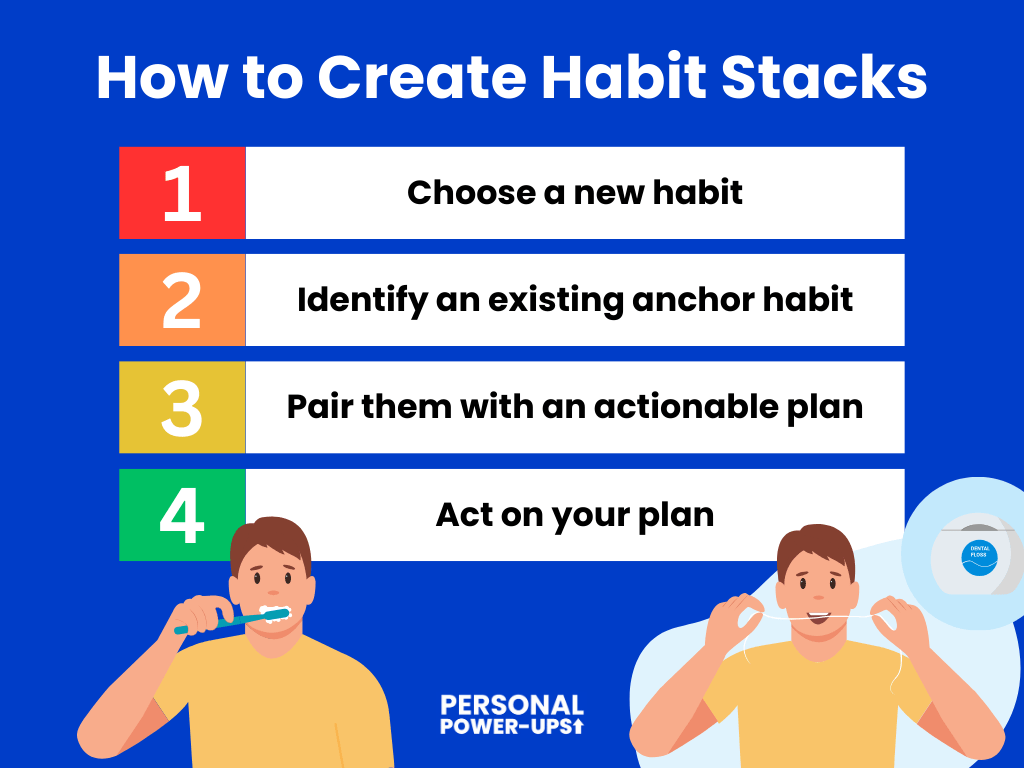
Step 1: Identify Your "Anchor" Habits
Before you can stack a new habit, you need a solid foundation. Take a moment to list some of your existing, highly consistent daily habits. These are your anchors. Don't judge them as "good" or "bad"; just focus on what is automatic.
Common anchors include:
- Waking up / Turning off your alarm
- Making coffee or tea
- Brushing your teeth
- Eating lunch
- Commuting to/from work
- Closing your laptop at the end of the day
- Getting into bed
Step 2: Choose a Small New Habit
The key to success is to start small—ridiculously small. The goal is not to transform your life overnight but to build a chain that doesn't break. A new habit should take less than two minutes to complete.
Examples of small habits:
- Doing five push-ups
- Taking your vitamins
- Wiping down one kitchen counter
- Writing down your top priority for the next day
- Putting your keys and wallet in a designated tray
- Reading one page of a book
- Doing 60 seconds of stretching
Step 3: Create and Refine Your Stacks
Now, combine your anchor and your new habit using the formula. Write it down. The physical act of writing reinforces the intention.
Here are some examples tailored for a busy professional:
- Morning Stack: After I pour my first cup of coffee, I will review my calendar for the day.
- Workday Start Stack: After I sit down at my desk, I will write down my #1 most important task for the day.
- Workday End Stack: After I close my laptop, I will clear my desk of any clutter.
- Evening Stack: After I brush my teeth, I will lay out my clothes for tomorrow.
Choose one or two stacks to begin with. Trying to implement too many at once is a common pitfall.
Step 4: Enhance Your Stack with Environmental Cues
To make your new habit even more foolproof, design your environment to make it obvious. This directly addresses the "initiation friction" you're looking to solve. Don't rely on memory; make the next action impossible to miss.
ADHD and visual cues: How to build habits that stick
The article 'ADHD and visual cues' provides an excellent deep-dive into why environmental design is so powerful for the ADHD brain and offers practical strategies.
Please read the sections 'The science behind effective cues,' 'Visual strategies that build lasting habits,' and 'Building chains that reinforce themselves.' Focus on how visual cues bypass executive function demands and how you can apply these strategies (like object positioning) to your own habit stacks.
Practical Application:
- If your stack is "After coffee, I will take my vitamins," put the vitamin bottle right next to the coffee maker.
- If your stack is "After closing my laptop, I will clear my desk," keep a small basket on your desk to quickly collect stray items.
- If your stack is "After brushing my teeth, I will read one page," put the book on your pillow.
This environmental design is not a sign of weakness; it's a mark of a smart system builder. You are creating a physical reality that cues the behavior you want, reducing the cognitive load to near zero.
Part 4: Troubleshooting and Iteration
No system is perfect from the start. Just as in engineering or portfolio management, you must plan for setbacks and iterate.
Dr. Novotni offers some crucial advice on this.
Healthy Habits for Adults with ADHD: How to Make Meaningful Changes Stick (w/ Michele Novotni, PhD)
Let's return to Dr. Novotni's talk for guidance on implementation. She discusses how long it can take for habits to form and the importance of planning for setbacks without self-criticism.
Please watch from 30:42 to 34:32. Pay attention to the realistic timeframe for habit formation (up to 90 days) and the advice to 'plan for the setbacks, not if a setback hits.'
When your habit stack fails (and it will), don't see it as a personal failure. See it as a data point. Ask:
- Was the new habit too big? (Make it smaller.)
- Was the anchor habit not reliable enough? (Choose a different anchor.)
- Was the cue not obvious enough? (Make it bigger, brighter, or move it.)
- Did I try to do too much at once? (Focus on only one new stack for a week.)
This is an iterative process of refinement, not a one-time setup.
Conclusion
Today, we've explored a powerful, proactive strategy for building sustainable systems. You've learned how to design and implement habit stacks by linking new behaviors to established routines, effectively "hijacking" the momentum of your existing habits.
Key Takeaways:
- Habits Conserve Energy: Automating routines with habits dramatically reduces the daily "spoon cost," freeing up your executive functions for high-value tasks.
- The Habit Stack Formula: The simple
After [Current Habit], I will [New Habit]structure is the key to engineering new behaviors. - Start Small and Be Obvious: The most successful new habits are small (under 2 minutes) and are supported by unmissable environmental cues.
- Iterate, Don't Berate: Treat missed days as data for system improvement, not as personal failures. Adjust the variables and try again.
Preview of the Next Lesson:
You've now learned to design the internal mechanics of a habit. But what happens when motivation dips, especially in the early stages before a habit is automatic? In our next lesson, we will address this by focusing on how to establish an external accountability system (e.g., with a partner, app, or coach) to support motivation and follow-through. This external layer of support can be the critical factor that ensures your new habits survive long enough to become permanent.