Recommended resources
The freely available resources this lesson will direct you to.
- Wigner–Eckart Theorem | Clebsch-Gordan & Spherical Tensor Operatorswww.youtube.com
- L13.3 Einstein's B and A coefficients determined. Lifetimes and selection ruleswww.youtube.com
- [PDF] The Wigner-Eckart Theorem - University of California, Berkeleybohr.physics.berkeley.edu
- 8. Atoms in Electromagnetic Fieldswww.damtp.cam.ac.uk
Hello! Welcome to the final lesson in our module on symmetries and conservation laws.
In our last lesson, we developed a powerful toolkit based on group representation theory to classify eigenstates and simplify Hamiltonians. We saw how constructing symmetry-adapted basis functions allows us to block-diagonalize the Hamiltonian, turning a complex problem into a set of smaller, manageable ones. We essentially used symmetry to understand the static properties of a quantum system—its energy levels and wavefunctions.
Today, we shift our focus from the static to the dynamic. We will investigate how quantum systems transition between these energy levels when perturbed by an external field, like light. Our goal is to derive selection rules for electromagnetic transitions using symmetry arguments. You will learn why certain transitions are "allowed" while others are "forbidden," a fundamental concept that underpins all of spectroscopy.
The core principle is an elegant extension of what we learned last time. A transition from an initial state to a final state is driven by an interaction operator . The probability of this transition depends on the magnitude of the matrix element . We will see that group theory provides a definitive answer to the question: under what conditions is this integral guaranteed to be zero?
1. The Physics of Transitions: A Quick Refresher
Before we apply our symmetry tools, let's briefly recall the physical context from time-dependent perturbation theory. When an atom interacts with a classical electromagnetic wave, the dominant interaction is usually the coupling of the atom's electric dipole moment to the electric field of the light.
The rate of transitions is given by Fermi's Golden Rule, which depends on the square of a matrix element. The key quantity that determines whether a transition can occur is the transition dipole moment, , where is the electric dipole operator. If this matrix element is zero, the transition is "dipole-forbidden".
The following video provides a great review of how this matrix element arises from the theory of absorption and emission, and it introduces the specific selection rules for the hydrogen atom.
L13.3 Einstein's B and A coefficients determined. Lifetimes and selection rules
This video from MIT OpenCourseWare links the phenomenological Einstein A and B coefficients to the quantum mechanical matrix element we need to calculate. It then states the well-known selection rules that we are about to derive.
Please watch from 8:01 to 13:56. Pay attention to: How the transition rate depends on the matrix element (\langle \psi_f | \vec{d} | \psi_i angle). The statement of the selection rules for electric dipole transitions: \Delta m = 0, \pm 1 and \Delta l = \pm 1. The application of these rules to the energy levels of the hydrogen atom, explaining why, for instance, a 2s to 1s transition is forbidden.
Now that we have the physical context, let's derive these rules from first principles using symmetry.
2. The General Selection Rule from Group Theory
In the previous lesson, we saw that the Hamiltonian matrix element is zero unless the representations and are the same. This happened because the Hamiltonian operator is invariant under all symmetry operations of the group, meaning it belongs to the totally symmetric representation ( or ).
The transition operator (like the dipole operator ) is generally not totally symmetric. The selection rule for the matrix element is therefore more general. For the integral over all space not to vanish, the integrand itself, , must contain a component that is totally symmetric.
This leads to the fundamental selection rule: The matrix element can be non-zero only if the direct product of the representations of its components, , contains the totally symmetric representation.
An equivalent and often more practical way to state this is:
A transition from to is allowed only if the representation of the final state, , is contained within the direct product of the representations of the operator and the initial state, .
3. Application to Electric Dipole Transitions
Let's apply this master rule. For an electric dipole transition, the operator is the position vector , which transforms as a vector. We need to know the irreducible representations spanned by its components . These are usually listed in the basis function columns of character tables.
3.1 Parity and the Laporte Rule
The most immediate consequence comes from inversion symmetry. For systems with a center of inversion (centrosymmetric groups), all basis functions have a definite parity: either gerade (g, even) or ungerade (u, odd) under inversion.
- The position vector is inherently odd: . It has ungerade parity.
- The wavefunctions and also have definite parity.
- The integrand is . For its integral over all space to be non-zero, the integrand itself must be even under inversion.
- The parity of the integrand is . Since is 'u', the product must also be 'u'. This is only possible if and have opposite parity.
This gives the famous Laporte selection rule: Electric dipole transitions are only allowed between states of opposite parity.
Since atomic orbitals with angular momentum have parity , this immediately implies that must be odd, which is consistent with the rule.
3.2 Angular Momentum Selection Rules
The selection rules for the quantum numbers and arise from rotational symmetry. A concise way to derive them, given your physics background, is by using commutation relations.
Atoms in Electromagnetic Fields
The following notes from David Tong's lecture on 'Atoms in Electromagnetic Fields' provide a clear, physicist-friendly derivation of the selection rules without immediately invoking the full Wigner-Eckart theorem.
Please read the subsection '8.3.3 Selection Rules' (pages 239-240). Follow the arguments: Parity: It starts by reiterating the parity selection rule we just discussed. Spin: It makes the simple but important point that since \vec{r} doesn't act on spin, \Delta s = \Delta m_s = 0. \Delta m rule: See how the commutation relation [L_z, z] = 0 immediately leads to \Delta m = 0 for light polarized along the z-axis. Similarly, [L_z, x \pm iy] = \pm\hbar(x \pm iy) leads to \Delta m = \pm 1 for circularly polarized light. \Delta l rule: The derivation for \Delta l = \pm 1 using the nested commutator [L^2, [L^2, \vec{x}]] is a bit of an algebraic trick, but it elegantly shows the result without needing more advanced machinery.
4. A More Powerful Approach: The Wigner-Eckart Theorem
The derivation using commutation relations is effective, but as the text mentions, it feels "a little like a trick." A more systematic and profound approach uses the Wigner-Eckart Theorem, which formalizes the connection between matrix elements and the conservation of angular momentum.
The theorem's power lies in classifying operators by how they transform under rotations. An operator that transforms like the spherical harmonics is called an irreducible tensor operator of rank . The dipole operator is a vector, which transforms like the spherical harmonics, making it a rank-1 tensor operator, .
The Wigner-Eckart theorem states that the matrix element of a tensor operator is a product of two terms: a physical part that is independent of orientation (the reduced matrix element) and a geometrical part that contains all the information about orientation and is given by a Clebsch-Gordan coefficient.
All the selection rules are now encoded in the Clebsch-Gordan coefficient , which you know from adding angular momenta.
Wigner–Eckart Theorem | Clebsch-Gordan & Spherical Tensor Operators
This video gives a concise and visual introduction to the Wigner-Eckart theorem, explaining its components and demonstrating its use in a practical example.
Please watch the full video (around 10 minutes). It will clarify: What spherical tensor operators are and how the dipole operator fits in. How the theorem separates a complicated matrix element into a single 'reduced' element and a set of universal Clebsch-Gordan coefficients. The practical steps of applying the theorem to find transition amplitudes.
Now let's see the formal application of this theorem to derive our selection rules.
These notes from U.C. Berkeley provide a formal statement of the Wigner-Eckart theorem and directly apply it to the problem of dipole radiative transitions, which is exactly our goal.
Please read the following two sections: Section 3: An Application of the Spherical Basis (pages 3-4): This section shows how expressing the position operator \vec{x} in the spherical basis (related to Y_{1q}) naturally connects it to angular momentum l=1 and simplifies the transition matrix element into a radial integral and an angular integral involving a Clebsch-Gordan coefficient. Section 7: Statement and Applications of the Wigner-Eckart Theorem (pages 11-13): Focus on the formal statement of the theorem and, most importantly, the part titled 'Probably the most useful application...'. This part explicitly states how the selection rules for the matrix element follow directly from the selection rules of the Clebsch-Gordan coefficient: m' = m+q and |j-k| \le j' \le j+k.
Let's summarize the Wigner-Eckart derivation for electric dipole transitions:
- The operator is a rank-1 tensor operator (). Its components can be written as linear combinations of with .
- From the Clebsch-Gordan coefficient , we have the selection rule on magnetic quantum numbers: . Since , this immediately gives .
- The triangle inequality from the Clebsch-Gordan coefficient requires , which means .
- We combine this with the Laporte rule (parity), which requires to be odd. This eliminates the case.
- Thus, the complete set of selection rules for electric dipole transitions is: and .
Test your understanding!
A nucleus is in a state with total angular momentum . Can it undergo an electric quadrupole transition?
(Hint: An electric quadrupole transition is mediated by a rank-2 tensor operator, . Use the selection rules from the Wigner-Eckart theorem.)
Show answer
No, it cannot.
For a rank-2 tensor operator, the triangle inequality from the Clebsch-Gordan coefficient requires .
Here, and .
If the nucleus decays, its final state must satisfy , which means . The initial state has . A transition requires two distinct states, so we are looking for a transition from a state to some other state . The rule states what could be.
However, the Wigner-Eckart theorem applies to a single matrix element . A more fundamental limitation comes from considering the operator itself acting on the state space. As discussed in Problem 2a of the Berkeley notes, the maximum rank of an irreducible tensor operator that can be constructed from the angular momentum operators within a space of dimension is .
For a system, the space is 2-dimensional. The maximum rank of a tensor operator you can construct is . You can have scalar () and vector () operators, but not quadrupole () or higher multipole moments. The matrix elements of any rank-2 operator between any two states within the manifold must be zero. Therefore, a nucleus with spin has no electric quadrupole moment and cannot undergo such a transition.
5. Other Transition Types
Electric dipole transitions are usually the strongest, but when they are forbidden, other, weaker interactions become important. The selection rules are different because the operator is different.
- Magnetic Dipole Transitions: The operator is the magnetic moment . This is a pseudovector (or axial vector), which is even under parity. This flips the Laporte rule: magnetic dipole transitions occur between states of the same parity (). This means .
- Electric Quadrupole Transitions: The operator is a rank-2 tensor which is even under parity. The selection rules are (with forbidden).
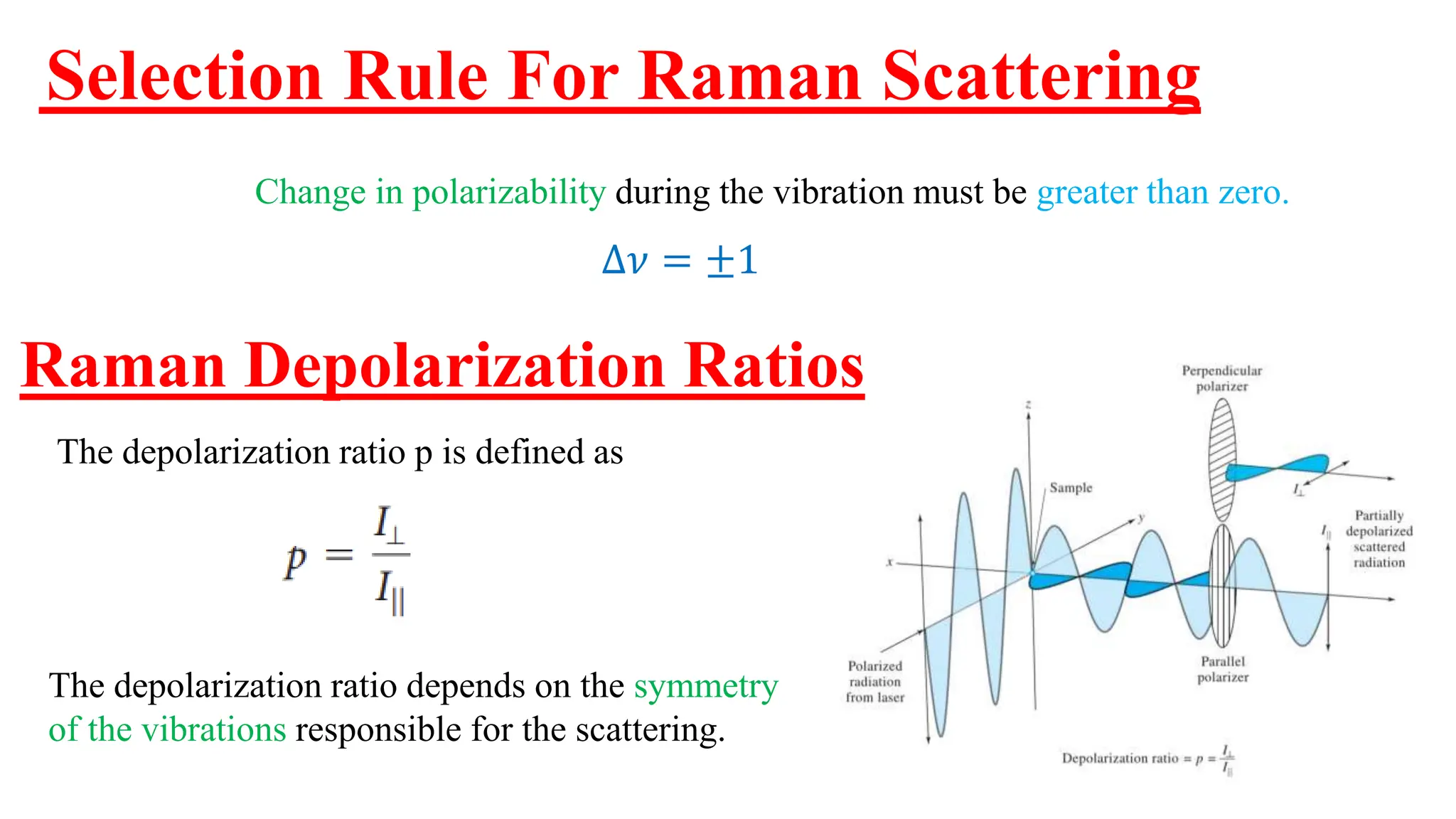
- Two-Photon Processes (e.g., Raman Scattering): These involve a virtual intermediate state. The selection rules depend on the polarizability operator, which is a rank-0 and rank-2 tensor. This leads to a rule.
Atoms in Electromagnetic Fields
Let's return to the Tong notes for a brief discussion of magnetic dipole transitions, which highlights the crucial role of parity.
Read the short section 'Magnetic Dipole Transitions' on page 241. Note how the fact that the magnetic moment operator \mu is parity even immediately leads to a different selection rule compared to the electric dipole case.
Conclusion
In this lesson, we have connected the abstract framework of group theory to the concrete, measurable phenomenon of spectroscopic transitions. By analyzing the symmetry of the states and the operator that connects them, we can predict which transitions are possible.
Key Takeaways:
- A transition between states and is governed by the matrix element .
- The general selection rule is that the direct product must contain the totally symmetric representation.
- For electric dipole transitions, the operator has odd parity and is a rank-1 tensor. This leads to two main sets of rules:
- Laporte Rule (Parity): Transitions only occur between states of opposite parity ().
- Angular Momentum Rule: and .
- The Wigner-Eckart theorem provides the most elegant and general derivation of the angular momentum rules, encoding them in the properties of Clebsch-Gordan coefficients.
- Other interactions, like magnetic dipole or Raman scattering, involve different operators with different symmetries, and therefore have different selection rules.
Preview of the next lesson:
This lesson concludes our first module on Symmetries. The Wigner-Eckart theorem has given us a glimpse into the power of angular momentum algebra. In our next module, "Advanced Angular Momentum and Spin," we will dive deeper into this topic. The first lesson will be to "Derive the general theory of angular momentum from commutation relations and determine the eigenvalue spectrum," establishing the formal algebraic foundation that underpins everything from spin rotations to tensor operators.