Recommended resources
The freely available resources this lesson will direct you to.
Hello! Welcome to your next lesson on symmetries in quantum mechanics.
In our previous lesson, we established a deep and powerful principle: the degeneracies in a quantum system's energy spectrum are dictated by the symmetries of its Hamiltonian. We learned that degenerate eigenstates form multiplets, and each multiplet serves as a basis for an irreducible representation (irrep) of the system's symmetry group. The dimension of the irrep directly gives the degree of the degeneracy.
Today, we transition from the "what" and "why" to the "how." This lesson is designed to equip you with the practical tools of group representation theory to achieve two main goals, which are central to your learning outcome: Apply group representation theory to label degenerate eigenstates and block-diagonalize a Hamiltonian.
You will learn how to:
- Use character tables, the compact summaries of a group's symmetries, to decompose any set of basis states into their fundamental irreducible components.
- Employ projection operators to construct new basis functions—often called symmetry-adapted linear combinations (SALCs)—that transform cleanly according to specific irreps.
- See how using this new symmetrized basis automatically simplifies the Hamiltonian matrix into a block-diagonal form, dramatically reducing the complexity of finding its eigenvalues and eigenvectors.
This is where the abstract theory of groups becomes a formidable computational tool, with direct applications in your fields of interest, such as calculating the electronic structure of molecules and crystals in condensed matter physics.
1. From Symmetry to Block-Diagonalization: The Big Picture
Before diving into the mathematical details, let's get a high-level overview of the entire process. The following video masterfully illustrates the journey from a physical system (the ammonia molecule) to a simplified, block-diagonalized eigenvalue problem using the power of group theory.
How to use Group Theory in Physics ?
This video provides an excellent conceptual roadmap. It shows how the symmetry operations of the ammonia molecule lead to a large matrix representation, and how representation theory allows us to break this large problem down into smaller, manageable blocks without ever needing to know the specific numbers in the matrix.
Please watch the video from the beginning to 17:45. Pay close attention to the overall logic: Modeling the system: A physical problem (molecular vibrations) is mapped to a large matrix eigenvalue problem. Identifying symmetries: The geometric symmetries of the molecule (rotations, reflections) form a group. Representing symmetries: These symmetry operations are themselves represented by matrices that act on the system's basis vectors. Decomposition: This large representation is decomposed into its irreducible 'atomic' components (irreps). Block-diagonalization: In a basis adapted to these irreps, the original matrix problem simplifies into independent, smaller blocks. Don't worry about the specific mathematical tools mentioned, like 'Schur's Lemma' or the direct sum notation, for now. We will cover the necessary techniques in the next sections.
2. The Toolkit: Character Tables and Decomposition
As the video highlighted, the key is to decompose a "reducible" representation (like the 12x12 one for the ammonia molecule's vibrations) into its "irreducible" components. The main tool for this is the character table.
A character, , is the trace of a representation matrix . Its power comes from being invariant under a change of basis. Since all group operations in the same class are related by a similarity transformation, they all have the same character. A character table is a grid where rows correspond to the group's irreps and columns correspond to its classes.
Let's learn how to use these tables to figure out which irreps are 'hiding' within a given basis.
The following text by Chris Marianetti provides a very clear and practical introduction to reducible/irreducible representations, character tables, and the crucial formulas for decomposition. It's an excellent physicist's guide to the topic.
Please read the section titled 'Reducible and Irreducible representations' (starts on page 10 and ends before 'Scalar Fields' on page 13). Focus on these key concepts: Characters (\chi(R)): Understand why the trace is a useful 'fingerprint' for a representation. The Great Orthogonality Theorem: Grasp its main consequence for characters—the characters of the irreps form a set of orthogonal vectors. This is why the decomposition is unique. Character Tables: Familiarize yourself with the layout of a character table (e.g., C4v). Note the orthogonality of rows and columns. Decomposition Formula: The most important practical tool here is the formula for finding the number of times, a_j, an irrep \Gamma_j appears in a reducible representation \Gamma: \chi(R) = \sum_j a_j \chi_j(R) which, using orthogonality, leads to: a_j = rac{1}{h} \sum_R \chi(R)^* \chi_j(R) = rac{1}{h} \sum_k N_k \chi(C_k)^* \chi_j(C_k) where h is the order of the group, N_k is the number of elements in class C_k, and the sum is over classes.
To find the characters of your reducible representation, , you don't need to write down the full matrices. There's a simple rule: the character is the number of basis functions that are mapped onto themselves by the symmetry operation .
Let's try this with a quick example.
Test your understanding!
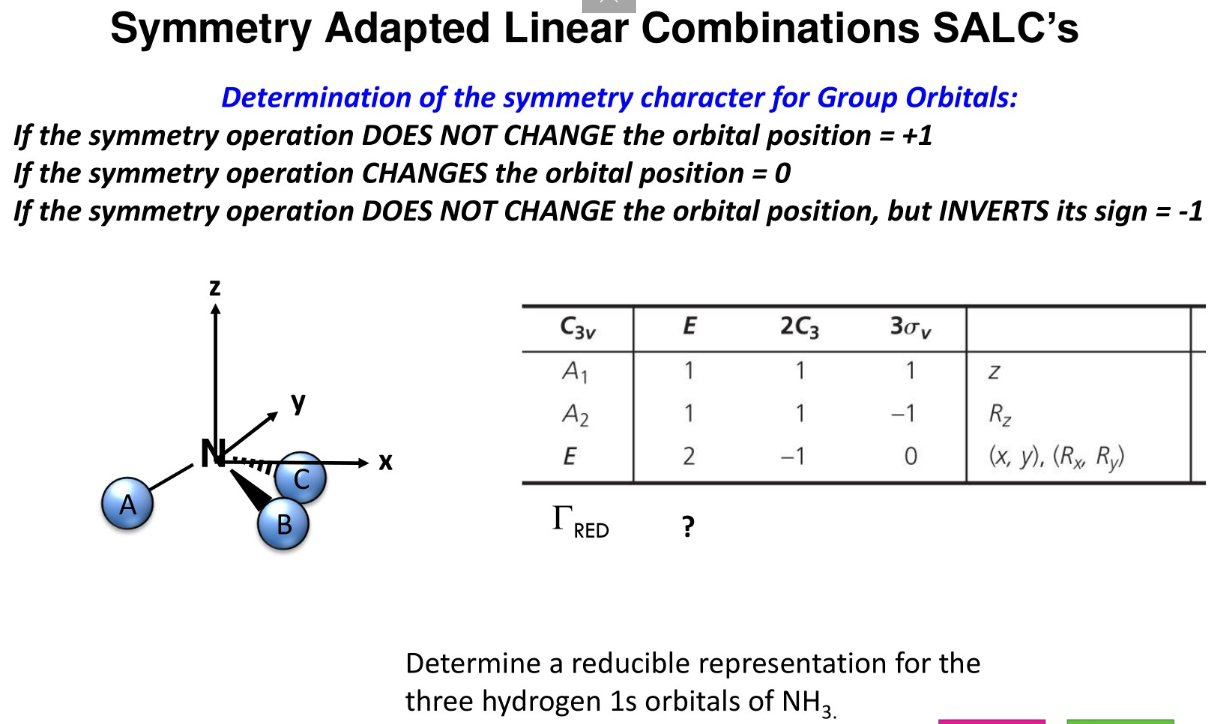
Using the ammonia molecule in the image above as a guide, determine the characters of the reducible representation, , formed by the three hydrogen 1s orbitals. The basis is . Use the rule that is the number of orbitals that remain in their original position after the operation .
- E (Identity): How many H atoms are unmoved?
- C₃ (Rotation by 120°): How many H atoms are unmoved?
- σᵥ (Reflection): Consider a reflection plane passing through one H atom (e.g., atom A). How many H atoms are unmoved by this operation?
Now, using your characters and the decomposition formula from the reading, show that decomposes into .
Show answer
- E: All three H atoms stay in place. So, .
- C₃: The rotation moves AB, BC, CA. No atom stays in place. So, .
- σᵥ: A reflection plane like passes through atom A and C, but swaps A and C from the perspective of the point group's C3v. Let's use the diagram: a reflection through the plane containing the N atom and atom A will leave atom A fixed but swap B and C. So, .
Our reducible character is . The order of the group is .
Let's find the coefficients :
- For :
. - For : .
- For : .
So, the decomposition is . This tells us the three H orbitals will combine to form one non-degenerate state (of symmetry) and one doubly-degenerate state (of symmetry).
3. Constructing Symmetrized States: The Projection Operator
We've now figured out which symmetries our eigenstates will have. The next step is to explicitly construct basis functions that transform according to these irreps. The tool for this is the projection operator.
For an irrep , the projection operator is defined as:
where is the dimension of the irrep, is the order of the group, and is the operator corresponding to the group element .
When you apply to an arbitrary starting function , the result, , is a new function that is guaranteed to transform according to the irrep .
Let's return to Marianetti's notes to see how this operator is used in practice to construct symmetry-adapted basis functions.
Please read the two sections 'Degenerate eigenfunctions as a basis for irreducible represenation' and 'Projection Operator' (pages 13-15). The first section formally proves that degenerate eigenfunctions form a basis for an irrep. The second introduces the projection operator and provides a first look at how to use it.
4. The Payoff: Block Diagonalization
Now for the final and most important step. What happens when we express our Hamiltonian in a basis of these symmetry-adapted functions we just constructed?
The crucial result, which stems directly from the Great Orthogonality Theorem, is that the Hamiltonian matrix element between two functions that transform according to different irreps is zero.
Even more, if and are different basis functions within the same multi-dimensional irrep , the matrix element is also zero.
This means the Hamiltonian matrix, when written in this new basis, will have non-zero elements only in blocks along the diagonal. Each block corresponds to a specific irrep.
This block-diagonalization is the ultimate goal of our efforts. The following short section proves this result concisely.
Please read the section 'Orthogonality and block diagonalization' (pages 17-18). The final equation shows that the matrix element (\langle\phi_k^j|H|\psi_{k'}^{j'} angle) is proportional to \delta_{jj'} \delta_{kk'}, which is the mathematical statement of block diagonalization. The Hamiltonian does not couple states from different irreps (j) or different partner functions (k) within the same irrep.
The consequence is profound. Instead of diagonalizing one large, messy matrix, we only need to diagonalize a series of much smaller, independent matrices. If an irrep appears times in our decomposition, we will have a block to diagonalize. If , the eigenenergy is simply the value of the matrix element, and the SALC we constructed is the eigenvector!
5. Application: A Tight-Binding Model
Your background in condensed matter physics and computational modeling makes a tight-binding model the perfect context to see this entire procedure in action. Let's walk through an example that is more complex than the diatomic molecule but still analytically tractable.
We will now apply everything we've learned to a square molecule with C4v symmetry. This is a classic problem in solid-state physics and chemistry.
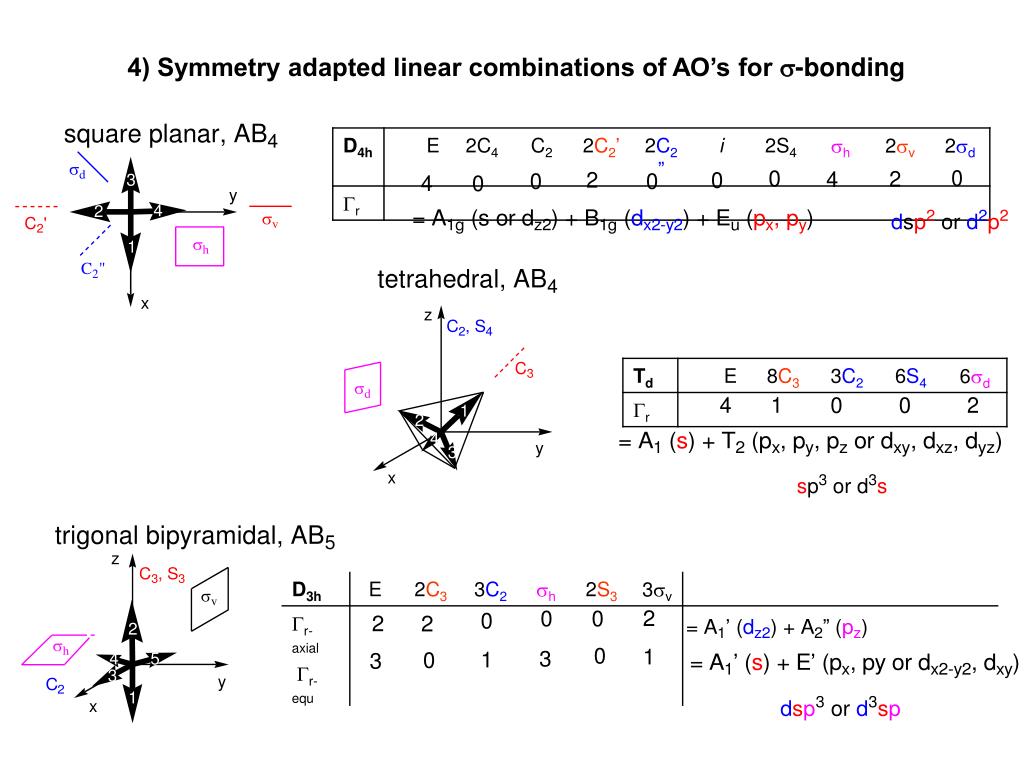
Please read the section 'Examples' (pages 18-23). Focus on the second example: the square molecule with an s-like orbital at each of the four corners and one at the center. Follow the steps: Decomposition (p. 20): See how the 4x4 representation for the corner orbitals is constructed and its character \chi = (4, 0, 0, 0, 2) is decomposed into A_1 + B_2 + E. Projection (p. 21): Observe how the projection operator is used on a single corner orbital (e.g., at site 1) to generate the symmetrized orbitals (SALCs) for A_1, B_2, and E. Block Diagonalization (p. 22-23): Compare the original 5x5 Hamiltonian matrix (Eq. 107) with the block-diagonal Hamiltonian H' in the symmetrized basis (Eq. 109). Notice how the full 5x5 problem has been reduced to diagonalizing a single 2x2 block for the A_1 symmetry, with the other eigenvalues appearing directly on the diagonal. The final discussion on using different central orbitals (xy-type, x^2-y^2-type) further illustrates how symmetry dictates which states can mix.
This example perfectly demonstrates the power of group theory. The symmetry analysis not only simplifies the problem but also gives deep physical insight into the nature of the eigenstates. The SALCs you construct are essentially the molecular orbitals of the system, pre-classified by their symmetry properties.
Conclusion
In this lesson, you have acquired the essential operational skills of applied group theory in quantum mechanics. We've moved beyond the abstract principle that "symmetry causes degeneracy" to a concrete, step-by-step procedure for exploiting that symmetry.
Key Takeaways:
- Character tables are the cheat sheets of group theory, allowing you to decompose a reducible representation into its irreducible components using a simple formula.
- The character of a representation based on a set of atomic orbitals can be found by simply counting how many orbitals are left unchanged by each symmetry operation.
- The projection operator is the constructive tool that takes an arbitrary basis function and generates a symmetry-adapted linear combination (SALC) that transforms according to a specific irrep.
- When the Hamiltonian is expressed in a basis of these SALCs, it becomes block-diagonal. Each block corresponds to a specific irrep, and its size is determined by how many times that irrep appeared in the decomposition.
- This procedure drastically simplifies the eigenvalue problem and provides the eigenstates pre-labeled with their symmetry properties (), which is invaluable for understanding their physical behavior.
Preview of the next lesson:
We have seen how group theory helps us classify and find the states of a quantum system. The next natural question is: how do these states interact with external fields? In the next lesson, we will "Derive selection rules for electromagnetic transitions using symmetry arguments." We will see that the same group theory framework, particularly the orthogonality of irreps, determines which transitions between energy levels are allowed and which are forbidden, forming the basis of spectroscopy.