Recommended resources
The freely available resources this lesson will direct you to.
Introduction
In our previous lessons, we deconstructed the architectural philosophies of key agent frameworks: LangChain's single-agent, sequential model; CrewAI's hierarchical, process-driven orchestration; and AutoGen's dynamic, conversational collaboration. You now have a solid understanding of what these frameworks are and how they enable agents to work.
This lesson synthesizes that knowledge into a critical skill for any AI Solutions Architect. Our learning outcome is to develop a decision model for selecting a framework based on project requirements and constraints. We will move from descriptive analysis to prescriptive strategy, constructing a formal, reusable model that transforms framework selection from an art into a disciplined engineering decision.
This is not about finding a single "best" tool. In line with Stoic principles, it's about correctly perceiving the context of a problem and logically choosing the tool whose trade-offs are most acceptable for that specific context.
1. The Architect's Mandate: From Features to Trade-offs
A junior developer might ask, "Which framework is best?" An architect, however, asks, "For this specific project, with its unique constraints and goals, which framework's strengths are most relevant, and which of its weaknesses are most tolerable?"
To answer this, we need a model that forces us to weigh competing priorities. Before we build our detailed model, let's look at two high-level visual heuristics that can help frame the decision space.

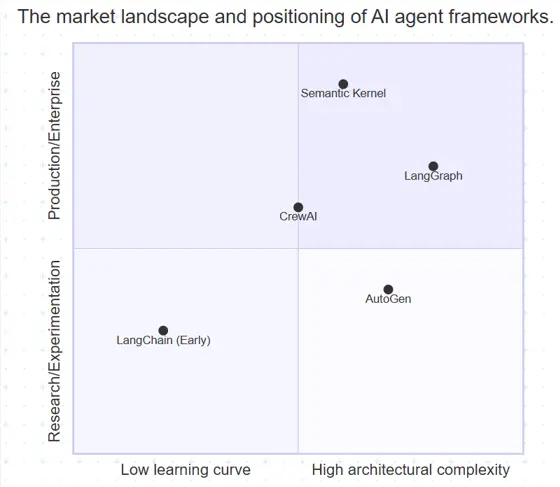
These visuals are useful for initial orientation. Now, we will build a more rigorous and quantifiable decision model that you can deploy in a professional setting.
2. Constructing the Decision Model: A Weighted Scorecard
The core of our decision model will be a weighted scorecard. This is a classic tool for strategic analysis that prevents us from being swayed by a single, exciting feature. It forces a holistic evaluation against a pre-defined set of criteria that reflect business and technical priorities.
The model has two parts:
- Criteria (the "What"): The specific dimensions along which we will evaluate each framework.
- Weights (the "How Much it Matters"): The relative importance of each criterion for a given project.
To define our criteria, we will draw from a comprehensive analysis that breaks down the essential aspects of agent frameworks.
LangChain, AutoGen, and CrewAI – Which is the Best Choice for You?
To build our model, we need a robust set of evaluation criteria. The following article, 'LangChain, AutoGen, and CrewAI – Which is the Best Choice for You?', provides an excellent, production-focused set of dimensions to consider.
Read the sections 'Core architecture: orchestration model and control surface' (Table 3), 'Production readiness checklist' (Table 4), and 'Decision scorecard (10 criteria)' (Table 6). Focus on the types of criteria presented: architectural axes, production concerns, and the scorecard categories. These will form the rows of our decision model.
Synthesizing from the resource and our previous lessons, we can establish a robust set of ten criteria for our scorecard:
| Category | Criterion | Description |
|---|---|---|
| Workload Fit | 1. Primary Use Case Fit | How well the framework's core philosophy (e.g., orchestration, conversation) matches the problem type. |
| 2. Orchestration Control | The degree of explicit, deterministic control the developer has over the agent workflow. | |
| Production Readiness | 3. State & Durability | Support for managing state in long-running tasks, and resuming/replaying workflows. |
| 4. Human-in-the-Loop (HITL) | The ease of implementing approval gates, overrides, and other human interventions. | |
| 5. Observability & Debugging | The native or integrated ability to trace execution, log events, and diagnose failures. | |
| 6. Safety & Guardrails | Mechanisms to constrain agent behavior, manage tool use, and prevent runaway processes or costs. | |
| Team & Ecosystem | 7. Developer Experience (DX) | The learning curve, clarity of abstractions, and ease of onboarding for a new developer. |
| 8. Maintainability & Testability | How the framework's structure supports long-term maintenance and automated testing. | |
| 9. Integration Effort | The ease of connecting to required models, data sources, and external tools (APIs, databases). | |
| Strategic | 10. Time-to-Value vs. Control | The balance between rapid prototyping and the fine-grained control needed for production systems. |
This scorecard is our decision-making instrument. Now, let's learn how to use it.
3. Applying the Model: A Tale of Two Scenarios
A model is only useful when applied. We will now apply our scorecard to two distinct scenarios that map directly to your course goals, demonstrating how changing the context (the weights) alters the optimal choice.
To help inform the scores we assign, this video provides a detailed, feature-by-feature comparison that we can use as a reference.
Which Agentic AI Framework to Pick? LangGraph vs. CrewAI vs. AutoGen
To help us assign scores (from 1-10) in our model, this video provides a direct comparison of AutoGen, CrewAI, and LangGraph. The scoring system and final recommendations align well with our scenario-based approach.
Watch the analysis from 01:33 to 24:16. You don't need to agree with every score, but pay close attention to the justification for each one, as it reveals the trade-offs between the frameworks. The final summary at 23:04 is particularly relevant.
Scenario A: Agentic Underwriting (Production, Regulated)
- Context: Building a multi-agent system to automate parts of a commercial loan underwriting process. The system must ingest documents, perform risk analysis, and generate a recommendation report. The process must be auditable, reliable, and include human oversight for final decisions.
- Priorities: Governance, reliability, and auditability are paramount. Speed of initial development is secondary to long-term stability and control.
Here is the weighted scorecard for this scenario (Weights: 1=Low, 3=Medium, 5=High Priority):
| Criterion | Weight | LangGraph (for LangChain) | CrewAI | AutoGen |
|---|---|---|---|---|
| 1. Primary Use Case Fit | 5 | 8 | 9 | 4 |
| 2. Orchestration Control | 5 | 10 | 8 | 3 |
| 3. State & Durability | 5 | 9 | 7 | 4 |
| 4. Human-in-the-Loop | 5 | 9 | 6 | 5 |
| 5. Observability & Debugging | 5 | 8 | 7 | 5 |
| 6. Safety & Guardrails | 5 | 8 | 8 | 4 |
| 7. Developer Experience (DX) | 1 | 3 | 7 | 8 |
| 8. Maintainability & Testability | 3 | 8 | 7 | 5 |
| 9. Integration Effort | 3 | 8 | 8 | 6 |
| 10. Time-to-Value vs. Control | 1 | 5 | 7 | 9 |
| Weighted Score | 250 | 232 | 133 |
Analysis:
- LangGraph wins. Its graph-based structure provides maximum
Orchestration Control, making it ideal for defining the explicit, auditable steps required in a regulated workflow. Its strong support forState & Durabilityand flexibleHuman-in-the-Loopintegration are critical for this use case. - CrewAI is a strong second. Its role-based orchestration is a great fit for the use case, but it offers slightly less granular control and HITL flexibility than LangGraph.
- AutoGen is a distant third. Its emergent, conversational nature is a liability here. The lack of predictability and explicit control makes it unsuitable for a high-stakes, regulated process where auditability is non-negotiable.
Scenario B: Personal OS Research Agent (Prototype, Experimental)
- Context: Building a personal agent to perform open-ended research. The user provides a complex topic, and the agent must autonomously browse sources, synthesize findings, identify conflicting information, and produce a structured summary.
- Priorities: Flexibility, speed of prototyping, and the ability to handle complex, non-linear problem-solving are key. Formal governance and auditability are low priorities.
Here is the weighted scorecard for this scenario:
| Criterion | Weight | LangGraph (for LangChain) | CrewAI | AutoGen |
|---|---|---|---|---|
| 1. Primary Use Case Fit | 5 | 7 | 8 | 9 |
| 2. Orchestration Control | 1 | 10 | 8 | 3 |
| 3. State & Durability | 1 | 9 | 7 | 4 |
| 4. Human-in-the-Loop | 3 | 9 | 6 | 5 |
| 5. Observability & Debugging | 3 | 8 | 7 | 5 |
| 6. Safety & Guardrails | 3 | 8 | 8 | 4 |
| 7. Developer Experience (DX) | 5 | 3 | 7 | 8 |
| 8. Maintainability & Testability | 1 | 8 | 7 | 5 |
| 9. Integration Effort | 3 | 8 | 8 | 6 |
| 10. Time-to-Value vs. Control | 5 | 5 | 7 | 9 |
| Weighted Score | 193 | 221 | 223 |
Analysis:
- AutoGen narrowly wins. Its strength in flexible, conversational collaboration is a perfect match for an exploratory task where agents need to "brainstorm" and iteratively refine their approach. The high
Developer Experience (DX)andTime-to-Valuefor this type of task are major advantages. - CrewAI is also an excellent choice. Its structured "crew" of researchers and writers can perform the task well, and its higher-level abstractions make it quick to set up.
- LangGraph is viable but might be overkill. Building the complex, cyclical reasoning (e.g., research -> critique -> refine -> research) from scratch requires more effort, lowering its
Time-to-Valuescore for this prototype.
This exercise demonstrates that the "best" framework is entirely dependent on the weighted priorities of the project.
4. The Principle of Sufficiency: Architecture and Process Over Tools
A framework is a tool, not a solution. Before selecting a framework, an architect must consider two higher-level principles.
First, is a multi-agent system even necessary? There is a tendency to over-engineer solutions. As the following video cautions, many tasks are best handled by a simpler architecture.
Choosing the Right Multi-Agent Architecture
Before committing to a complex multi-agent framework, it's vital to consider if it's necessary. This short clip from LangChain offers a crucial piece of architectural wisdom.
Watch the first 22 seconds. The key takeaway is the principle of sufficiency: always start with the simplest possible solution (a single agent with good tools) and only add the complexity of a multi-agent system when the task genuinely demands it.
Second, a decision model gives you a hypothesis, not a final answer. The ultimate validation comes from empirical testing. A structured Proof-of-Concept (POC) is the only way to move from an "opinion-based decision" to an "evidence-based decision."
LangChain, AutoGen, and CrewAI – Which is the Best Choice for You?
This section of the 'LangChain, AutoGen, and CrewAI' article outlines a rigorous, 1-week validation plan to test your framework choice against reality.
Read the section '1-week validation plan (POC) to avoid “opinion-only decisions”'. Focus on the 'Evidence artifacts' table and the 'POC rules'. This provides a structured, non-biased way to confirm your selection with real data on performance, cost, and failure modes.
Your role as an architect is not just to choose the tool, but to define the process by which the choice is made and validated.
Conclusion
In this lesson, we have constructed and applied a formal decision model for selecting an agent framework. This elevates your role from a user of AI tools to a strategic architect of AI systems.
Key Takeaways:
- A Model Over a Guess: Use a structured tool like a weighted scorecard to make objective, defensible architectural decisions.
- Context is King: The "best" framework is a function of project requirements. By explicitly weighting criteria, you can align your technical choices with business priorities.
- Control vs. Flexibility: The core trade-off often lies between the predictable control of orchestration frameworks (LangGraph, CrewAI) and the emergent flexibility of conversational ones (AutoGen).
- Validate with a POC: Your decision model produces a hypothesis. A time-boxed, evidence-driven POC is the necessary final step to confirm your choice before committing significant resources.
Preview of the Next Lesson:
We have now established a model for choosing the orchestration layer of your agentic system. The next logical step is to select the engine that powers it: the Large Language Model. In our next lesson, we will begin Module 9, "Infrastructure and Deployment Architecture," by addressing the outcome: "Develop a decision framework for selecting LLM providers based on cost, performance, and security requirements." We will build another decision model, this time for the LLM itself, which is an equally critical architectural choice.