Recommended resources
The freely available resources this lesson will direct you to.
- How to Choose the BEST LLM for YOUR Project: A Methodical Guidewww.youtube.com
- The REAL cost of LLM (And How to reduce 78%+ of Cost)www.youtube.com
- Comparing LLM Provider Pricing and Performance - Librarywww.grizzlypeaksoftware.com
- Choosing LLMs for AI Agents: Cost, Latency, Intelligence ...softcery.com
Introduction
In our last lesson, you constructed a weighted scorecard to select an agent framework, demonstrating how to make a defensible architectural choice based on project priorities. We established that the "best" tool is entirely context-dependent, shifting with the demands of the task—be it a regulated underwriting process or an experimental research agent.
Now, we move from the agent's "skeleton" (the framework) to its "brain" (the Large Language Model). The choice of LLM provider is one of the highest-leverage decisions an AI architect can make, with profound implications for your system's cost, performance, and security.
This lesson directly addresses the learning outcome: to develop a decision framework for selecting LLM providers based on cost, performance, and security requirements. We will build upon the disciplined, scorecard-based approach from the previous module, applying it to the complex and dynamic LLM market. This is not about picking a favorite model; it's about engineering a selection process that is logical, repeatable, and aligned with strategic objectives.
1. The LLM Selection Trilemma: Cost, Performance, and Control
When selecting an LLM provider, you are fundamentally managing a trade-off between three competing dimensions. It is nearly impossible to maximize all three simultaneously. Your primary role as an architect is to identify the project's non-negotiable dimension and then find the most acceptable balance for the other two.

The core trade-offs are:
- Cost: The economic expense of using the model, measured not just in dollars per token, but in the total cost to achieve a successful outcome.
- Performance: A composite measure of the model's capabilities, including its reasoning ability (intelligence), its responsiveness (latency), and its feature set (e.g., tool use, context window).
- Control: The degree of governance you have over data privacy, security, and model behavior. This is primarily influenced by the choice between third-party APIs and self-hosting.
The following article provides an excellent framing of this trilemma.
Choosing LLMs for AI Agents: Cost, Latency, Intelligence Tradeoffs
To understand the core tensions in LLM selection, please read the introductory sections of 'Choosing LLMs for AI Agents' from Softcery.
Read the sections 'The Three-Dimensional Tradeoff in LLM Selection' and 'Diagnosing Your LLM Constraints'. Focus on how cost, latency, and intelligence are interconnected and how to diagnose which of these is the primary bottleneck for a given project.
2. Deconstructing the Decision Criteria
To build our framework, we must break down the high-level trilemma into specific, measurable criteria.
A. The True Cost of Inference
Superficial cost analysis, based solely on marketing pages, is a common and expensive mistake. A rigorous analysis must account for the total cost of task completion.
The following video provides a visceral, practical look at how LLM costs can spiral out of control and introduces several levers for cost optimization.
The REAL cost of LLM (And How to reduce 78%+ of Cost)
The video 'The REAL cost of LLM (And How to reduce 78%+ of Cost)' offers crucial, hard-won insights into managing inference expenses. The cautionary tales and strategic cost-saving patterns are highly relevant.
Watch from the beginning to 13:47. Pay close attention to two key areas: the anecdote about the runaway agent costs (00:00-02:40) and the strategic levers for cost reduction through model selection, such as fine-tuning smaller models, cascading, and routing (07:31-13:47).
Drawing from this, our Cost criteria must include:
- Price per Token (Input vs. Output): Output tokens are computationally more expensive and are priced higher. Your cost profile depends on whether your use case is input-heavy (e.g., document analysis) or output-heavy (e.g., content generation).
- Cost per Successful Task: This is the most critical metric. A cheaper model that fails 20% of the time and requires retries can be more expensive than a pricier, more reliable model. The formula is
Total Cost / Number of Successful Completions. - Hidden Costs: These include costs from API retries due to errors, wasted tokens from parsing failures (e.g., malformed JSON), and network egress charges.
- Availability of Cost-Saving Features: Look for features like batch API endpoints (often 50% cheaper for non-urgent tasks) and prompt caching.
B. Multi-faceted Performance
Performance is not a single number. It's a blend of raw intelligence, speed, and specific technical capabilities.
For a broad overview of how to approach performance evaluation, watch the following segment.
How to Choose the BEST LLM for YOUR Project: A Methodical Guide
The video 'How to Choose the BEST LLM for YOUR Project' provides a methodical guide to evaluating model performance, covering both quantitative benchmarks and qualitative factors.
Watch the sections on judging raw intelligence (04:00-12:19), human evaluations (19:23-23:09), and specific capabilities like structured outputs and tool calling (22:53-25:24). Note the healthy skepticism towards benchmarks and the emphasis on real-world usefulness.
Our Performance criteria are:
- Intelligence & Reliability:
- Reasoning Quality: The model's ability to perform multi-step logic, follow complex instructions, and handle nuance. This is critical for your underwriting use case.
- Reliability/Consistency: The model's tendency to produce consistent outputs for similar inputs, especially with
temperatureset to 0. High variance can be fatal for production agentic workflows.
- Latency:
- Time to First Token (TTFT): How quickly the model begins generating a response. Crucial for user-perceived responsiveness in chatbots.
- Tokens per Second (TPS): The overall generation speed. Determines total request duration.
- Capabilities:
- Context Window: The maximum number of tokens the model can process. Essential for tasks involving long documents.
- Structured Output: Native support for generating valid JSON or other structured data, which is vital for tool use and reliable data extraction.
- Tool-Use/Function-Calling: The model's native ability to invoke external tools and APIs.
C. Security and Control
For applications in finance, this is often the paramount concern. The central trade-off is between the convenience of proprietary APIs and the control of open-source models.
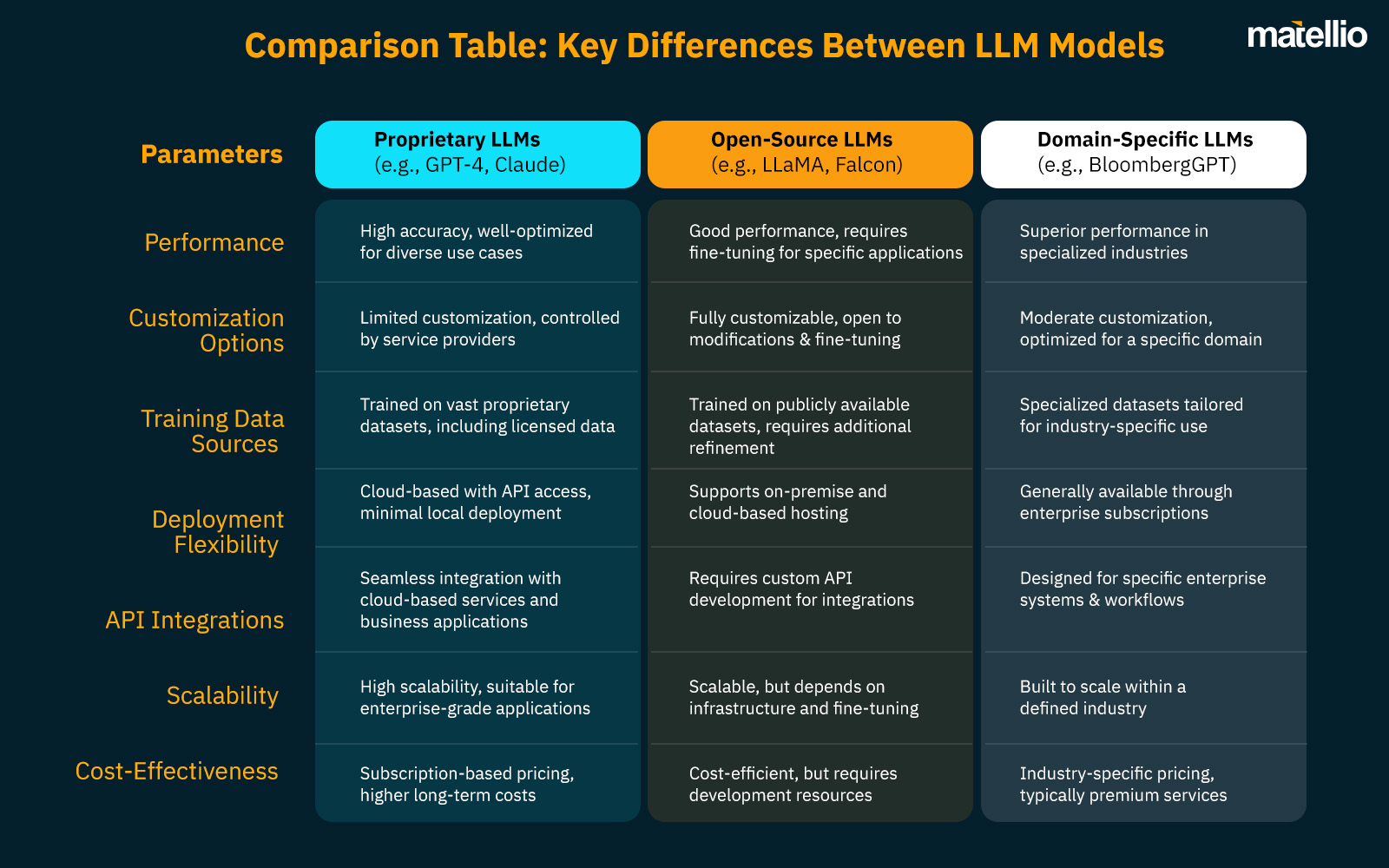
Our Security & Control criteria are:
- Data Privacy & Residency: Where is the data processed and what are the provider's policies on using it? Can data be restricted to a specific geographic region (e.g., EU)?
- Security Posture: Does the provider offer enterprise-grade security features, such as private networking, dedicated instances, and compliance certifications (e.g., SOC 2, HIPAA)? Services like Azure OpenAI are built for this.
- Deployment Model:
- Managed API: Easiest to use, but you cede control over the infrastructure and data pipeline.
- Self-Hosted Open Source: Maximum control over data and security, but comes with significant operational overhead and cost for managing GPU infrastructure. This is only viable at very large scale or under strict regulatory constraints.
3. Assembling the Decision Framework: The LLM Scorecard
We will now synthesize these criteria into a weighted scorecard. The following article provides detailed, up-to-date comparisons that we can use to assign scores.
Comparing LLM Provider Pricing and Performance
The article 'Comparing LLM Provider Pricing and Performance' is an excellent, data-rich resource for populating our scorecard. It contains detailed pricing tables, latency benchmarks, and qualitative performance assessments.
Review the 'Detailed Cost Comparison', 'Latency Benchmarks', and 'Quality Benchmarks' sections. Use these tables as a reference for the scores in the scenarios below. Also, read the 'Best Practices' section, which provides a superb summary of the key principles of LLM selection.
Scenario A: Agentic Underwriting (Production, Regulated)
- Context: A multi-agent system for commercial lending that analyzes financial statements, legal documents, and market data to produce a risk assessment.
- Priorities: Accuracy, reliability, and security are non-negotiable. The model must handle complex reasoning and follow instructions precisely. Cost is secondary to correctness and auditability.
LLM Scorecard: Underwriting Agent (Weights: 1=Low, 3=Medium, 5=High Priority)
| Criterion | Weight | Claude 4 Opus | GPT-o1 | Gemini 1.5 Pro | GPT-4o-mini |
|---|---|---|---|---|---|
| Cost per Successful Task | 3 | 5 | 5 | 7 | 10 |
| Reasoning Quality | 5 | 10 | 10 | 8 | 4 |
| Reliability/Consistency | 5 | 9 | 8 | 7 | 5 |
| Latency (TTFT/TPS) | 1 | 6 | 5 | 7 | 9 |
| Context Window | 5 | 8 | 8 | 10 | 6 |
| Structured Output | 5 | 9 | 8 | 8 | 7 |
| Security (Enterprise Options) | 5 | 9 | 9 | 9 | 7 |
| Weighted Score | 229 | 217 | 213 | 149 |
Analysis:
- Claude 4 Opus emerges as the top choice. It scores highest on the heavily-weighted criteria of
Reasoning QualityandReliability, which are critical for high-stakes financial analysis. Anthropic's strong enterprise offerings address theSecurityrequirement. - GPT-o1 and Gemini 1.5 Pro are strong contenders but fall slightly behind. GPT-o1 is a reasoning specialist but might show slightly lower consistency. Gemini Pro offers an unparalleled context window but may not match the top-tier reasoning of Opus for this specific task.
- GPT-4o-mini is clearly unsuitable. Its low scores on reasoning and reliability make it a non-starter for a task where correctness is paramount, despite its attractive cost.
Scenario B: Personal OS - Research Synthesis (Cost-Sensitive)
- Context: A personal agent that autonomously scrapes articles and synthesizes them into a summary.
- Priorities: Low cost is the primary driver. Performance needs to be "good enough" for summarization. Latency should be reasonable for a good user experience.
LLM Scorecard: Research Synthesis Agent
| Criterion | Weight | Claude 4 Opus | Gemini 2.5 Flash | GPT-4o-mini | Mistral Small |
|---|---|---|---|---|---|
| Cost per Successful Task | 5 | 2 | 10 | 10 | 10 |
| Reasoning Quality | 1 | 10 | 6 | 6 | 5 |
| Reliability/Consistency | 3 | 9 | 7 | 7 | 6 |
| Latency (TTFT/TPS) | 3 | 6 | 10 | 9 | 8 |
| Context Window | 3 | 8 | 7 | 7 | 7 |
| Structured Output | 1 | 9 | 8 | 8 | 7 |
| Security (Standard) | 1 | 9 | 8 | 8 | 8 |
| Weighted Score | 117 | 158 | 156 | 144 |
Analysis:
- Gemini 2.5 Flash wins. It completely dominates on the two most important criteria:
CostandLatency. Its "good enough" quality is sufficient for a summarization task where the stakes are low. - GPT-4o-mini is a very close second, offering a similar value proposition. The choice between them could come down to ecosystem preference or minor differences discovered during A/B testing.
- Claude 4 Opus is massive overkill. Its high cost makes it economically unviable for this use case, demonstrating how a "better" model can be the wrong choice.
4. Architecting for Flexibility
The LLM market is volatile. Today's best model may be obsolete in six months. A crucial part of your decision framework is not just selecting a model, but designing your system to be model-agnostic.
The LINK article you read earlier outlines several essential architectural patterns. The key principle is to avoid hardcoding your application to a single provider.
- Abstraction Layer: Create an internal client that wraps the provider-specific SDKs. Your application code calls
llm_client.generate()notopenai.chat.completions.create(). This allows you to swap models by changing a configuration file, not refactoring code. - Router-Based Selection: For more sophisticated systems, implement a routing layer. Simple, low-stakes user queries can be routed to a cheap, fast model (like Gemini Flash), while complex queries are routed to a powerful reasoning model (like Claude Opus). This optimizes cost and performance dynamically.
- Fallback Chains: Build resilience by defining a fallback sequence. If your primary model (e.g., Claude) fails or times out, the system automatically retries the request with a secondary provider (e.g., OpenAI). This provides graceful degradation instead of total system failure during a provider outage.
Conclusion
In this lesson, you have developed a rigorous decision framework for one of the most critical choices in AI architecture: selecting an LLM provider. By moving beyond simple price comparisons and embracing a holistic, weighted-scorecard approach, you can make choices that are technically sound and strategically aligned with business objectives.
Key Takeaways:
- Master the Trilemma: Every LLM selection is a trade-off between Cost, Performance, and Control. Your primary task is to identify the project's lead constraint.
- Calculate Cost Per Successful Task: This is the true north of cost analysis. A cheap model with a high failure rate is not cheap.
- Deconstruct Performance: Evaluate models along multiple axes: intelligence, reliability, latency, and specific capabilities like context window and tool use.
- Use a Weighted Scorecard: Formalize your decision-making to ensure objectivity and alignment with project priorities. The "best" model is relative to the weighted needs of the use case.
- Architect for Change: The LLM landscape is constantly shifting. Build abstraction layers, routers, and fallback chains to ensure your system is agile and not locked into a single provider.
Preview of the Next Lesson:
With the LLM provider selected, our agent now has a brain. The next step is to give it hands and eyes by connecting it to the tools and data it needs to perceive and act upon its environment. In our next lesson, we will "Map essential tool categories (e.g., vector databases, data APIs, monitoring) to financial use cases," bridging the gap between your agent's reasoning capability and its ability to execute real-world tasks.