Recommended resources
The freely available resources this lesson will direct you to.
Introduction
In our last lesson, we analyzed LangChain's architecture, identifying its core strength in rapid, sequential workflow development via a Directed Acyclic Graph (DAG) model. We also noted its limitations for tasks requiring cyclical reasoning or sophisticated coordination between multiple autonomous entities.
This lesson directly addresses those limitations by exploring frameworks built specifically for multi-agent systems. Our learning outcome is to contrast the collaboration models of multi-agent frameworks like CrewAI and AutoGen.
We will move beyond the single-agent paradigm and dissect two dominant, yet fundamentally different, approaches to making AI agents work together. For you as an aspiring AI Solutions Architect, this isn't about finding a "better" framework but understanding the distinct architectural philosophies—orchestration versus conversation—and their profound implications for building reliable, scalable, and effective autonomous systems in a business context.
1. From Single Agent Limitations to Multi-Agent Solutions
Before comparing CrewAI and AutoGen, let's crystallize why multi-agent systems are necessary. A single, monolithic agent, even one built with a powerful framework like LangChain, often struggles with complex, real-world problems for several reasons:
- Tool Overload: Providing a single agent with dozens of tools can confuse it, leading to poor decisions on which tool to use.
- Context Window Constraints: As a task progresses, the history of actions and observations can overwhelm the LLM's context window, degrading its reasoning ability.
- Lack of Specialization: It's often more effective to have multiple specialized "expert" agents (e.g., a researcher, a data analyst, a writer) than one "generalist" agent trying to do everything.
To understand these challenges and the conceptual shift to multi-agent solutions, please watch the beginning of the following video from the LangChain team.
Conceptual Guide: Multi Agent Architectures
This video, 'Conceptual Guide: Multi Agent Architectures', provides a clear, concise explanation of the rationale behind moving from single-agent to multi-agent systems.
Watch the section from 00:00 to 02:33. Focus on the three main downsides of scaling a single agent system: too many tools, complex context, and the need for specialization.
These limitations of the single-agent model create the design space for the multi-agent frameworks we will now explore.
2. Two Competing Philosophies: Orchestration vs. Conversation
At the highest level, CrewAI and AutoGen represent two distinct philosophies for enabling agent collaboration.
-
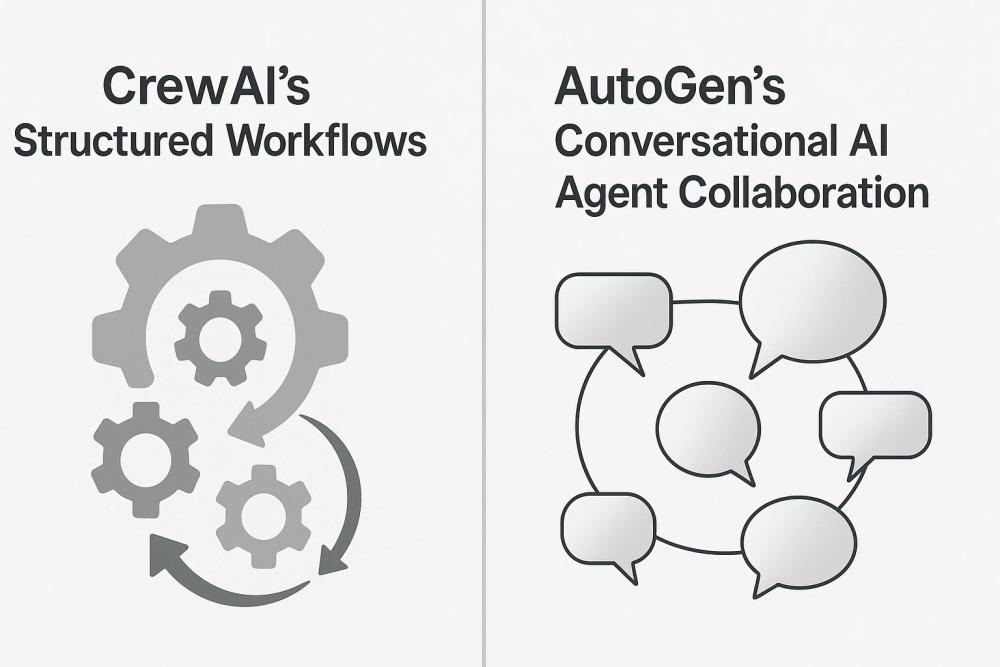
CrewAI: Hierarchical Orchestration. This model is analogous to a corporate team. Agents have defined roles, responsibilities, and operate within a structured process. There is a clear sense of hierarchy and workflow, making the system's behavior more predictable. It's a top-down approach.
-
AutoGen: Conversational Collaboration. This model is like a group chat or a brainstorming session. Agents collaborate by exchanging messages in a shared conversational space. The workflow is emergent and dynamic, driven by the dialogue itself. It's a bottom-up, peer-to-peer approach.
This image provides a perfect visual metaphor for the two models.
To solidify your understanding of these core differences, we'll turn to a detailed comparison article.
CrewAI Vs AutoGen: A Complete Comparison of Multi-Agent AI ...
The article 'CrewAI Vs AutoGen' from Medium provides an excellent, business-focused comparison of the two frameworks. We will use it as our primary reference for this lesson.
First, read the introduction (from the start down to 'What is CrewAI?'). Then, read Section 3, titled '1. Architecture' through '6. Community'. This will give you a high-level, point-by-point comparison of their design philosophies, use cases, and programming models.
Now, let's deconstruct each collaboration model in greater detail.
3. Deep Dive: CrewAI's Role-Based Orchestration
CrewAI's architecture is deliberately designed for predictability and reliability, making it a strong candidate for enterprise workflows. Its collaboration model is built on four core concepts:
- Agents: Specialized actors with a defined
role,goal, andbackstory. This is like a job description that primes the LLM for its specific function. - Tasks: Specific assignments given to an agent. Each task has a description and an
expected_output. - Tools: The functions and APIs an agent can use to perform its tasks.
- Crew: The group of agents and the tasks they need to accomplish. The
Crewdefines the Process, which is the collaboration logic.
The Process is the key to CrewAI's collaboration model. It dictates how agents interact. The default is a sequential process, where the output of one task becomes the input for the next. This creates a predictable, assembly-line-style workflow. More advanced workflows can use a hierarchical process, where a "manager" agent delegates tasks to "worker" agents, mimicking a corporate structure.
This architecture directly maps to the "supervisor agent" and "hierarchical" patterns you saw described in the Conceptual Guide: Multi Agent Architectures video.
Enterprise Implications of CrewAI's Model
Given your background in financial services, the advantages of this structured model should be apparent:
- Predictability & Auditability: The workflow is explicit and deterministic. You can clearly trace which agent performed which task with what input, which is critical for compliance and debugging.
- Reliability: By constraining agents to specific roles and a defined process, you reduce the chances of unexpected or undesirable behavior.
- Maintainability: The modular, role-based design makes it easier to manage, update, and test individual components of a complex system.
CrewAI Vs AutoGen: A Complete Comparison of Multi-Agent AI ...
Let's return to the 'CrewAI Vs AutoGen' article to explore how CrewAI's architecture is optimized for enterprise needs.
Please read the following sections: 'What is CrewAI?', 'CrewAI: Enterprise Security Practices', and 'Industry Adoption Implications'. Focus on how the design philosophy translates into features relevant for regulated industries like finance (e.g., on-premises deployment, audit capabilities, structured governance).
4. Deep Dive: AutoGen's Conversational Collaboration
AutoGen, developed by Microsoft Research, takes a fundamentally different approach. Collaboration is not orchestrated top-down; it emerges from a conversation between agents.
The core components are:
- Conversable Agents: The base class for all agents in AutoGen. They are defined by their ability to send and receive messages.
- UserProxyAgent: An agent that can act as a proxy for a human user, executing code or soliciting human input when needed.
- AssistantAgent: A standard LLM-powered agent that can write and execute code, solve problems, and communicate with other agents.
- GroupChatManager: An agent that manages the conversation between a set of other agents, defining the turn-taking logic (e.g.,
RoundRobinGroupChat).
In AutoGen, you don't define a rigid process. Instead, you place agents in a "group chat" and give them a task. The agents then "talk" to each other to solve the problem. For example, a Writer agent might propose a draft, and a Critic agent would then review it and provide feedback in the chat. This cycle of proposal and critique can repeat, allowing for iterative refinement—a form of cyclical reasoning that is difficult to achieve in a simple DAG architecture.
This model is closer to the "network of agents" concept, but with the GroupChatManager providing a layer of control over the communication pattern.
Research and Prototyping Implications of AutoGen's Model
This flexible, conversational model makes AutoGen exceptionally powerful for different kinds of tasks:
- Complex Problem-Solving: For tasks where the path to a solution is unknown, the conversational approach allows agents to explore, critique, and refine ideas dynamically.
- Rapid Prototyping & Research: The framework's flexibility is ideal for experimenting with novel agent behaviors and collaboration patterns.
- Human-in-the-Loop: Humans can easily join the "chat" via the
UserProxyAgentto guide the process, answer questions, or approve steps, making the collaboration fluid.
However, this flexibility comes at a cost, particularly for production environments.
CrewAI Vs AutoGen: A Complete Comparison of Multi-Agent AI ...
Now, let's use the same article to analyze AutoGen's model and its trade-offs.
Read the sections 'What is AutoGen?', 'AutoGen Case Studies', and the 'Key Insight' at the end. Focus on the conversational nature, its use in research and experimentation, and the trade-off between flexibility and production-readiness.
5. The Architect's Decision Matrix
Neither framework is universally superior. The choice is an architectural decision that depends entirely on the problem you are solving. As an architect, you must weigh the trade-offs.
Here is a decision matrix summarizing the key differences:
| Dimension | CrewAI (Hierarchical Orchestration) | AutoGen (Conversational Collaboration) |
|---|---|---|
| Collaboration Model | Structured, role-based, process-driven. (Like a project plan) | Dynamic, message-based, emergent. (Like a group chat) |
| Predictability | High. The workflow is explicit and generally deterministic. | Low. The path to a solution is emergent and can vary. |
| Primary Use Case | Production Workflows. Automating well-defined business processes (e.g., underwriting report generation, compliance checks). | Research & Prototyping. Solving complex, open-ended problems; exploring novel agent behaviors. |
| Flexibility | Moderate. Flexible within defined roles and tasks, but the overall process is structured. | High. Agents can dynamically adapt their roles and strategies based on the conversation. |
| Control | High. The developer defines the exact workflow and agent hand-offs. | Lower. The developer sets up the "room," but the agents' interaction drives the outcome. |
| Enterprise Readiness | High. Designed with features for security, auditability, and reliable execution. | Lower. Requires more custom work to be made robust and compliant for production. |
To get a final, concise perspective on this choice, please review the following short resource.
CrewAI vs LangGraph vs AutoGen: Choosing the Right Multi-Agent ...
The article 'CrewAI vs LangGraph vs AutoGen' from DataCamp provides a very clear summary of when to choose each framework. This will reinforce our decision matrix.
Focus on two parts. First, read the section 'Multi-Agent Support' for a direct comparison of the collaboration models. Second, read the section 'When to choose each' for a practical, prescriptive guide.
Conclusion
In this lesson, we have moved beyond the single-agent world and contrasted the two primary models for multi-agent collaboration: CrewAI's hierarchical orchestration and AutoGen's conversational approach.
Key Takeaways:
- Two Philosophies: Multi-agent collaboration is not a single concept. It splits into two main camps: structured orchestration (CrewAI) and dynamic conversation (AutoGen).
- CrewAI for Production: Its role-based, process-driven model offers the predictability, reliability, and auditability required for enterprise-grade workflow automation, especially in regulated fields like finance.
- AutoGen for Exploration: Its flexible, conversational model excels in research, prototyping, and solving complex problems where the solution path is not known in advance. The emergent nature allows for more creative and iterative problem-solving.
- The Architect's Trade-off: The choice between them is a classic engineering trade-off: control and predictability (CrewAI) vs. flexibility and dynamism (AutoGen).
Preview of the Next Lesson:
Having analyzed LangChain (single-agent, sequential), CrewAI (multi-agent, hierarchical), and AutoGen (multi-agent, conversational), you now have a solid understanding of the architectural landscape. In our next lesson, "Develop a decision model for selecting a framework based on project requirements and constraints," we will synthesize this knowledge. You will build a formal, reusable decision model that allows you, as an AI Solutions Architect, to systematically select the right framework for any given project.