Recommended resources
The freely available resources this lesson will direct you to.
Welcome back. In the previous lesson, you mapped a café customer’s path from discovering a lunch option to ordering and, potentially, returning. That map helps locate a problem: if customers cannot find the café, advertising may help them discover it; if they abandon a confusing checkout, the ordering experience may need attention first.
Today you’ll turn a business problem into one measurable advertising objective. The aim is to say what the campaign should accomplish—not merely what ads you plan to run—and how you will tell whether it happened.
Separate the problem from the objective
Suppose a café has spare capacity at weekday lunch but receives too few pickup orders. “We need more lunch business” describes the business problem. “Grow weekday lunch sales” is a useful goal: it gives direction, but leaves open which result an advertising campaign should pursue.
The distinction is visible in this Smartsheet comparison. Its examples pair broad marketing goals with outcomes that can be checked against a number and a deadline.
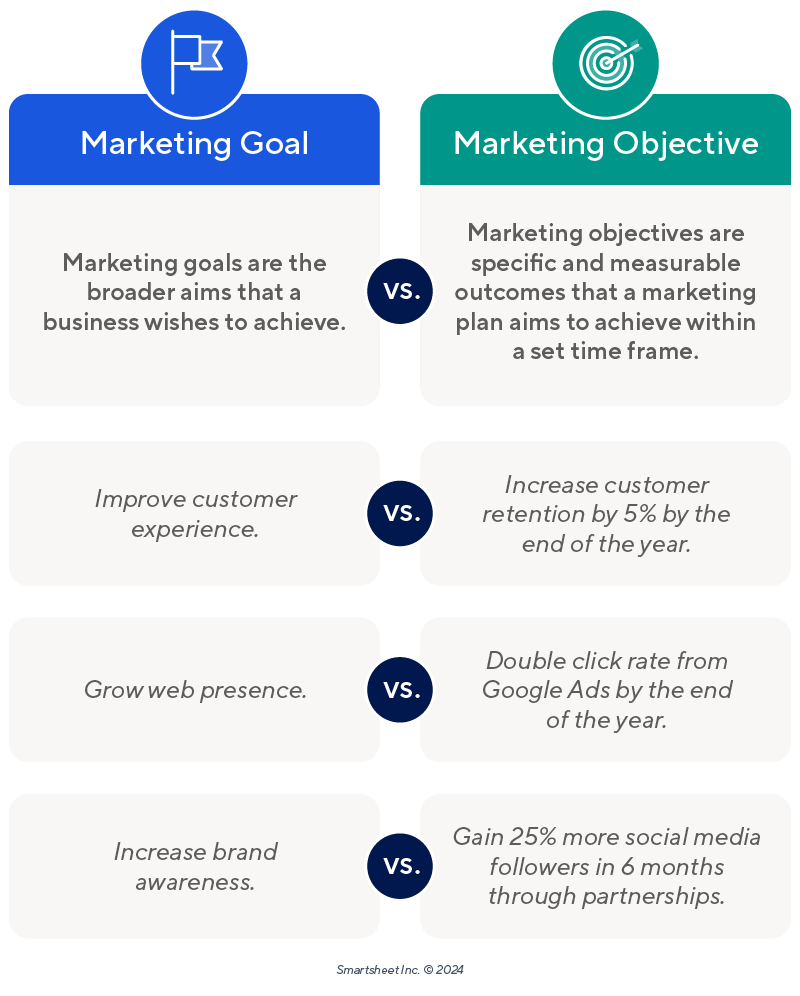
A marketing objective is not automatically an advertising objective. Improving food quality, reducing pickup delays, and bringing in first-time customers could all support the café’s goal, but advertising is best suited to influencing what people know, consider, or do in response to a message. Before writing an objective, ask what appears to be holding back the business and whether an ad can plausibly help.
HubSpot’s Goals vs objectives: The simple breakdown makes a second distinction worth keeping: the objective states the result to achieve; the strategy describes how you intend to achieve it.
Goals vs objectives: The simple breakdown
Read HubSpot’s explanation to separate a broad goal and a measurable objective from the strategy used to pursue it.
In “Goals vs Objectives,” begin with “A goal is an achievable outcome that is typically broad and long-term.” Read the distinction, stopping at the sentence about measurable actions. Then, in “Strategy vs Objective,” begin with “An objective is a measurable, specific action” and read the comparison through the sentence explaining why strategy can change. Focus on which statements specify a result and which specify a way to get it.
For the café, “run social ads about quick pickup” is a proposed tactic, not an objective. It specifies a channel and message but no success condition. The café might later change channels while pursuing the same objective.
Choose the part of the journey that needs help
A campaign objective should follow from a diagnosis, even if that diagnosis is provisional. Consider three versions of “not enough lunch business”:
| What the café observes | Likely point of difficulty | An advertising objective could focus on… |
|---|---|---|
| Few nearby customers seem to know pickup is available | Awareness | Reaching a defined local audience with the pickup offer |
| People discover the café but rarely look at its lunch options | Consideration | Visits to the lunch menu from ads |
| People view the menu and some order, but there are too few paid pickup orders | Conversion | Completed paid pickup orders connected to the campaign |
These are different objectives, not three targets to put into one campaign statement. The observation determines which is most relevant. It also matters what the café can measure: an ad’s reach can show that a message was delivered, but not prove that people remember it; a menu visit shows interest, but not a sale.
The journey map also gives you a reason to reject an advertising objective. If many customers reach checkout but cannot select an available pickup time, promising more orders through ads sidesteps the likely obstacle. Investigate and fix the ordering process before treating low sales as a shortage of advertising.
Give the objective a measurable finish line
The SMART framework is a useful check: an objective should be specific, measurable, achievable, relevant, and time-bound. Watch WebFX’s How to Set Marketing Goals | SMART Goals Explanation for its short account of what each requirement tests.
How to Set Marketing Goals | SMART Goals Explanation
Watch WebFX’s explanation of SMART criteria to see how a broad aim becomes a target you can evaluate.
Watch SMART in use for the lead-generation example. Then watch each criterion, paying particular attention to the questions about tracking, feasibility, business relevance, and the evaluation deadline.
Apply those questions to our café. Suppose its order records show 20 completed paid weekday lunch pickup orders per week, averaged over the previous four weeks. There is capacity to prepare more. Staff also report hearing from customers who did not know advance pickup was available. That feedback suggests a possible advertising opportunity, though it does not prove how widespread the awareness gap is.
A draft objective might read:
Generate 40 completed paid weekday lunch pickup orders through campaign-tagged ordering links during the next four weeks, as recorded in the café’s paid-order log.
Here is what makes that sentence usable:
- Result: It specifies completed paid orders, rather than impressions, clicks, or checkouts started.
- Scope: It limits the orders to weekday lunch pickup and to ordering links associated with the campaign.
- Target and deadline: It sets 40 orders over four weeks, giving the campaign a finish line.
- Evidence: It names the paid-order log as the place to check the result.
The number is a proposed target, not a forecast. Forty campaign-linked orders would average ten per week—the same size as the gap between the café’s current 20 weekly orders and its capacity for 30. Before approving that target, the café would need to consider its budget, any past advertising results, and whether enough customers can realistically be reached. A precise but implausible number is not a good objective.
Notice also what the target does not establish. Forty orders through tagged links would not necessarily mean 40 additional orders: some buyers might have ordered anyway. Conversely, someone might see an ad and order later without using its link. Compare campaign-linked orders with the café’s total weekday pickup orders for context, but do not call every tracked order an incremental sale. More rigorous assessment of campaign results comes later in the course.
Test the wording before committing to it
A useful objective can be understood and checked by someone who did not write it. Compare the draft above with four tempting alternatives:
| Statement | Why it is not yet the objective |
|---|---|
| “Improve lunch sales.” | It gives direction but no defined result, target, or deadline. |
| “Post three ads each week.” | It measures work produced, not a customer outcome. |
| “Get lots of clicks and orders.” | “Lots” is undefined, and the statement competes across two outcomes. |
| “Generate 40 paid weekday pickup orders via campaign links in four weeks.” | This is close; adding the paid-order log makes the measurement method explicit. |
A campaign can monitor several numbers without making all of them objectives. Clicks may help explain whether an ad attracted interest, while paid orders answer whether this campaign’s chosen objective was met. HubSpot Marketing makes this distinction in a cookie-box campaign example: views and likes cannot, by themselves, establish whether a revenue aim was achieved.
How To Create a Marketing Campaign (FREE Template)
Watch the relevant excerpt of HubSpot Marketing’s How To Create a Marketing Campaign (FREE Template) for an example of keeping measurements connected to the intended result.
Watch outcome and metrics. The example moves among subscriptions, prospects, and revenue; focus especially on the point beginning at 00:08:14 about why views and likes do not measure a change in income.
The café’s objective remains useful even if the eventual advertising strategy changes. It does not require a particular platform, ad format, or headline. It does, however, commit the café to a particular result and a way of checking it. If the problem later turns out to be checkout friction rather than lack of awareness or demand, that new evidence should prompt a fresh diagnosis—not a quiet redefinition of success after the campaign ends.
Takeaways
To translate a business problem into one measurable advertising objective, first identify the customer-journey point where advertising could plausibly help. Then state one outcome, a numeric target, a time period, and a credible measurement source. Check that the target is relevant to the business problem and feasible; keep tactics such as channel choice separate from the objective.
Next, you’ll choose the primary customer action that directly supports a campaign objective, so the ad asks people to take a step that matters.