Recommended resources
The freely available resources this lesson will direct you to.
- How To Make An Effective Customer Journey Map In 1 Hour (FREE Templates)www.youtube.com
- The Customer Journey & the Marketing Funnel | Google Digital Marketing & E-commerce Certificatewww.youtube.com
- Excel at all 7 stages of the restaurant customer journeybusiness.yelp.com
- Understanding the Restaurant Customer Journey: Leveraging Data for Enhanced Guest Experiences - Restaurant Blogwww.fishbowl.com
Welcome back. In the previous lesson, you distinguished advertising from the wider work of marketing, branding, promotion, and selling. Now we’ll put those activities in the order a customer might encounter them. An advertisement may introduce a café, but the customer still needs enough information to choose it, a workable way to buy, and a reason to return.
This lesson uses a local café to build a customer journey map across four stages: awareness, consideration, conversion, and retention. The map will help you see where advertising can help—and where a menu, ordering process, or dining experience matters more.
Start with the customer’s path
Imagine someone who needs a quick lunch. The café’s goal may be to make a sale, but the customer’s goal is to find a meal that fits their time, budget, and preferences. A journey map follows that customer’s actions and concerns, including the points where they encounter the business. Each encounter is a touchpoint: a sign, search result, menu, review, checkout page, or conversation with staff.
Watch these excerpts from The Customer Journey & the Marketing Funnel by Grow with Google. The video distinguishes the customer’s journey from the simpler four-stage framework we’ll use to organize it.
The Customer Journey & the Marketing Funnel | Google Digital Marketing & E-commerce Certificate
Watch The Customer Journey & the Marketing Funnel from Grow with Google to see why a useful map begins with what customers need and do, rather than with a list of ads.
Watch customer touchpoints for the definition of a journey and the limits of predicting any one person's route. Continue with four stages for awareness, consideration, conversion, and loyalty. Finish with two perspectives, which contrasts a detailed customer journey with the business's simpler funnel.
The four stages are organizing categories, not a script everyone follows. Someone might see a café sign, check its menu, leave, and return to order two weeks later. Another person might hear a recommendation and walk straight in. The map should show a plausible path and the important decisions along it, without pretending every customer behaves identically.
Map one plausible café visit
Let’s follow someone looking for a weekday lunch they can collect quickly. The six-stage fast-food example below shows how a detailed map can name individual moments—such as ordering and arrival—while our four-stage version groups those moments by the customer’s broader decision.
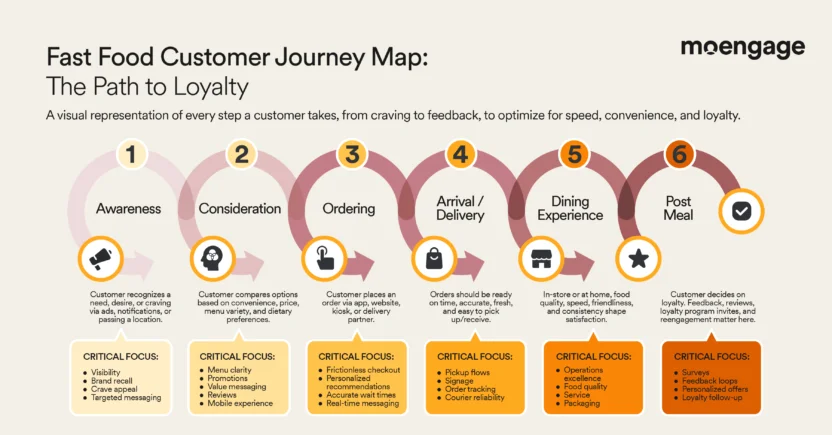
For restaurant-specific examples, read the selected parts of Yelp for Business’s Excel at all 7 stages of the restaurant customer journey. Its seven touchpoints offer detail that can sit inside our four-stage map; you do not need to adopt every suggested tactic.
Excel at all 7 stages of the restaurant customer journey
Read Yelp for Business's restaurant journey guide for concrete examples of what customers encounter before ordering, during a visit, and afterward.
In "Stage 1: Awareness" and "Stage 2: Consideration," read discovery and comparison. Notice the difference between first noticing a restaurant and checking whether it suits a particular meal. In "Stage 3 (online version): Online ordering," read ordering details. In "Stage 3 (in-person version): Booking," read booking friction, then scan the booking options immediately below. These are alternative paths, not steps every diner takes. Finally, in "Stage 7: Post-visit," read post-visit contact. Focus on how feedback and appropriate follow-up can support a later visit.
Here is a compact map for our quick-lunch, advance-order scenario. The touchpoints are places where the café could learn something about the experience or improve it—not all places where it should buy an ad.
| Stage | What the customer is doing | Key touchpoint and possible friction | Café opportunity |
|---|---|---|---|
| Awareness | Notices a nearby lunch option while thinking about what to eat | Street sign or sponsored local post; the café’s name is visible, but what it serves may not be | Make the food and location clear enough to be remembered |
| Consideration | Checks the menu, prices, hours, and whether pickup fits a short break | Menu and reviews; unclear prices or pickup information may rule it out | Give accurate, easy-to-find details that help the customer decide |
| Conversion | Selects a meal and completes a paid pickup order | Mobile checkout; extra fees or a confusing pickup choice may stop the order | Make the total and pickup instructions clear, and confirm the order |
| Retention | Collects and eats the meal, then decides whether the café is worth revisiting | Pickup experience and food quality; a long wait could undo the convenience promise | Deliver the promised experience, address problems, and make a return visit easy |
Awareness means the café becomes an option in the customer’s mind. The person does not have to be ready to buy. A paid post can create awareness, but so can a visible storefront or a recommendation. This is where the prior lesson’s distinction matters: the touchpoint might be advertising, branding, or neither.
Consideration begins when the person seriously assesses the café against alternatives. “Is it open?” “What can I get for my budget?” “Will pickup actually be quick?” A food photo might attract attention, but a readable menu, current hours, and credible reviews do more to answer those questions. A customer can also move between awareness and consideration: finding the café in a search result and inspecting its menu may happen within seconds.
Conversion is the customer action the business wants at this point: in our example, a completed paid order. Starting checkout is progress, but it is not the same as completing it. An ad might encourage the order; clear pricing, available items, and a usable checkout help make it possible.
Retention concerns what happens after the first transaction and whether the customer comes back. The collected meal must live up to the expectation created earlier. A follow-up message or loyalty offer may help the café stay in mind, but it cannot substitute for an accurate order and dependable service. A customer reading a follow-up message is not yet a retained customer; a later repeat purchase is stronger evidence of retention.
Make the map useful, not merely tidy
The café’s four rows are a starting hypothesis. A useful journey map records what the customer is trying to do, what might get in the way, and which touchpoint could resolve that difficulty. It also marks the difference between something the café knows and something it assumes. If the café has not heard customers say that pickup speed matters, it should treat that concern as a plausible question to investigate, not a proven fact.
The path also changes with the type of visit. For a dine-in restaurant, checking reviews and the menu may still be consideration. Booking a table can be an important step toward purchase, but if the business cares about paying diners, a reservation alone is not yet a completed purchase. Arrival, service, the meal, and payment all shape whether that visitor returns. For a walk-in café, the customer might consider the menu at the counter and convert by paying there. Specify the customer and the purchase path before assigning touchpoints to stages.
Finally, avoid labeling every stage an “advertising problem.” If people notice the café but cannot find prices, better information may matter more than another awareness ad. If they order once but do not return because pickup is unreliable, a retention ad cannot fix the underlying experience. The journey map shows where paid communication can support the customer and where other marketing or operational work has to carry the promise.
Takeaways
A local F&B journey can be mapped as awareness (discovering the business), consideration (deciding whether it fits), conversion (completing the chosen purchase), and retention (experiencing enough value to return). For each stage, identify a plausible customer action, touchpoint, source of friction, and opportunity to help. Keep the map customer-centered and treat unverified assumptions as questions to check.
Next, you’ll use this view of the journey to turn a business problem into one measurable advertising objective—a clearer choice once you know which stage needs attention.