Recommended resources
The freely available resources this lesson will direct you to.
Welcome back. In our previous lesson, we explored the conservative argument, rooted in the ideas of Edmund Burke, that a stable society needs authority and tradition that go beyond individual consent. We saw that for conservatives, liberty is not an abstract ideal but something that grows within the soil of an ordered, hierarchical community.
Today, we will examine a related but distinct critique of libertarianism: the communitarian critique. While it shares conservatism's emphasis on community, communitarianism offers a unique philosophical challenge to the libertarian idea of the individual. This lesson will explain the core of this critique: the argument that libertarianism fundamentally misunderstands human nature by underestimating the profound role that community, tradition, and shared purpose play in defining who we are and what makes for a good life.
What is Communitarianism?
At its heart, communitarianism is a philosophy that pushes back against excessive individualism. It argues that the community is not just a collection of separate individuals who happen to live near each other; instead, the community is essential to our identity and well-being.
To get a clear initial definition, let's start with a short video.
This video from PHILO-notes provides a concise introduction to the basic tenets of communitarianism. It explains how the philosophy emerged as a direct response to contemporary liberalism and libertarianism.
Please watch from the beginning to the end of the introduction. As you watch, focus on two key points: The belief that a person's social identity is "largely shaped and influenced by community relations." The fact that communitarianism developed specifically as a critique of philosophies that prioritize personal autonomy and individual rights above all else.
As the video explains, communitarianism challenges the idea that the individual can be understood in isolation. Libertarianism, like the broader liberal tradition it grew out of, tends to see society as a contract between pre-existing, independent individuals. Communitarians argue this gets things backward. We are born into communities, and our values, beliefs, and even our sense of self are formed by them.
The "Unencumbered Self" vs. The "Embedded Self"
The most powerful communitarian critique centers on the very concept of the individual. Libertarians envision a person as an "unencumbered self"—a free agent who stands apart from their history, social roles, and relationships, able to choose their own values and commitments from scratch. Your obligations, in this view, are either chosen (like a contract) or universal (like the non-aggression principle).
Communitarians argue this is a fiction. They propose that we are "embedded" or "encumbered" selves. This doesn't mean we are trapped; it means our identity is interwoven with the stories and communities we are a part of. To be a son or daughter, a citizen of a country, or a member of a religious group isn't just a role you play; it's part of who you are. These unchosen attachments come with their own unique moral weight.
One of the foremost thinkers in this area is the philosopher Michael Sandel. In a famous lecture from his Harvard course on justice, he brilliantly articulates this fundamental disagreement.
Justice: What's The Right Thing To Do? Episode 11: "THE CLAIMS OF COMMUNITY"
In this excerpt from his "Justice" series, Michael Sandel contrasts the liberal view of the free, independent self with the communitarian view of the self as "encumbered" by history and community.
Please watch the following segments carefully: The Independent Self (2:56-4:39): Sandel explains the liberal vision of the self as a "free and independent self, capable of choosing his or her own ends." This is the "unencumbered self" that underpins libertarianism. The Communitarian Critique (4:39-5:21): He introduces the communitarian argument that this view misses a whole category of obligations we recognize in our lives: those of membership, loyalty, and solidarity. The Narrative Self (5:21-8:04): Here, he introduces philosopher Alasdair MacIntyre's idea of the "narrative conception of the self." The key insight is that we are storytelling creatures, and our moral life is part of a larger story we inherit. We are born with "debts, inheritances, expectations, and obligations" that form our "moral starting point."
Sandel's argument cuts to the core of the issue. If our identity is partly made up of our connections to others, then we can't simply detach ourselves to make purely abstract choices about justice, as theories like John Rawls's "veil of ignorance" or the stark individualism of libertarianism would suggest.
The following reading elaborates on this critique, focusing directly on how thinkers like Sandel challenge the abstract, individualistic foundations of liberal and libertarian thought.
Communitarian Critique of Rawls's Theory: Prioritizing ...
This article from the PolSci Institute clearly explains Michael Sandel's critique of the "unencumbered self," providing another angle on the ideas in the video.
Please read the section titled "Michael Sandel’s critique of the unencumbered self." The author uses an analogy about deciding on good food without knowing one's cultural background, which effectively illustrates the communitarian point that context and identity are essential to moral reasoning.
Obligations of Solidarity: Duties We Don't Choose
If we accept the communitarian idea of the "embedded self," it follows that we have obligations that go beyond universal duties (like "do no harm") and voluntary contracts. These are the obligations of solidarity and membership. They arise from our specific relationships and identities.
Do you have a greater responsibility to care for your own parent than a stranger's parent on the other side of the world? Most people intuitively feel that they do. A strict libertarian framework has difficulty explaining this. Your relationship with your parent is not a contract, and the obligation is not a universal duty owed to everyone. It is a particular duty arising from a particular, unchosen relationship.
Sandel provides several powerful examples to test this intuition.
Justice: What's The Right Thing To Do? Episode 11: "THE CLAIMS OF COMMUNITY"
Let's return to Sandel's lecture. He now moves from theory to concrete examples to illustrate what obligations of solidarity look like in practice.
Watch the section from 12:36 to 17:09, where Sandel discusses several cases: The special obligation between parents and children. The French Resistance pilot who refused to bomb his home village. The Israeli airlift of Ethiopian Jews. The concept of patriotism and our special responsibilities to fellow citizens. As you watch, consider whether these obligations can be fully explained by libertarian principles alone, or if they point to a moral dimension that libertarianism might overlook. Later in the lecture, students debate these very points, highlighting cases like loyalty to a cheating roommate or to a fugitive family member to test the limits of these obligations. We won't watch those now, but it shows how complex these issues can become.
These examples are designed to show that our moral world is richer and more complex than a simple framework of individual rights and consent allows. For communitarians, these loyalties are not just sentimental feelings; they are real moral claims. A good society, and a good life, requires acknowledging and navigating these claims, not pretending they don't exist.
Locating Communitarianism
So, where does communitarianism fit on the political map? It doesn't align neatly with the modern "left" or "right." The chart below offers one way to visualize it.
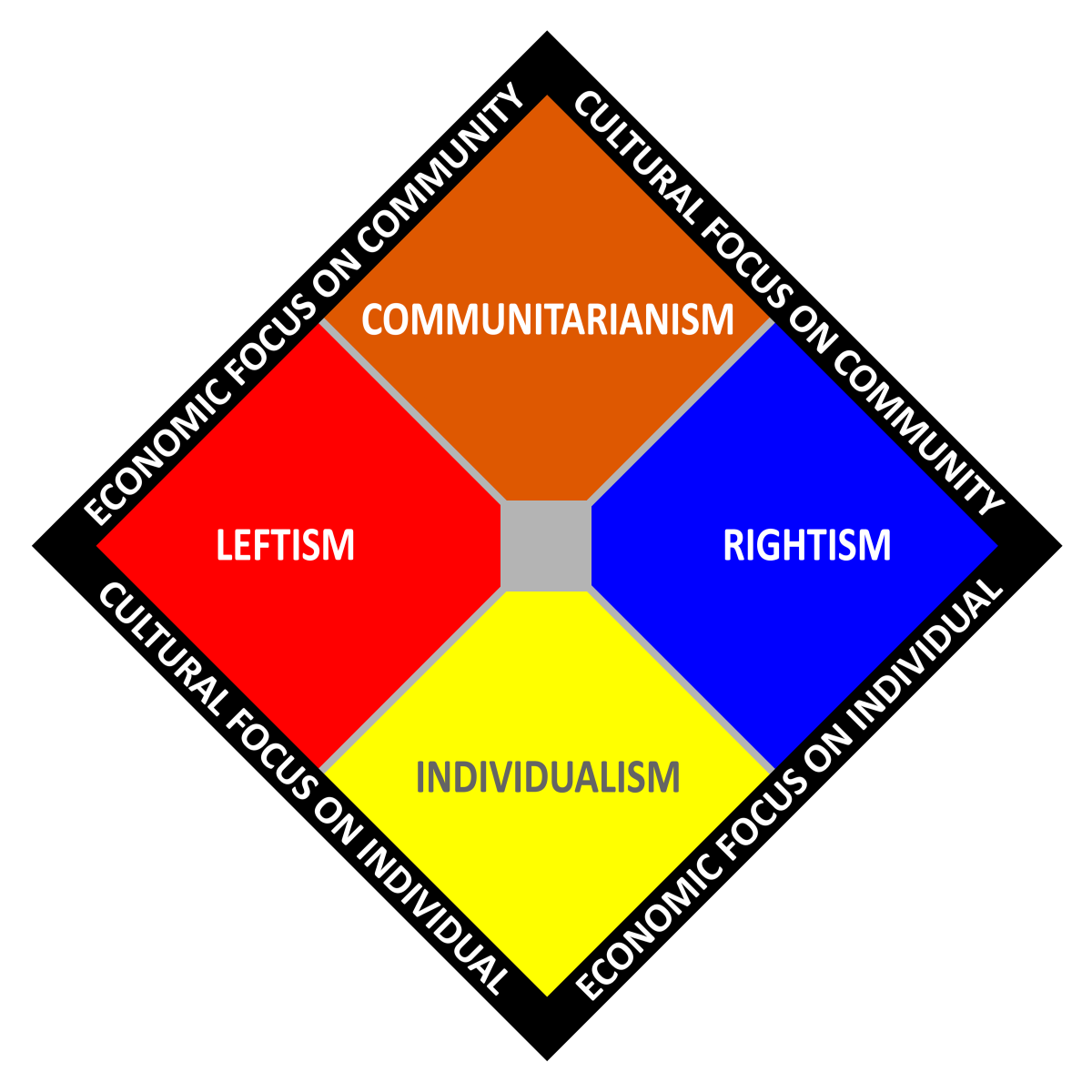
As the chart shows, communitarianism's focus on the community on both the economic and cultural fronts sets it apart.
- Economic Focus on Community: This implies that the collective well-being can sometimes take precedence over pure market outcomes or individual economic freedom. It opens the door for social safety nets, regulation in the public interest, and other collective projects that a strict libertarian would oppose.
- Cultural Focus on Community: This reflects the belief in shared values, traditions, and a common good that we've been discussing. It stands in direct opposition to the radical cultural individualism that characterizes much of modern libertarianism.
Conclusion
In this lesson, we have explored the communitarian critique of libertarianism. This perspective challenges libertarianism at its very root: its conception of the individual. By arguing that humans are fundamentally social creatures whose identities are shaped by their communities, communitarianism presents a powerful case that a just and flourishing society must value more than just individual liberty.
Let's recap the main points:
- The "Embedded Self": Communitarians argue that individuals are not isolated "unencumbered selves" but are "embedded" in a web of social relationships, traditions, and communities that constitute their identity.
- Critique of Individualism: They see the radical individualism of libertarianism as a philosophical mistake that ignores the social nature of human existence and leads to an impoverished understanding of moral life.
- Obligations of Solidarity: Our embeddedness gives rise to special moral obligations to our family, community, and nation—duties that we do not choose through consent but discover as part of who we are.
- The Common Good: A good life involves more than just being left alone; it involves participating in a community and pursuing a shared vision of the common good.
In our final lesson on criticisms from the conservative tradition, we will bring these ideas together. We will examine the specific, practical tensions that arise between libertarian principles and the cherished conservative institutions of the nation, the family, and religion, using the concepts we've learned today to understand these conflicts more deeply.