Recommended resources
The freely available resources this lesson will direct you to.
- Russell Kirk's "Libertarians, the Chirping Sectaries"www.youtube.com
- Why Catholics CAN’T Be Libertarian: The Lie That Poisoned Both Left and Right | Patrick Deneenwww.youtube.com
- Results from the 2018 Libertarianism vs. Conservatism Post-Debate ...www.cato.org
- Conservatives and Libertarians: Uneasy Cousinstheimaginativeconservative.org
Welcome to the final lesson of our course on libertarianism. In our previous session, we examined the communitarian critique, which argues that libertarianism's focus on the "unencumbered self" is a philosophical error. We saw how communitarians propose that we are "embedded selves," shaped by communities and bound by obligations of solidarity that we don't choose but inherit.
Today, we will build directly on that foundation. We'll move from the broader philosophical argument to the specific, practical areas where libertarian individualism clashes with core conservative commitments. This lesson addresses our final learning outcome: to identify the tensions between libertarian individualism and conservative commitments to nation, family, and religion. These three pillars are, for many conservatives, the very institutions that embody the unchosen duties and shared life that communitarians speak of. By exploring these conflicts, we will conclude our survey of the most significant criticisms of libertarian thought.
The Individual vs. The Group: A Fundamental Divide
Before diving into the three specific areas, it's helpful to grasp the core difference in how libertarians and conservatives perceive society itself. Robert Nisbet, a prominent conservative sociologist, provides a clear framework for this.
Conservatives and Libertarians: Uneasy Cousins
This essay by Robert Nisbet, published in Modern Age, is a classic analysis of the relationship between conservatism and libertarianism. It masterfully lays out both their shared beliefs and their fundamental differences.
Please read the first part of section III, starting with the contrasting view of the population. Focus on Nisbet's distinction: Conservatives see society as composed of natural groups (family, church, nation). The individual is understood through these group identities. Libertarians tend to see individuals as the primary reality, with institutions being secondary shadows.
This distinction is the key that unlocks the tensions we will now explore. For conservatives, the nation, the family, and the church are not just voluntary clubs; they are organic, authoritative structures that precede the individual and are essential for a free and ordered society. Libertarianism, with its focus on the sovereign individual, naturally questions the unchosen authority of these institutions.
1. Tension with the Nation
Conservatives, following Edmund Burke, often see the nation as a "community of communities." It's a cultural and spiritual entity built on a shared history, language, and loyalties. This "patriotism" is seen as a virtue and a necessary glue for social cohesion. Furthermore, conservatives tend to believe that a strong, militarily capable nation is essential for protecting its people and their way of life in a dangerous world.
Libertarians, in contrast, are often deeply skeptical of the nation-state. They see nationalism as a dangerous ideology that fuels war, interventionism, and the growth of state power at the expense of individual liberty. For many libertarians, loyalty is owed to principles (like liberty and justice), not to a particular piece of land or a government.
This clash is not just theoretical. It shows up clearly in polling data.
Results from the 2018 Libertarianism vs. Conservatism Post-Debate ...
This survey from the Cato Institute provides fascinating data on the differing views of young libertarians and conservatives.
First, read the brief section titled "Western civilization is at risk." Notice the stark difference in whether each group believes their civilization's identity is at risk. Next, read the section under "Understanding the Differences" that begins "Do young people love America?" This reveals a crucial difference in loyalty: conservatives' loyalty tends to be to the nation itself, while libertarians' loyalty is more to the ideals the nation is supposed to represent.
The core tension here revolves around the trade-off between security and liberty. A conservative may argue that defending the nation sometimes requires conscription, high taxes for defense, and a powerful state—all things a libertarian abhors. A libertarian argues that these very things are the greatest threat to liberty and that a non-interventionist foreign policy is the only one consistent with a free society.
Nisbet captures this ultimate conflict perfectly.
Conservatives and Libertarians: Uneasy Cousins
Let's return to Robert Nisbet's essay.
Please read the final section, starting from "There is a final area" where he discusses the nation. He argues that for conservatives, the supreme danger is national weakness in a world of aggressive despotisms. For libertarians, the supreme danger is the growth of our own state's power in the name of fighting those despotisms. He predicts this issue is the "rock above all others" on which the two ideologies will break.
2. Tension with the Family
Conservatives view the family—specifically, the traditional two-parent family—as the natural and indispensable foundation of social order. It is the primary institution for transmitting moral values, raising children into responsible citizens, and providing social stability. Its authority is seen as natural, not based on the daily consent of its members.
Libertarianism, founded on self-ownership and voluntary contract, views the family as an association of individuals. While most libertarians value family, the philosophy itself doesn't grant any special status to a particular family structure. The key is that all relationships within it are consensual and non-aggressive. This logic can be seen as undermining the traditional, hierarchical authority that conservatives believe is essential to the family's function.
Political theorist Patrick Deneen argues that the "market logic" inherent in liberalism and libertarianism—the logic of consumer choice and individual preference—inevitably seeps into and corrodes traditional institutions like the family.
Why Catholics CAN’T Be Libertarian: The Lie That Poisoned Both Left and Right | Patrick Deneen
In this interview, Patrick Deneen, a professor at the University of Notre Dame, explains his critique of liberalism, which he sees as the parent philosophy of both modern progressivism and right-libertarianism.
Watch the segment from 14:50 to 17:50, where Deneen explains how "market logic" dismantles authoritative systems. He argues this logic of individual choice extends to dating, marriage, and family, undermining traditional norms and parental authority. Then, watch from 19:23 to 21:05. Here, he argues that the "natural family" became a primary "wall" of resistance to this logic, leading the state to take a more aggressive role in "liberating" children from their families.
Again, this philosophical tension is reflected in survey data.
Results from the 2018 Libertarianism vs. Conservatism Post-Debate ...
Let's look at the Cato survey data on the family.
Read the short paragraph starting "In a consistent pattern,". Note the overwhelming conservative belief that the "intact heterosexual two-parent family" is the "necessary bedrock for a stable polity," and how libertarians are deeply divided on the same question.
The tension is clear: For conservatives, the family is a pre-political institution with a specific structure and purpose essential for society. Any philosophy that reduces it to just another voluntary arrangement of individuals threatens its vital role.
3. Tension with Religion
For many conservatives, religion is the ultimate source of moral order. They believe that a society's laws and values must be anchored in a transcendent moral code, often rooted in a specific tradition like Judeo-Christianity. Religion provides the "oughts" that guide human behavior, and the institutions of religion (churches, synagogues, mosques) are crucial for building community and character.
Libertarianism, while not anti-religious, is philosophically secular. Its principles are derived from reason and natural law, not divine revelation. The proper role of the state is to be neutral in matters of faith, protecting every individual's right to believe or not believe as they see fit. The idea of basing political life on the principles of one particular religion is fundamentally at odds with this commitment to individual liberty and a limited state.
The conservative thinker Russell Kirk saw ideologies like libertarianism as dangerous "secular counter-religions" that tried to replace the moral order provided by traditional faith.
Russell Kirk's "Libertarians, the Chirping Sectaries"
This video discusses the famous essay "Libertarians: the Chirping Sectaries" by conservative intellectual Russell Kirk.
Please watch from 10:44 to 11:53. The speakers discuss the role of religion in conservatism and Kirk's suspicion that any ideology is an attempt "to create a kind of secular counter-religion."
Patrick Deneen takes this critique even further, arguing that the relentless pursuit of individual autonomy logically culminates in rejecting God as the "ultimate tyrant."
Why Catholics CAN’T Be Libertarian: The Lie That Poisoned Both Left and Right | Patrick Deneen
Returning to the Patrick Deneen interview, let's see how he connects the logic of liberty to religion.
First, watch from 11:34 to 12:36. Deneen argues that the principle of "freedom from every arbitrary imposition" naturally expands from politics to the family, the church, and ultimately to God. Then, consider his final point from 1:38:01 to 1:40:25. He discusses how prayer itself becomes a "political problem" because the modern world, organized around distraction and efficiency, works directly against the time, silence, and effort that religious devotion requires.
Once more, this deep philosophical divide is visible in polling. The Cato survey shows that conservatives and libertarians have almost perfectly opposite views on whether political life should be based on Judeo-Christian principles.
Results from the 2018 Libertarianism vs. Conservatism Post-Debate ...
Let's look at the data on religion.
Read the section titled "Conservatives Say Political Life Should be Based on Judeo-Christian Principles." The numbers here—87% of conservatives agreeing versus 70% of libertarians disagreeing—could not be more stark.
Synthesis: To Whom is the Debt Owed?
We can synthesize these three tensions—nation, family, and religion—by returning to the communitarian idea of unchosen debts and obligations. This is perfectly captured in the following diagram.
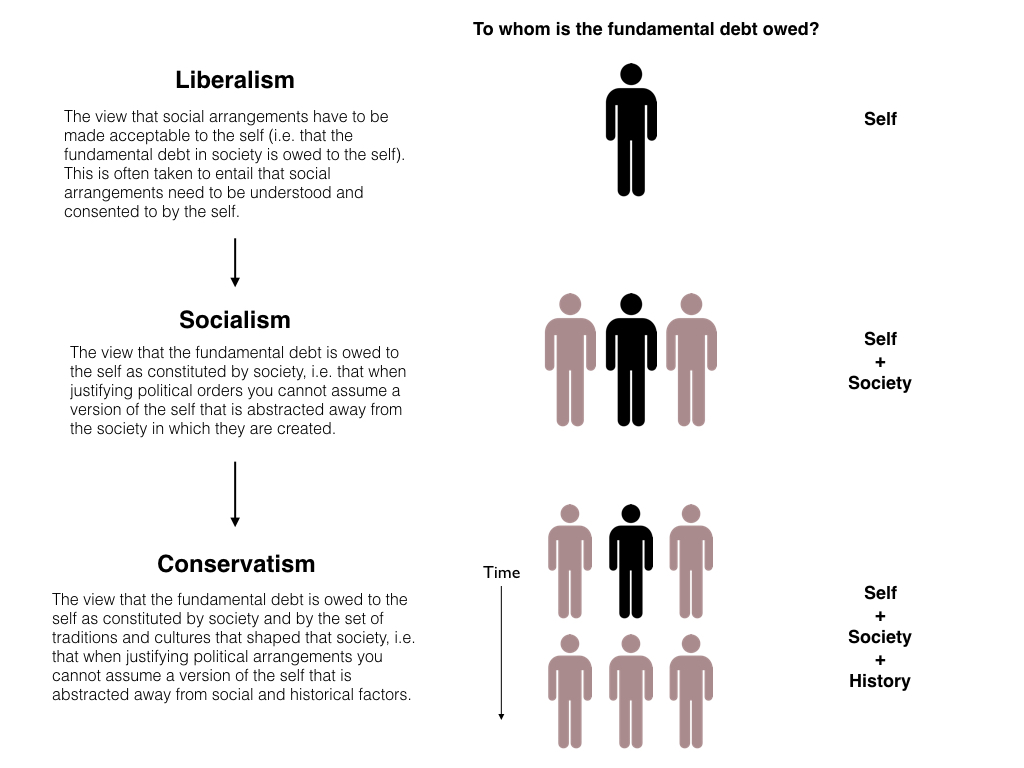
This diagram elegantly summarizes our journey. Libertarianism, growing from the root of liberalism, holds that the fundamental debt is owed to the Self. Our primary obligations are to respect the autonomy and rights of other individuals.
Conservatism argues that this is radically incomplete. We also have a debt to Society and to History. For conservatives, the institutions of nation, family, and religion are the primary vessels through which we understand and fulfill these inherited obligations to our country, our ancestors, and God. Because libertarianism prioritizes the autonomous individual, it inevitably finds itself in tension with the unchosen authority and collective demands of these core conservative commitments.
Conclusion
This lesson, and our course, concludes here. We have charted the deep-seated tensions between libertarian individualism and the conservative emphasis on an organic social order.
Let's summarize the key takeaways:
- Nation: Conservatives prioritize national strength and cohesion, even at the cost of some individual liberties, seeing it as a bulwark in a dangerous world. Libertarians prioritize non-intervention and fear the growth of the state, viewing nationalism as a threat to freedom.
- Family: Conservatives see the traditional family as the natural, authoritative bedrock of society. Libertarians see it as one of many forms of voluntary association, questioning its traditional hierarchy in favor of individual consent.
- Religion: Conservatives often view religion as the essential source of public morality. Libertarians insist on a secular public square where religion is a private matter, and no single creed informs the law.
At the heart of these conflicts is the fundamental disagreement we first encountered in the communitarian critique: is the human person a free-floating, "unencumbered self," or an "embedded self" who finds meaning and identity within the unchosen realities of history, community, and tradition?
You began this course with the goal of studying libertarianism rigorously enough to form your own informed and honest position. You have explored its principles, its major thinkers, its economic arguments, and its internal debates. Finally, you have grappled with its most powerful critics from both the socialist and conservative traditions. The intellectual foundation is now yours. The task of synthesis and judgment now begins.