Recommended resources
The freely available resources this lesson will direct you to.
- Edmund Burke - Reflections on the Revolution in France| Political Philosophywww.youtube.com
- Roger Scruton: Why Intellectuals are Mostly Leftwww.youtube.com
- The Importance of Authority and Power in Conservative Thoughtpolsci.institute
- 4.1.2 Hierarchy and Authority – Political Ideologies and Worldviewskpu.pressbooks.pub
Welcome back. In our last lesson, we explored the conservative concern that an unchecked market economy can erode the moral and social fabric of a community by commercializing aspects of life that should be sacred. We saw how virtues like honesty and self-discipline—which conservatives call "ethical reserves"—are cultivated in non-market institutions like the family and church, yet are consumed by the market itself.
Today, we will delve deeper into the conservative worldview by examining another of its core arguments against libertarianism. This lesson addresses the fundamental libertarian principle that all legitimate human interactions must be based on voluntary consent. Conservatives challenge this, arguing that a stable and flourishing society requires something more: an acceptance of legitimate authority and natural hierarchy, even when we haven't explicitly consented to them. Our goal is to understand why conservatives believe that social order, and indeed true liberty, depends on authority that goes beyond individual agreement.
Authority vs. Power: A Crucial Distinction
To begin, we need to clarify what conservatives mean by "authority," as it is often confused with raw power or brute force. For conservatives, the two are distinct.
- Power is the ability to force someone to do something, whether they agree or not. It is based on coercion.
- Authority is the legitimate right to direct, guide, and command. It is based on respect, tradition, or a recognized social role.
Conservatives argue that authority arises naturally within society from the basic functions people perform. A parent has authority over a child not because of a signed contract, but because their role requires them to protect, guide, and educate. A teacher has authority in a classroom to maintain an environment where learning is possible. For conservatives, this kind of authority isn't an arbitrary imposition but an organic and necessary part of a functional society.
The Importance of Authority and Power in Conservative Thought
This article from the PolSci Institute provides a straightforward introduction to how conservatives think about authority and power. It clearly lays out the foundational concepts we'll be building on.
Please read the first two main sections, covering the foundation of authority and the role of power. As you read, focus on the distinction between authority as a natural and legitimate right to command (like a parent's) and power as the ability to enforce those commands (like the government's).
The Inevitability of Hierarchy
The idea that authority arises naturally from different social roles leads directly to another core conservative belief: the necessity of hierarchy. If different people have different roles and responsibilities—parent and child, employer and employee, ruler and citizen—then society will inevitably be structured hierarchically.
From a libertarian perspective, any hierarchy that isn't voluntarily agreed upon is suspect. Conservatives, however, see hierarchy not as a system of oppression, but as a natural and essential framework for social order. They argue that this structure isn't just a top-down command system. It involves mutual obligations: those in authority have a duty to lead responsibly and care for those under their charge, while those in subordinate positions have a duty to respect legitimate authority. When these obligations are met, the hierarchy fosters stability and social cohesion.
4.1.2 Hierarchy and Authority – Political Ideologies and Worldviews
This textbook excerpt further clarifies the conservative view of hierarchy and its connection to legitimate authority. It emphasizes the network of duties that holds a hierarchical society together.
Read the section titled Hierarchy and Authority. Pay close attention to how the author explains that legitimate authority creates two sets of obligations—for both the leaders and the led—and why this is seen as crucial for preventing exploitation.
Edmund Burke and the Organic Society
The most influential articulation of these ideas comes from the 18th-century philosopher and statesman Edmund Burke. His thought, forged in response to the French Revolution, stands as a powerful counterpoint to ideologies that seek to redesign society based on abstract reason and universal rights—the very impulses that animate much of libertarianism.
Burke argued that society is not a machine that can be taken apart and rebuilt according to a blueprint. Instead, he saw it as a complex, living organism—a partnership between "those who are living, those who are dead, and those who are to be born." It grows slowly over centuries, and its institutions (like the monarchy, the church, and the law) embody the accumulated wisdom of countless generations. To sweep them away in the name of abstract principles like "the rights of man" was, for Burke, an act of supreme arrogance and folly that would inevitably lead to chaos and tyranny. He believed that liberty was not an abstract ideal but a concrete inheritance, secured by the very institutions and hierarchies the revolutionaries sought to destroy.
Edmund Burke - Reflections on the Revolution in France| Political Philosophy
This video from James Muldoon's channel provides an excellent overview of Burke's critique of the French Revolution, which became a founding text of modern conservatism.
Please watch the following segments to grasp Burke's core arguments: Introduction (0:17-0:45): This sets the stage, explaining his opposition to abstract Enlightenment principles in favor of established custom and tradition. Ordered vs. Radical Change (5:34-7:24): The narrator contrasts the English Glorious Revolution (which preserved continuity) with the French Revolution (which sought a radical break). This highlights the conservative preference for gradual evolution over revolutionary upheaval. Liberty Requires Order (7:24-9:27): This is a crucial section. Note Burke's argument that liberty is not an abstract right but requires preconditions like social ranks, property, and respect for authority. He famously warned, "But what is liberty without wisdom, and without virtue? It is the greatest of all possible evils." Organic Society & Hierarchy (10:16-11:59): This part explains Burke's "organic" view of society and his belief in natural social hierarchies, which he saw as embodying the collective wisdom of generations.
Liberty Through Order, Not Against It
This brings us to the heart of the conservative challenge to libertarianism. A libertarian hears talk of authority, tradition, and hierarchy and sees only oppression and a violation of individual autonomy. The conservative response is that this view is dangerously naive. They argue that true, lasting liberty is impossible without the structure and stability that these things provide.
In the conservative view, liberty and authority are not opposing forces but complementary ones. Authority, when legitimate, creates the order within which freedom can be safely exercised. Without the guardrails of law, tradition, and shared moral norms, society would descend into a "war of all against all," where the strong dominate the weak and no one's rights are secure. Freedom, in this view, is not about being left alone to do whatever you want; it is "ordered liberty"—freedom exercised responsibly within a stable social and political framework.
The Importance of Authority and Power in Conservative Thought
Let's return to the PolSci Institute article to see how conservatives reconcile their emphasis on authority with the value of liberty. This passage directly addresses the central tension between the two ideologies.
Read the section "Liberty and order: The conservative perspective". Focus on the argument that liberty and authority are complementary, and that the rule of law and respect for tradition create the necessary environment for freedom to thrive.
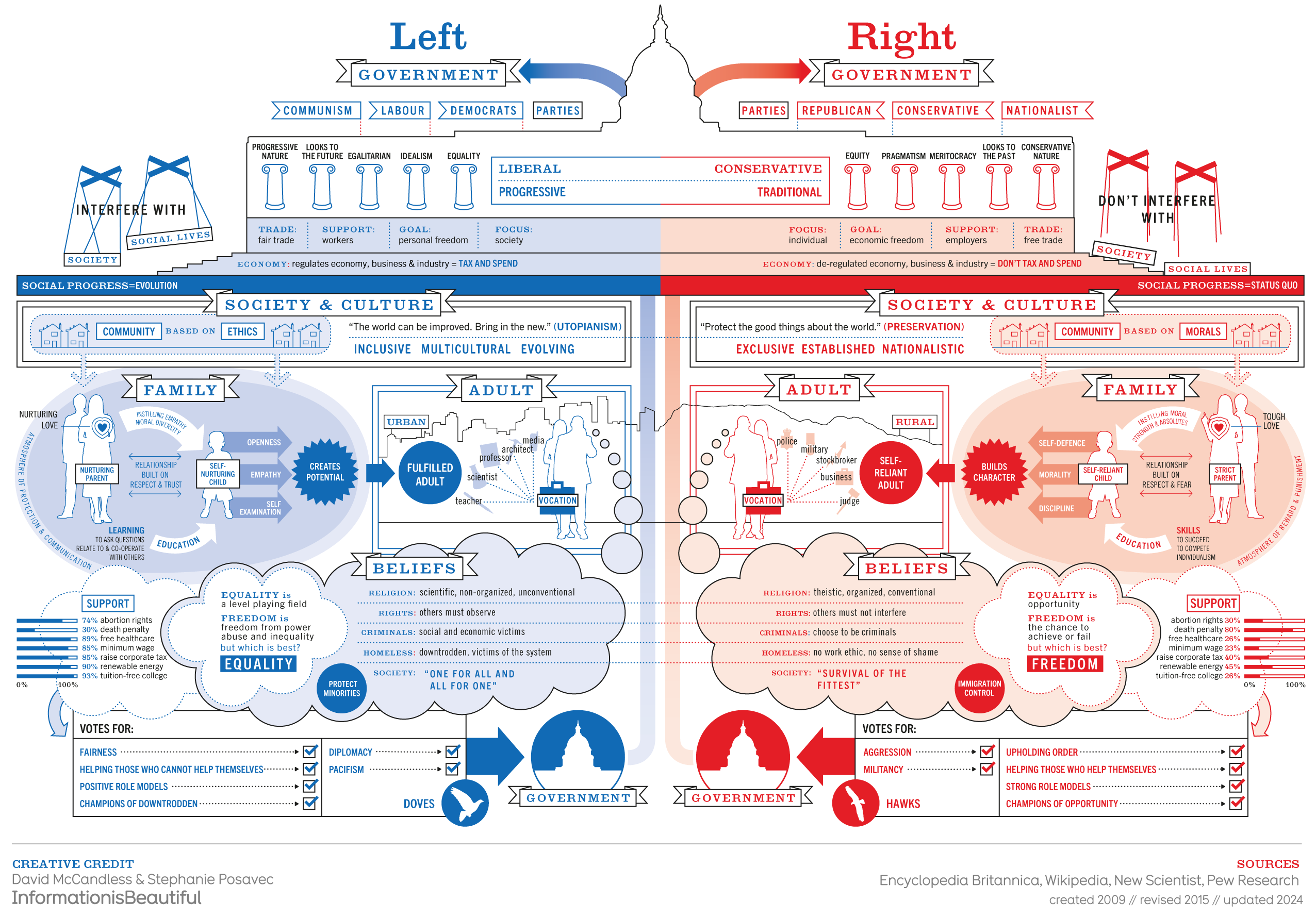
The infographic below offers a simplified visual map of the differing worldviews. Notice how the "Right" side emphasizes concepts that align with the conservative position we've been discussing.
Conclusion
In this lesson, we have explored the conservative argument that social order requires authority that extends beyond individual consent. This view presents a fundamental challenge to the libertarian focus on voluntary agreements as the sole basis of a just society.
Let's summarize the key takeaways:
- Authority is not Power: Conservatives distinguish between legitimate authority, which is based on respect and social function, and mere power, which is based on coercion.
- Hierarchy is Natural: They see society as naturally hierarchical. This structure, when based on mutual obligation, is considered essential for order, stability, and efficiency.
- Society is an Organism: Following thinkers like Edmund Burke, conservatives view society as a living organism that has evolved over generations. Its traditions and institutions contain inherited wisdom and should not be discarded lightly for abstract theories.
- Order Enables Liberty: The core of the argument is that true liberty depends on order. Without the framework provided by tradition, institutions, and legitimate authority, freedom collapses into chaos, and rights become meaningless.
This conservative argument suggests that by focusing exclusively on freeing the individual from all unchosen obligations, libertarianism risks dissolving the very social bonds and authoritative structures that make a free and civilized life possible.
In our next and final lesson on critiques of libertarianism, we will examine the communitarian critique. While it shares the conservative emphasis on the importance of community, it arises from a different philosophical tradition and offers its own unique arguments against radical individualism, often from a more politically left-leaning perspective.