Recommended resources
The freely available resources this lesson will direct you to.
Welcome back. The previous lesson developed a disciplined way to assess AI in fund administration: data quality, variability, exceptions, auditability, confidentiality, and human oversight determine whether AI should draft, assist, or stay out of production.
Blockchain requires a different question. It is not principally a tool for making one firm’s internal work faster. A distributed ledger can be valuable when several organisations need to maintain, trust, and update the same record—yet currently hold separate records and spend effort reconciling them. In private equity and venture capital, that could include the fund manager, administrator, transfer agent, custodian, investors, and sometimes a regulated trading or settlement venue.
By the end of this lesson, you should be able to judge whether a fund-administration workflow is a credible DLT candidate by testing seven issues: shared-record need, legal finality, identity, interoperability, governance, adoption, and the constraints created by private-fund economics.
First principle: a token is not automatically the legal fund interest
A tokenized fund interest is a digital representation of ownership or entitlement relating to a fund, recorded on a blockchain or other distributed ledger. That description sounds straightforward, but it hides the central operational question:
Does the ledger record the legally authoritative investor register, or does it merely mirror another legally authoritative register?
If the answer is “mirror,” the blockchain may still improve visibility or automate a process. But it does not eliminate the need for reconciliation. It may create another controlled record that the administrator must reconcile to the accounting system, transfer register, bank records, and legal documentation.
This distinction is particularly important for closed-end PE and VC funds. An LP interest is not a freely transferable public share. It is ordinarily subject to the limited partnership agreement, subscription documents, side letters, investor-eligibility rules, KYC and AML controls, manager consent, tax considerations, and often restrictions on transfers. A token cannot override those terms.
The UBS and SBI workflow below illustrates a realistic design principle. The fund administrator still calculates and validates NAV, the transfer-agent logic acts on that validated data, and the asset manager continues to operate the underlying fund. The distributed ledger connects parties and records selected events; it does not cause all off-chain accounting, valuation, and legal responsibilities to disappear.
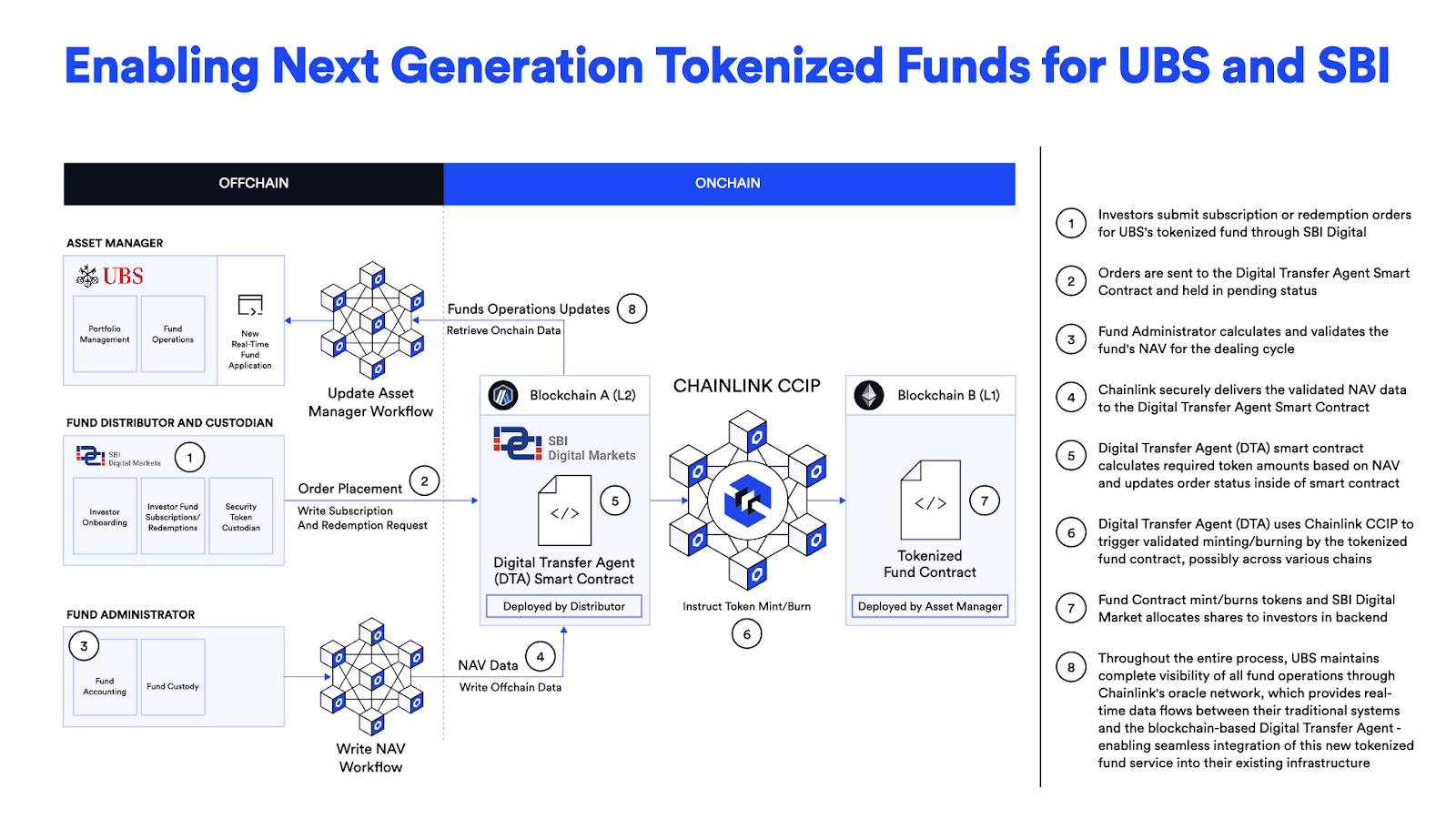
A useful contrast is:
| Traditional architecture | DLT-enabled architecture |
|---|---|
| Each participant maintains its own record and reconciles differences | Eligible participants access a synchronised record under agreed permissions |
| Transfers and checks pass through several messages and updates | Approved transfer rules may be executed and recorded in one shared workflow |
| The administrator produces reports for other parties | Certain authorised parties may inspect defined ledger data directly |
| The official investor register is maintained in a conventional system | The on-chain register may be the official register only where law, fund documents, and governance support that status |
Before considering a product or vendor, build the conceptual foundation.
[PDF] An Investment Perspective on Tokenization
Read the CFA Institute report for two foundations: how permissioned and permissionless ledger designs differ, and why a shared ledger can reduce reconciliation only where multiple parties genuinely need the same transaction record.
In Chapter 1, read subsections “1.1.1 Permissioned vs. Permissionless” through “1.1.4 Open Source vs. Closed Source.” Begin at the network-design discussion. Focus on who may read, validate, and change records; these choices matter more to a private fund than generic claims about decentralisation. Then read Chapter 3, Section “3.1 Clearing and Settlement,” on pages 27–29. Start at the clearing and settlement analysis. Notice the caution at the end: faster settlement alone is not evidence that blockchain is necessary.
The seven-part DLT suitability test
A sound assessment starts with the workflow, not the technology. “Tokenize the fund” is not a workflow. “Maintain a controlled register of permitted LP transfers across an administrator, custodian, and regulated venue” is a workflow that can be assessed.
Use the following seven questions. A weak answer to one may be manageable; failure on legal authority, identity, or governance is generally a reason to stop or narrow the proposal.
| Test | Core question | A favourable answer | Warning sign |
|---|---|---|---|
| 1. Shared-record need | Do independent parties need the same current record? | Several parties maintain overlapping ownership or transaction records and repeatedly reconcile them | One administrator already controls the record, and an API or conventional database solves the issue |
| 2. Legal finality | Does an on-chain update legally transfer the interest and settle obligations? | Law, fund documents, and contracts recognise the ledger or define it as authoritative | The token is technically transferable but legal title still changes only after off-chain approval |
| 3. Identity and permissions | Can every holder, wallet, approver, and service provider be verified and appropriately restricted? | KYC status, investor eligibility, wallet controls, and role permissions are reliably linked | An investor can transfer to an unknown wallet or lose access through unmanaged private keys |
| 4. Interoperability | Can the ledger connect safely to accounting, cash, custody, reporting, and other chains? | Common data standards and controlled interfaces exist for the necessary systems | The project creates manual exports, duplicate data, or isolated token ecosystems |
| 5. Governance | Who controls code, validators, upgrades, incidents, and exception handling? | Clear authority, change control, code audits, escalation procedures, and liability allocation | “The blockchain handles it” substitutes for accountable operating governance |
| 6. Adoption and incentives | Will the necessary participants use the system? | Investors, manager, administrator, custodian, counsel, and relevant venue gain enough value to participate | A technically sound network has too few users, little liquidity, or no commercial incentive |
| 7. Private-fund constraints | Does the design respect illiquidity, bespoke terms, valuations, and transfer restrictions? | Token permissions reflect the LPA, side letters, and fund economics | Technology assumes continuous liquidity or standardised rights that the fund does not have |
1. Shared record: the genuine reason to consider DLT
A shared ledger is most promising when there are multiple independent record keepers. Consider an LP transfer in a tokenized feeder fund. The fund administrator may maintain the investor register, a custodian may track holdings, a transfer agent may apply restrictions, a venue may match a permitted buyer and seller, and the manager must consent to the transfer. If each maintains a separate record, reconciliation and timing mismatches are plausible sources of cost and risk.
By contrast, calculating the quarterly NAV of a private portfolio is rarely a strong blockchain use case by itself. The calculation may involve financial statements, forecasts, comparable-company data, valuation policies, and committee judgment. Those are primarily questions of data quality, valuation governance, and accounting control. Putting the final number on a ledger does not improve the underlying valuation judgment.
Practical test: identify every organisation that maintains or relies on its own version of the record. Then estimate the cost, frequency, and risk of reconciling those versions. If there is no material duplication or mistrust problem, a DLT network is unlikely to justify its complexity.
2. Legal finality: technical confirmation is not legal settlement
A blockchain may provide technical finality: network rules treat a transaction as confirmed and difficult to alter. Legal finality is different. It asks whether the transaction is recognised as having transferred ownership or discharged an obligation under applicable law and the fund’s legal documents.
For a private fund, legal analysis should establish:
- whether the token represents legal title, beneficial ownership, or only a contractual claim;
- whether the on-chain register is the official register of partners or investors;
- whether an on-chain transfer is valid under the LPA and subscription documents;
- who has authority to approve a transfer, correct an error, freeze a wallet, or reverse an unauthorised event;
- what happens in an insolvency, lost-key, fraud, or cybersecurity incident;
- whether a cash payment and fund-interest transfer settle together in a legally recognised manner.
An immutable ledger does not mean an erroneous transaction cannot be addressed. It means that correction generally requires a new, traceable transaction rather than erasing history. The legal and operational process for that correction must be established before production use.
3. Identity: permissioning is a fund-control issue, not a technical footnote
In a conventional private fund, investor identity sits inside the onboarding process. The administrator collects documents, performs KYC and AML checks, records investor classification, and applies eligibility restrictions. A DLT system must preserve that discipline.
For most private-fund applications, the likely model is therefore permissioned access. Only approved investors and service providers may view or initiate designated actions. Transfer permissions can enforce conditions such as:
- an investor must be verified and eligible;
- the transferee must have passed KYC and AML review;
- the manager or transfer agent must approve the transfer;
- a lock-up period or transfer window must be respected;
- a side-letter restriction must be applied;
- a wallet must be linked to the verified investor record.
The difficult part is linking a real-world legal person to a digital wallet while preserving confidentiality. A wallet address alone does not establish investor identity. Nor should an administrator expose sensitive LP information to every participant simply because they share a ledger.
Interoperability, governance, and adoption determine whether the model survives contact with operations
A blockchain cannot be assessed as an isolated technical component. A fund administrator works across accounting systems, investor registers, bank accounts, custodians, document repositories, tax reporting, and reporting platforms. The DLT solution must work with those systems.
Interoperability: the chain must connect to the operating reality
A tokenized fund interest can only be useful if information moves reliably between the ledger and the rest of the fund’s operating environment. Three integration points matter especially.
-
The fund-accounting and NAV interface
For PE and VC funds, NAV is often periodic and valuation-dependent. The ledger may record a validated NAV, but it should not independently invent or determine it. A controlled source supplies the approved value. -
The cash leg
Ownership transfer and cash payment are distinct events unless the design can settle both in a coordinated manner. A token transfer that completes while payment remains pending can create operational and counterparty risk. Digital cash or tokenized bank deposits may eventually support more integrated settlement, but conventional bank rails remain central in many real implementations. -
Cross-system and cross-chain records
If a manager supports more than one blockchain, custodian, or distribution channel, the system needs common data definitions and dependable controls. Otherwise, tokenization may merely move reconciliation from one set of systems to another.
A common failure mode is dual running without a clear purpose: the administrator keeps the normal books and register, while a blockchain vendor maintains another record. Dual running can be sensible during a pilot or legal transition, but it should be treated as additional control work, not automatically as an efficiency gain.
Governance: someone must be accountable when code is wrong
Smart contracts can enforce predefined rules, such as a transfer lock-up or investor-count limit. But rules must first be interpreted, coded, tested, approved, monitored, and changed. That is governance.
A production design needs explicit answers to questions such as:
- Who appoints or removes validator nodes?
- Who approves smart-contract code and later upgrades?
- Who can pause transfers after a cyber incident?
- Who resolves a mismatch between the on-chain register and a signed side letter?
- How are keys held, recovered, or replaced?
- What evidence is retained for auditors, regulators, the AIFM, and the depositary where relevant?
- How are code defects, investor complaints, and vendor failures handled?
The required governance resembles familiar fund-administration controls: segregation of duties, controlled changes, approval evidence, incident management, and reconciliations. The technology changes the operating model; it does not eliminate the need for accountable humans and firms.
Adoption: a network is only useful if its critical participants join it
DLT benefits often depend on network participation. If only the fund manager uses the platform while the administrator, custodian, investors, and cash providers remain outside it, the shared-record advantage is limited.
This is especially important for secondary liquidity in private funds. Tokenization can make a transfer technically easier, but it cannot create buyers for illiquid fund interests. A PE fund may still have multi-year holding periods, manager-consent requirements, valuation uncertainty, and restricted transfer windows. A VC fund may hold highly uncertain, concentrated positions that are unsuitable for continuous trading.
The question is not, “Can an LP token be traded?” It is, “Would enough eligible, approved investors trade it within the fund’s legal and economic constraints to create useful liquidity?”
The following material concentrates these constraints in the alternatives context.
Scaling alternatives with tokenised fund structures
Read the AIMA overview to connect the DLT assessment criteria to alternative funds: fragmented platforms, KYC, legal recognition, smart-contract controls, digital cash, and the special complexity of PE and VC fund terms.
Start with “Challenges: Interoperability, liquidity formation and operating risk.” Read the operating-risk discussion. Focus on why an immutable record must still coexist with privacy, identity, and resilience obligations. In “Legal and regulatory considerations in key funds jurisdictions,” read the opening discussion at the legal-certainty discussion, then read the European Union bullet through the Luxembourg context. The jurisdictional examples are illustrative; the transferable principle is that legal recognition must be verified for the particular fund and structure. Finally, read “Emerging best practices,” first the resilient-model design, then the alternatives-specific design through the final paragraph. Treat “oracle inputs” as controlled mechanisms that bring approved off-chain data, such as NAV, into an on-chain workflow.
Applying the test to PE and VC fund-administration workflows
The same technology produces very different answers depending on the workflow boundary.
| Workflow | DLT suitability | Why |
|---|---|---|
| Official register for permitted transfers of tokenized feeder interests | Potentially strong, conditional | There may be multiple parties with a real shared-record need. It requires legal recognition, verified identity, transfer restrictions, custody arrangements, and manager approval controls. |
| Quarterly NAV calculation for a PE fund | Low as a primary DLT use case | Valuation is off-chain, judgment-heavy, and based on private data. A ledger may distribute the approved result, but does not solve the calculation itself. |
| Capital-call notices and payment-status tracking | Moderate, usually hybrid | The ledger may give authorised parties a common view of notice status and receipts. Yet bank payment processing, investor-specific terms, defaults, and cash reconciliation remain central. |
| Distribution waterfall execution | Moderate only after terms are settled | Smart contracts can execute deterministic approved rules, but side letters, tax treatment, catch-ups, recycling, and interpretation of the LPA often require off-chain review. |
| Investor eligibility controls | Potentially strong as a supporting control | A verified investor register linked to approved wallets can prevent unauthorised transfers. The hard work is onboarding, identity maintenance, and data protection. |
| Continuous secondary trading of a VC fund token | Usually weak initially | Tokenization does not remove the underlying illiquidity, valuation uncertainty, lock-ups, or consent requirements that constrain the market. |
Worked assessment: tokenizing transfers in a Luxembourg PE feeder
Imagine a Luxembourg feeder fund whose LP interests are proposed to be tokenized. The sponsor expects lower transfer-administration cost and controlled secondary liquidity for eligible professional investors.
A disciplined assessment might conclude:
| Criterion | Initial finding | Implication |
|---|---|---|
| Shared record | Plausible: manager, administrator, transfer agent, custodian, and venue may need synchronised ownership data | Proceed to define precisely which record becomes authoritative |
| Legal finality | Unproven until counsel confirms recognition of the register, transfer mechanics, and insolvency treatment | Do not launch an official on-chain register without legal documentation |
| Identity | Achievable through a permissioned investor and wallet allowlist | Build KYC, AML, sanctions, consent, and revocation controls before enabling transfers |
| Interoperability | Likely difficult because NAV, cash, tax, and accounting remain in conventional systems | Start with limited integrations and retain reconciliation controls |
| Governance | Material requirement: code upgrades, key custody, incidents, and exception resolution need clear owners | Establish a governance agreement and operational runbook |
| Adoption | Uncertain: eligible LPs and their custodians must use the arrangement for liquidity to form | Test demand before building a broad trading feature |
| Overall conclusion | Suitable for a limited, controlled pilot—not yet for unrestricted transferability | Begin with an approved investor register and periodic transfer windows |
That conclusion is not anti-blockchain. It simply keeps the scope aligned with the value. A reasonable first stage may be a permissioned record of approved investor holdings and transfer approvals, operated alongside the existing administrator-controlled process. The pilot can measure whether it reduces reconciliation, approval time, or operational error without assuming that it creates immediate liquidity.
The following excerpts give a fund-manager perspective on choosing the underlying infrastructure. Watch them with a critical eye: the speaker describes real criteria, but the criteria must still be matched to a specific fund’s legal and operational requirements.
Tokenizing the Future: How abrdn is utilizing blockchain technology for fund tokenization
In “Tokenizing the Future: How abrdn is utilizing blockchain technology for fund tokenization,” Hedera interviews abrdn’s Duncan Moyer. The selected portions connect the basic tokenization proposition to network choice, legal recognition, and controls.
Watch the definition for the idea of representing ownership rights through a digital token and a shared record. Then watch network selection. List the governance and business-continuity criteria alongside the technical ones; speed alone is not a sufficient choice criterion. Watch legal recognition to reinforce the difference between tokenization and legal enforceability. Finish with compliance controls, focusing on domicile, venue restrictions, KYC, distribution controls, and cybersecurity.
A practical go, narrow, or no-go decision
For a proposed DLT workflow, prepare a short assessment memo with these six elements:
-
Define the authoritative event
Specify the precise event to be recorded: an approved transfer, a subscription, a NAV publication, a distribution entitlement, or something else. -
Map each party and record
Identify who creates, validates, reads, approves, and relies on the record today. Distinguish genuine independent participants from internal users of one firm. -
Establish legal status before technical design
Obtain a documented conclusion on the status of the token, register, transfer, custody, settlement, and correction process. -
Specify identity and permission rules
Define investor eligibility, wallet controls, KYC refreshes, sanctions screening, access tiers, consent rights, and offboarding procedures. -
Design operating governance
Assign responsibility for code review, upgrades, exceptions, error correction, key management, cybersecurity, audit evidence, and incident response. -
Measure an operational benefit
Compare the expected reduction in reconciliations, settlement delay, error rates, operational workload, or distribution friction against implementation, legal, control, and change-management costs.
A narrow pilot is justified when it creates measurable value without changing legal ownership or releasing irreversible money movements. An unrestricted production rollout is appropriate only when legal authority, identity controls, operating governance, and participant adoption are all mature.
Key takeaways
Blockchain is not a universal upgrade to fund administration. Its core value is a shared, synchronised record across independent participants. If the problem is internal data quality, bespoke legal interpretation, valuation judgment, or a lack of market liquidity, blockchain may not be the right solution.
For a PE or VC fund workflow, assess:
- whether multiple parties genuinely need one shared record;
- whether on-chain actions have legal finality;
- whether verified identity and transfer permissions can be maintained;
- whether the ledger works with accounting, cash, custody, NAV, and reporting systems;
- whether code and incidents have accountable governance;
- whether investors and service providers have a reason to adopt it;
- whether the design respects private-fund constraints such as side letters, valuation uncertainty, lock-ups, and consent rights.
AI and DLT change different parts of the administrator’s work. AI can reduce effort in reading, matching, drafting, and triaging. DLT can reduce duplication where several organisations must coordinate around the same controlled record. In both cases, the enduring role of the fund administrator is control: maintaining reliable records, applying fund terms, managing exceptions, and producing evidence that the operation is defensible.