Recommended resources
The freely available resources this lesson will direct you to.
Hello. In the previous lessons, you separated the operational roles in a private fund, followed the closed-end fund lifecycle, and assessed where AI or distributed-ledger technology is technically and operationally suitable. This final lesson adds the commercial test.
A workflow can be technically feasible yet still be a poor business opportunity. The decisive question is not “can AI extract this clause?” or “can a fund interest be tokenized?” It is whether a defined buyer has an urgent and costly problem, whether the solution creates measurable value after implementation, and whether the provider can sell, deliver, and defend it in a regulated market.
By the end, you should be able to produce a practical go, narrow-pilot, or no-go view on an AI or blockchain opportunity in fund administration.
From a technology idea to an investable opportunity
Fund administration is a useful market for technology because it contains persistent friction: document-heavy workflows, reconciliations, fragmented systems, reporting deadlines, investor-service demands, and a constrained supply of experienced accountants. But those general conditions do not validate every product.
An opportunity becomes commercially credible only when five statements are all true:
- A specific user has a recurring problem.
- An economic buyer can quantify the cost of that problem.
- The solution improves an outcome enough to justify adoption.
- The solution can be implemented without introducing disproportionate operational or regulatory risk.
- The vendor has a plausible way to acquire customers and retain an advantage.
This moves analysis from a broad claim such as “AI will transform fund administration” to a testable proposition:
A private-equity administrator handling thousands of deal and investor documents can use controlled AI extraction and human validation to reduce document-routing and data-extraction effort, while maintaining an auditable review process.
Notice the specificity: it identifies the buyer, workflow, mechanism, value, and control requirement.
The Fund Admin Report describes the underlying pain well: private-market operations still rely heavily on PDFs, emails, manual data checks, and customized processes. It also makes an important strategic point: industry commentary is evidence of where practitioners perceive pain, not proof that a particular vendor will achieve a particular return.
Read the excerpts from The Drawdown as market-context evidence. They show why document operations, accounting capacity, and fragmented workflows are commercially important, while also cautioning against treating broad technology claims as validated results.
First, in the feature “Private Equity’s Data Transformation Journey,” read the discussion beginning with the document-management problem. Focus on the distinction between AI extraction and human validation. Then find the article on the accountant shortage, beginning “At a time when everyone is talking about whether artificial intelligence is going to make us all redundant.” Read the market-gap discussion. Focus on the operational causes of the problem: rising volume, incomplete automation, legacy customization, and shortage of experienced staff.
Customer pain is not the same as inconvenience
A useful diligence tool is the pain statement. It should have six components:
| Component | What to define |
|---|---|
| User | Who performs the work: fund accountant, investor-services specialist, compliance analyst, controller, or operations manager |
| Job to be done | What they must accomplish, such as classify notices, reconcile positions, answer an LP query, or approve a transfer |
| Current workaround | Spreadsheet, inbox, outsourced team, manual re-keying, email approval chain, or reconciliation queue |
| Frequency and volume | Documents per year, funds supported, LP accounts, transfers, reconciliations, reporting cycles |
| Cost of failure | Delayed NAV, missed notice, investor complaint, compliance breach, cash error, reputational damage, or audit finding |
| Economic buyer | The person or firm with budget authority, often the COO, CFO, head of operations, fund administrator executive, or GP operations lead |
A pain is strongest when it is frequent, expensive, visible to senior management, and hard to solve through extra hiring alone.
For example, “fund managers want better AI” is too vague to support a product decision. In contrast, “a fund administrator receives 6,000 unstructured notices and deal documents annually, requiring routing and extraction before accounting teams can act” is measurable.
Size the opportunity without confusing a large market with reachable revenue
Fund-administration technology often appears to have a vast market: global private assets are large, managers are digitising, and every fund has operational needs. But a credible business case uses three layers.
| Layer | Meaning | Example for an AI document-intelligence product |
|---|---|---|
| TAM | Total addressable market: all potential spend if every relevant customer bought | Global spend on document, workflow, and operations technology across private-market administrators and managers |
| SAM | Serviceable available market: customers the product can actually serve | English-language PE, VC, and private-credit administrators using compatible systems and needing document extraction |
| SOM | Serviceable obtainable market: realistic near-term revenue | A small number of target administrators or mid-market GPs in selected jurisdictions that the vendor can reach and onboard |
A simple bottom-up estimate is more useful than a large top-down number:
For a vendor selling to large administrators, the reachable-customer count may be low but contract values can be substantial. For a product sold directly to smaller GPs, the customer count may be much larger, but sales, onboarding, and support costs may consume much of the revenue.
The buyer determines the market
The same product can have very different economics depending on its buyer.
- A large third-party administrator may have enough document volume to justify integration, enterprise security review, and a multi-year contract. It will demand robust controls and may expect custom workflows.
- A mid-market GP may feel the pain acutely but have less budget, less clean data, and limited internal capacity to implement a new platform.
- A depositary, AIFM, or custodian may value stronger evidence and control, but may be slower to adopt a tool that affects regulated responsibilities.
- A tokenization platform needs more than one buyer. It needs participation from the manager, administrator, investors, custody providers, legal advisers, and possibly a venue. Its commercial market is therefore constrained by network adoption, not merely by the number of funds.
This is why blockchain opportunities often have a larger theoretical market than immediately accessible revenue. The number of funds that could issue tokenized interests is not the same as the number willing and able to change their legal, custody, register, transfer, and distribution arrangements.
Calculate ROI from the customer’s perspective
A buyer does not receive value from “automation” in the abstract. They receive value through lower cost, greater capacity, faster completion, fewer errors, improved control evidence, or additional revenue.
A basic annual value model is:
Then compare that benefit with implementation expenditure:
These equations are simple, but the assumptions require discipline.
What counts as a real benefit?
Labour capacity released is not automatically cash savings. If a firm saves 600 hours but cannot reduce headcount, the immediate benefit is usually increased capacity, faster service, lower burnout, or avoidance of future hiring. That can still be valuable, especially amid accounting talent shortages, but should not be presented as a direct reduction in payroll unless it genuinely is one.
Error and rework avoided can be material, but should be estimated from actual internal history: correction time, delayed reports, missed deadlines, escalations, client dissatisfaction, and audit findings.
Revenue and retention benefits deserve a higher evidential standard. A technology vendor may claim that faster onboarding creates more assets under administration. The claim is plausible, but a business case should identify the causal mechanism: which clients were lost, delayed, or discouraged by the existing process, and how much new revenue would improved conversion actually produce?
Illustrative AI business case: document intelligence
Assume an administrator processes 6,000 relevant documents each year. Manual reading, classification, and data capture require an average of 12 minutes per document.
Suppose a controlled AI workflow, with human validation, reduces that effort by 45 percent. The released capacity is 540 hours. At an illustrative fully loaded operational cost of per hour, the capacity value is . If better routing and search also avoids of annual rework, gross annual benefit is .
If annual software and support cost , then:
The annual net benefit is , before one-time implementation costs. If implementation costs , the steady-state payback is a little over one year.
This is potentially attractive, but only if the 45 percent reduction survives a pilot using representative documents, including messy exceptions. The relevant KPI is not merely model accuracy. It is end-to-end verified processing time per document, together with exception rate, correction rate, and auditability.
Implementation burden is part of the price
A proposal can show positive ROI on paper while failing in implementation. In fund administration, the hidden costs are often more important than model development.
For AI, implementation questions include:
- Can the vendor securely access source documents and historical data?
- Are documents consistently labelled by fund, entity, transaction, and date?
- Can extracted outputs enter the workflow or accounting environment without manual re-keying?
- Who validates results and handles exceptions?
- How are user permissions, model changes, prompt controls, and audit logs managed?
- Does the workflow involve confidential investor, portfolio-company, or banking information?
For blockchain, implementation reaches beyond technology integration. It may require legal analysis, investor consent mechanics, digital custody, wallet identity controls, transfer-agent changes, operating agreements, and potentially regulator engagement.
The comparison below uses the fund-ownership diagram to make the point. Tokenization can make ownership records and approved transfers more synchronised, but it does not remove the legal entity, underlying portfolio assets, or the fund administrator’s need to maintain controlled records.
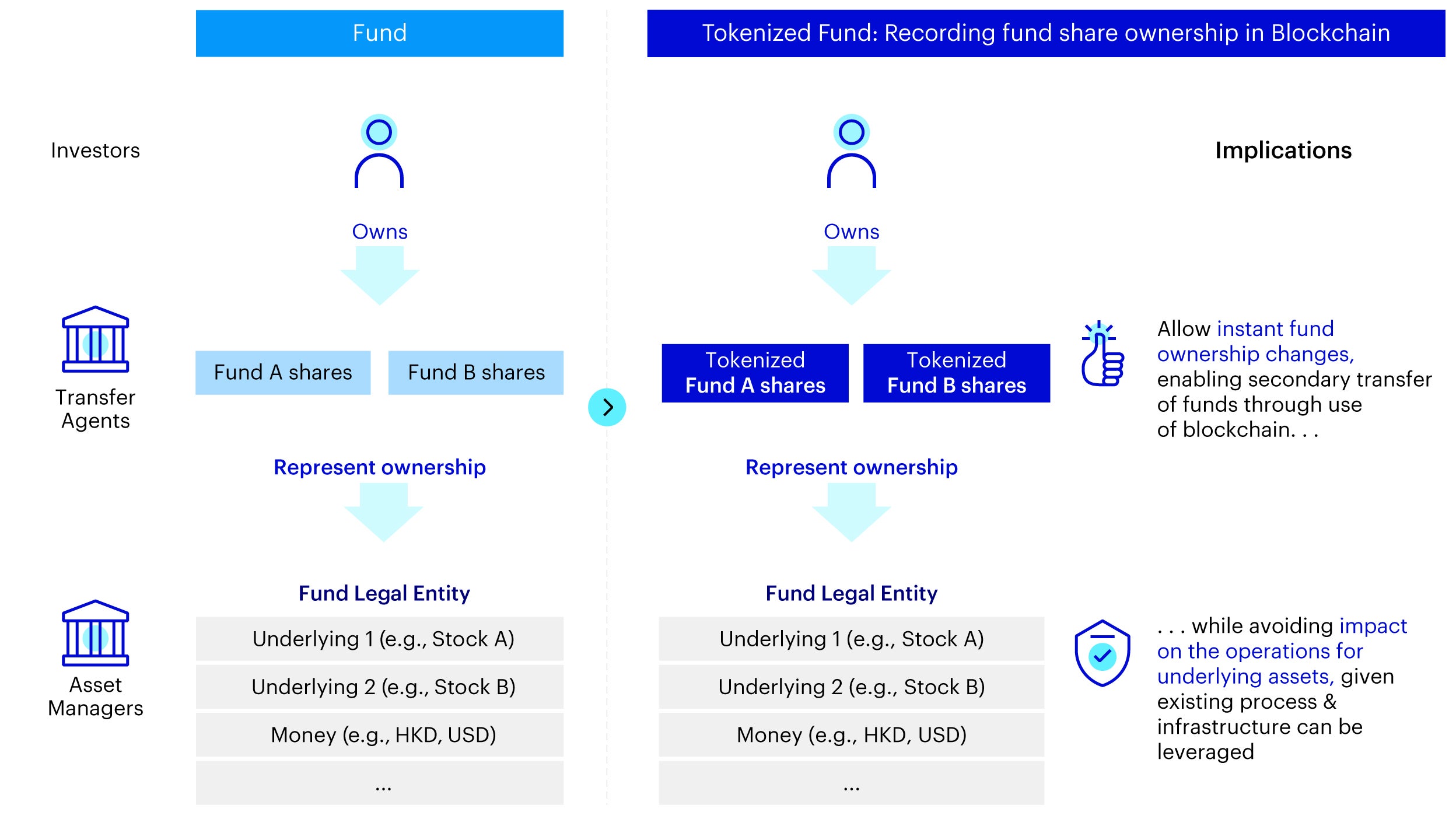
A sensible implementation model separates three kinds of work:
| Category | Examples | Typical funding approach |
|---|---|---|
| Configuration | Workflow design, user roles, reporting fields, document types | Included in onboarding or professional-services fee |
| Integration and control work | APIs, data mapping, identity management, security assessment, audit logs, reconciliation | Explicit project budget, often underestimated |
| Business-model change | New investor channel, digital custody, tokenized register, new transfer process | Pilot budget with executive sponsorship and legal/compliance ownership |
A strong opportunity has a narrow initial scope. For AI, that might mean classifying and extracting a small number of high-volume document types before expanding to all documents. For blockchain, it might mean maintaining a permissioned digital record of approved transfer requests before attempting secondary-market trading.
Build defensibility: why will a customer not switch?
A product with a good initial use case is not necessarily a durable business. Large technology firms, incumbent fund-administration platforms, and in-house teams can replicate generic capabilities quickly.
Defensibility in this market usually comes from the operating system around the technology rather than the underlying model or blockchain alone.
Stronger sources of defensibility
- Embedded workflow integration: The tool is integrated into document ingestion, task assignment, review, accounting, and reporting—not used as a standalone chatbot.
- Proprietary, permissioned data assets: The vendor has customer-authorised, well-labelled data and feedback loops that improve extraction, matching, or exception handling.
- Fund-domain configuration: The product understands capital calls, distributions, side letters, transfer restrictions, valuations, and entity structures.
- Control evidence: Audit trails, version history, reviewer actions, reproducible outputs, access controls, and exception management become part of the customer’s operating process.
- Distribution advantage: A partnership with an administrator, accounting-software provider, legal-services firm, or custodian can reduce customer-acquisition cost.
- Network effects: For a shared DLT register, value can grow as more relevant managers, administrators, custodians, and investors participate. However, the same network requirement makes early adoption difficult.
A weak claim of defensibility is “we use AI” or “we are on blockchain.” Those technologies are inputs. They are not, by themselves, a moat.
The following discussion offers a practical sequence for evaluating AI opportunities: understand the existing process, identify a pain point, start small, and introduce human oversight before expanding the use case.
#131 Harnessing AI in Fund Admin with Yvonne Newlands
Watch “Harnessing AI in Fund Admin with Yvonne Newlands” from Alt Funds Network for a practitioner’s view of AI adoption in alternative-fund operations. It is most useful for its emphasis on process discovery, constrained pilots, and graduated human oversight.
Begin with prioritising use cases. Focus on the movement from broad awareness of AI to identifying concrete operational pain and quick wins. Then watch human oversight for the role of audit trails, review, and increasing trust gradually rather than automating a high-risk decision immediately. Finish with building workflows. Focus on the insistence that a weak or poorly understood process should be improved before it is automated.
Sales dynamics: selling into fund administration is enterprise change management
The product buyer is rarely the only person whose approval matters. A fund-administration sale commonly involves an internal coalition:
| Stakeholder | Primary concern |
|---|---|
| COO or head of fund operations | Capacity, client service, process reliability, implementation disruption |
| CFO or finance leader | Business case, recurring cost, margin impact, vendor stability |
| Technology and information security | Integration, access control, data protection, resilience, vendor risk |
| Compliance, risk, and legal | Regulatory responsibilities, records, outsourcing oversight, confidentiality |
| Fund-accounting or investor-services teams | Whether the tool works in real exceptions and reduces rather than relocates work |
| Executive sponsor | Strategic fit, client differentiation, and ability to fund the programme |
This creates long sales cycles. A vendor should model the full path: initial discovery, proof of value, security review, procurement, integration, pilot, production approval, and eventual expansion. Revenue booked at contract signature can be much earlier than revenue recognised or cash received.
A useful commercial distinction is:
- Tool sale: A small, limited product that a department can adopt quickly. Lower contract value and lower friction, but often weaker defensibility.
- Workflow-platform sale: An integrated system that affects controlled processes. Higher annual contract value and retention potential, but heavier sales and implementation burden.
- Network-infrastructure sale: A shared ledger or tokenized-fund ecosystem. Potentially strategic, but dependent on multi-party adoption, legal design, and governance. Sales are often partnership-led rather than simple software sales.
For a startup, this means that a technically ambitious DLT proposition can be commercially weaker than a modest AI workflow tool if the first requires five independent institutions to change behaviour simultaneously.
Regulatory risk should be analysed as a design constraint
Regulation is not merely a risk register at the end of diligence. It changes the product scope, sales cycle, operating model, and addressable market.
For an AI product, key questions are:
- Is the output a draft for a human reviewer, or does it trigger an accounting, payment, compliance, or investor action?
- Is there a complete record of source document, extracted value, reviewer decision, and correction?
- Can confidential personal and financial information be controlled according to contractual and privacy obligations?
- Is the model provider permitted to retain or train on customer data?
- Can the vendor demonstrate suitable outsourcing, cybersecurity, resilience, and incident-management controls?
For a blockchain product, add these questions:
- Is the digital record legally authoritative or only a parallel record?
- What legal rights does the token represent?
- Who verifies investor identity and eligibility?
- Who approves transfers, corrects errors, or freezes a compromised wallet?
- Which firm is responsible for register maintenance, custody, transfer agency, and regulatory reporting?
- Can the relevant law, fund documents, and regulator support the intended operating model?
The Luxembourg-focused tokenization guidance is particularly helpful here because it links the business case to implementation scope and measurable KPIs. Read it as a framework, not as an assurance that tokenization will create liquidity or reduce cost in every private-fund setting.
TOKENISATION AND DIGITAL CUSTODY IN THE WORLD ...
Read this ALFI publication for a practical framework for evaluating tokenization as an operating-model change. The most useful material is its distinction among efficiency, client-experience, and future-readiness objectives, and its emphasis on pilots with measurable KPIs.
In Section 3.3, “Integration of the new world in the existing ecosystem,” begin with the why how outcome framework. Then continue with the implementation framing. Finally, read the KPI and pilot discussion. Focus on cost per transaction, end-to-end time, error percentage, user adoption, client acquisition cost, and the need to formalise learning from a pilot.
Two investment decisions: AI document intelligence versus a tokenized LP-transfer platform
The following comparison illustrates how the same evaluation framework produces different conclusions.
| Criterion | AI document-intelligence workflow | Tokenized LP-transfer and register platform |
|---|---|---|
| Customer pain | Frequent document routing, extraction, and search burden; skilled teams spend time on repetitive work | Transfer administration and record reconciliation may be slow, but transfer volume in a closed-end fund can be low |
| Economic buyer | Administrator COO, head of operations, or GP finance/operations leader | Fund manager, administrator, transfer agent, custodian, and possibly distribution or venue partners |
| Measurable ROI | Often measurable through hours, error rates, turnaround time, and capacity | Must show reduction in reconciliation or transfer cost, or incremental distribution revenue; “liquidity” is not enough |
| Implementation burden | Moderate if layered over existing processes; substantial if core accounting integration is required | High: legal structure, identity, wallet controls, governance, custody, integrations, and participant adoption |
| Defensibility | Integration, fund-specific data, human-review workflow, controls, distribution partnerships | Network participation, authoritative legal register, trusted governance, regulated status, interoperability |
| Sales dynamics | Enterprise sale, but one firm can start a pilot | Multi-party sale; benefit may not materialise unless several parties adopt |
| Regulatory risk | Data protection, outsourcing, auditability, human accountability | Legal finality, securities rules, register status, AML/KYC, custody, smart-contract governance |
| Initial decision | Often a credible narrow pilot | Usually a narrow pilot only; avoid promising broad liquidity or unrestricted transfers |
Decision A: AI document intelligence
This can be a strong opportunity when the product does four things well:
- Targets a repeatable, high-volume document category.
- Preserves human validation for material data and exceptions.
- Integrates with the team’s current work queue or document repository.
- Produces review evidence for client, auditor, and regulator scrutiny.
The commercial risk is that generic document-AI tools can handle part of the problem. The vendor therefore needs to prove that its fund-specific workflows, integrations, control design, and accuracy on real private-market documents create a meaningful advantage.
Decision B: tokenized private-fund interests
This can be a strategic opportunity, but the return must be tested much more carefully. Consider a Luxembourg PE feeder with 150 permitted transfers per year. If conventional transfer operations cost annually and associated reconciliation or error costs add , the current annual pain might be only .
A tokenization implementation costing several hundred thousand pounds, plus recurring governance, custody, legal, and platform costs, cannot be justified solely by making those 150 transfers faster. The proposal may become viable only if it also enables a proven distribution channel, supports a larger investor base, or creates reusable infrastructure across many funds.
The proper initial conclusion is often:
Narrow pilot: use a permissioned digital record for eligible investor holdings and approved transfer events; retain the conventional administrator-controlled register and reconciliation process until legal status, adoption, and operational benefit are demonstrated.
This is not a rejection of tokenization. It is commercial discipline: do not finance network-scale infrastructure before proving that the network will form and deliver value.
A decision scorecard for an investment committee
Score each dimension from 1 to 5, where 1 is weak and 5 is strong. But do not let a high average conceal a fatal weakness. Regulatory authority, data-security feasibility, and a genuinely measurable customer benefit are gates, not trade-offs.
| Dimension | 1: weak | 3: plausible | 5: strong |
|---|---|---|---|
| Customer pain | Vague interest in innovation | Identified inefficiency but inconsistent urgency | High-frequency, costly, evidenced pain with executive ownership |
| Addressable market | Broad theoretical market only | Defined segment with uncertain access | Clearly reachable customer cohort and credible pricing |
| ROI | Benefits are aspirational | Directionally positive with untested assumptions | Measured baseline and pilot evidence of attractive payback |
| Implementation burden | Requires wholesale replacement of core systems | Significant integration and change management | Narrow scope, controlled interfaces, staged rollout |
| Defensibility | Commodity technology or features | Some domain knowledge or partnership advantage | Deep integration, valuable data, controls, distribution, or network position |
| Sales dynamics | Unclear buyer and long unfunded sales process | Known buyer but multiple approval hurdles | Clear economic buyer, compelling pilot, expansion path |
| Regulatory risk | Unclear legal or accountability model | Manageable with legal and control work | Product design aligns with established responsibilities and evidence requirements |
A practical investment memo should contain:
- The workflow and customer pain in one paragraph.
- The buyer and buying trigger, including budget owner.
- A baseline metric: hours, errors, turnaround time, cost per transaction, or lost conversion.
- The value hypothesis, with conservative assumptions.
- Implementation scope, dependencies, and named control owners.
- Commercial model: pricing, sales cycle, onboarding cost, retention logic, and gross-margin implications.
- Defensibility thesis and the most credible substitute.
- Regulatory and operational gates that must be passed before scale.
- Pilot design with a time limit, success thresholds, and explicit stop conditions.
Key takeaways
An attractive fund-administration technology opportunity is not defined by how advanced its AI model or blockchain architecture appears. It is defined by a credible link between customer pain, measurable value, feasible implementation, and durable commercial delivery.
For AI, the most promising early opportunities are often controlled workflow improvements: document classification, extraction, reconciliation support, and knowledge retrieval with human validation and audit evidence.
For blockchain, the strongest opportunities involve a real shared-record problem across independent parties. But tokenization must clear higher hurdles: legal finality, investor identity, custody, governance, integration, and multi-party adoption. Faster transfer mechanics alone do not create liquidity or justify a large implementation.
Across both technologies, use a disciplined rule:
Fund the smallest implementation that can test a high-value customer hypothesis with measurable operational and commercial outcomes.
You now have a complete framework for assessing how AI and blockchain may reshape fund administration—not as abstract trends, but as specific operating and investment decisions.