Recommended resources
The freely available resources this lesson will direct you to.
Introduction
In our previous lesson, we explored Milton Friedman's general philosophy, understanding it as a pragmatic and consequentialist case for free markets. We saw that instead of starting with absolute moral rules, Friedman's approach is to ask what works best to create a prosperous and free society. His answer consistently points toward voluntary exchange, competition, and limited government, not because of a rigid doctrine, but because the evidence suggests these are the most effective means to achieve desirable ends.
This lesson brings that philosophy to life by examining one of Friedman's most famous and influential policy proposals: school vouchers. This is a perfect case study of his method. Faced with what he saw as a failing public education system, Friedman didn't just critique it; he proposed a practical, market-based reform designed to move the system in a better direction. Our goal is to understand his diagnosis of the problem, the mechanics of his proposed solution, and the positive consequences he believed it would unleash.
The Problem: A Government Monopoly on Schooling
For Friedman, the poor state of elementary and secondary education in the United States was a direct consequence of how it was organized. He viewed the public school system as a government monopoly that suffered from all the classic problems of monopolies: lack of innovation, inefficiency, and a tendency to serve the interests of its producers (administrators and teachers' unions) rather than its consumers (students and parents).
Let's hear Friedman describe the problem in his own words. He argues that the government's role should be to ensure education is funded, not to run the schools itself.
Milton Friedman - Educational Vouchers
This short clip from a talk by Milton Friedman lays out his fundamental critique of the education system.
Watch the video from the beginning to the end of this segment. As you watch, focus on these key points: Subsidizing Producers vs. Consumers: Friedman distinguishes between giving money directly to schools (subsidizing the producer) and giving it to parents to spend on education (subsidizing the consumer). He argues the current system does the former, which eliminates competition. The Consequences of the System: He paints a grim picture of the results, including high dropout rates, poor literacy, and a "stratified society" where many are condemned to low-income jobs. He considers this a "disgrace."
Friedman saw low-income families, particularly in inner cities, as the primary victims of this system. They were trapped in failing neighborhood schools with no alternative, while wealthier families could afford private schools or move to suburbs with better-funded public schools. This geographic assignment of children to schools, he argued, was the core mechanism of the monopoly.
The Solution: Introduce Competition with Vouchers
Friedman’s proposal was revolutionary in its simplicity. If the problem is a lack of competition, the solution is to introduce it. His idea was to change the flow of money, redirecting it from schools to families, thereby empowering parents to become active consumers of education. This is the school voucher system.
Here's how it would work:
- The government would calculate its average spending per student.
- Instead of giving this money directly to the local public school, it would give a voucher, or coupon, of an equivalent (or partial) amount to the parents of each child.
- Parents could then take this voucher to any school that would accept it—public, private, religious (parochial), or for-profit—to pay for tuition.
- The school would then redeem the voucher from the government to receive the funds.
The central idea is to make schools accountable to parents, not to government bureaucrats. If a school provides poor service, parents can take their voucher (and the funding it represents) elsewhere.
Milton Friedman - Educational Vouchers
Here, Friedman outlines the basic mechanics of his voucher proposal.
Please re-watch the portion of the previous video from "take the amount of money". This is where he succinctly states the core proposal.
This simple change, Friedman argued, would transform the entire educational landscape.
The Consequentialist Case: What Vouchers Would Achieve
Friedman's argument for vouchers was entirely consequentialist. He believed that creating a market in education would lead to a cascade of positive results.
1. Competition Drives Quality
The primary effect of vouchers would be to force all schools, including existing public schools, to compete for students. To attract and retain students, schools would have to improve their quality, respond to the needs of families, and operate more efficiently.
[PDF] An Interview with Milton Friedman on Education
In this 2002 interview, Friedman reflects on his voucher proposal 40 years after he first made it. He explains why competition is the key to progress.
Please read the section from the start of this argument. Focus on his central claim: in every other field, from automobiles to television, competition has driven progress and innovation. He asks, if public schools are as good as their defenders claim, why are they afraid of competition?
2. Empowerment for Low-Income Families
For Friedman, one of the most important moral benefits of vouchers was that they would give low-income families the same power to choose that wealthy families already have. No longer trapped by their zip code, parents in poor neighborhoods could seek out better educational opportunities for their children.
3. Innovation and Variety
A competitive market would also foster innovation. Entrepreneurs would have an incentive to create new types of schools with different teaching methods, curricula, and specializations to meet the diverse needs and preferences of students. As Friedman put it in the interview you just read, "Neither you nor I are imaginative enough to dream of what real competition, a real free market, could produce."
The real-world experiment with vouchers in Milwaukee, one of the earliest and largest in the US, provides a concrete example of the effects Friedman predicted.
Milton Friedman - School Choice
This documentary segment looks at the Milwaukee voucher program, providing real-world context for Friedman's theory.
Watch the clip from the start of the Milwaukee segment. Notice how the story illustrates Friedman's key points: Students from poor neighborhoods transferring out of failing public schools. Research suggesting improved academic performance for voucher students. Evidence that public schools, faced with the threat of losing students, began to improve their own performance.
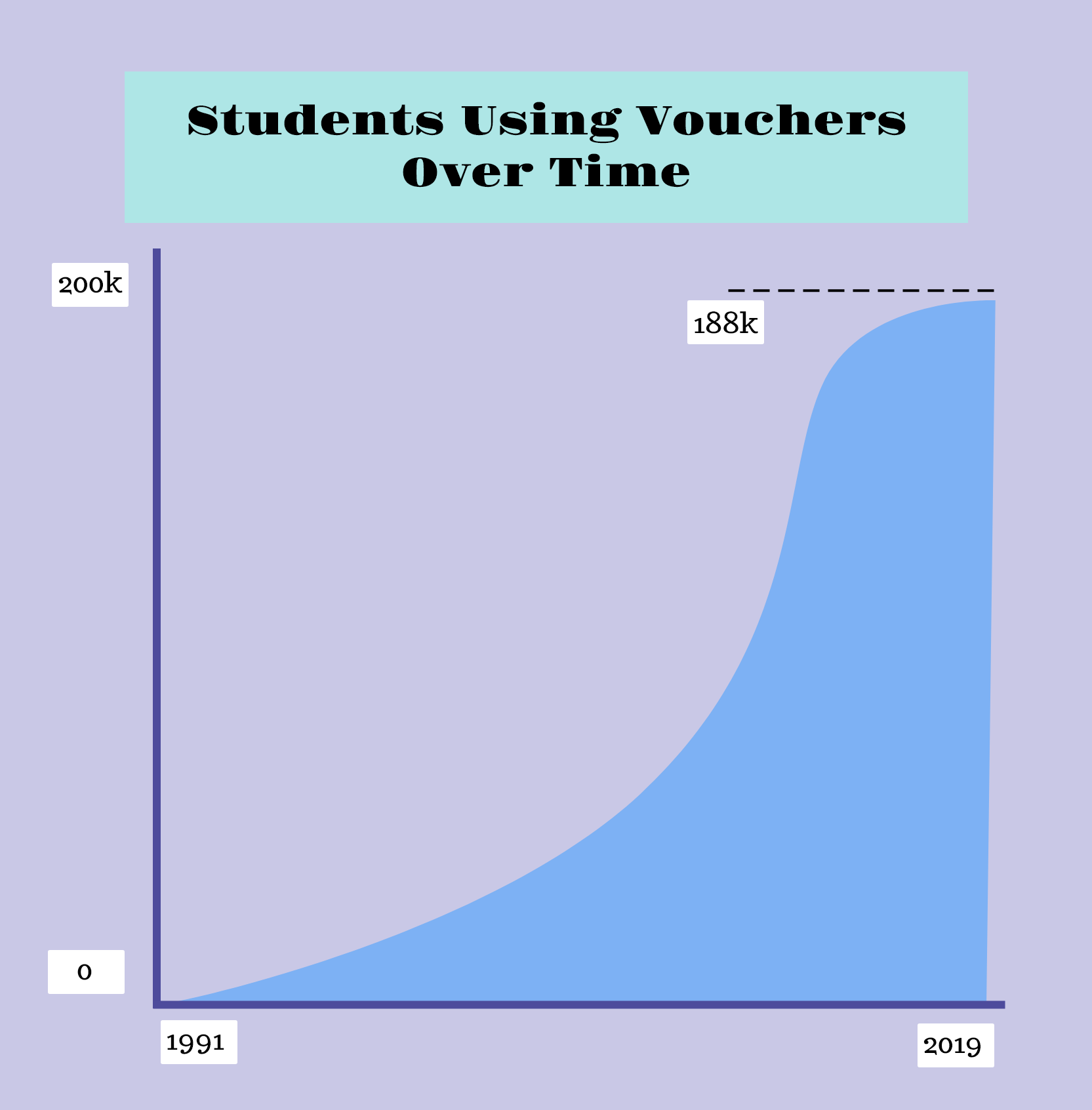
The idea of school choice has since spread. While not as universal as Friedman hoped, many states now have some form of voucher, tax-credit scholarship, or education savings account program.

The number of students participating in these programs has grown significantly since the first modern program was established in 1991.
Addressing the Objections
Friedman was well aware of the criticisms leveled against vouchers and addressed them from his consequentialist framework. He argued that the fears were misplaced and that the market would produce better outcomes than the status quo.
[PDF] An Interview with Milton Friedman on Education
In this part of the interview, Friedman directly confronts several major objections to his proposal.
Please read the section beginning "But I want to return..." and focus on his responses to these concerns: Social Cohesion and Segregation: Would vouchers lead to schools that are more divided by race and class? Friedman argues that government schools are already highly segregated by neighborhood and that private schools are often more integrated. He trusts that most parents want good, safe schools, not segregated ones. Access for the Poor: Would the wealthy choose all the "best" schools, leaving the poor with inferior options? Friedman flips this argument, stating that the current system is the most unfair to the poor. He uses the analogy of automobiles and televisions: what starts as a luxury for the rich becomes, through market competition and innovation, affordable and available to everyone.
In essence, Friedman’s defense is that the market for education would work like any other market: it would provide a wide array of options at different price points, and over time, competition would improve quality and lower costs for everyone, especially those who are worst-served by the current system.
Conclusion
Milton Friedman's advocacy for school vouchers is a powerful illustration of his pragmatic, consequentialist libertarianism in action. It demonstrates a clear method: identify a problem caused by government monopoly (poor educational outcomes), propose a market-based solution that introduces choice and competition (vouchers), and argue for it based on its expected positive consequences (better quality, innovation, and empowerment for the poor).
Here are the key takeaways from our examination of his argument:
- The Diagnosis: Public education suffers from a lack of competition because it operates as a government monopoly that subsidizes producers (schools) instead of consumers (students).
- The Proposal: To introduce competition by giving parents government-funded vouchers that they can use to pay for tuition at any school of their choice.
- The Consequentialist Case: Vouchers would force schools to improve, foster innovation, and most importantly, empower low-income families by giving them educational choices they currently lack.
- The Defense: Friedman argued that a market system would ultimately lead to less segregation and more opportunity for the disadvantaged than the geographically-based public school system.
Having explored a key policy application from Friedman, we are now ready to step back and compare his brand of libertarianism with the more radical vision of Murray Rothbard. The next lesson will highlight the crucial differences between Friedman's gradualist, pragmatic approach and Rothbard's uncompromising, rights-based anarcho-capitalism.