Recommended resources
The freely available resources this lesson will direct you to.
Introduction
In our last lesson, we took a close look at Milton Friedman's pragmatic and consequentialist philosophy through the lens of his proposal for school vouchers. We saw that his approach isn't about adhering to an abstract blueprint of a perfect society, but about finding practical, market-based policies that improve real-world outcomes and move us in the direction of greater freedom and prosperity.
Today, we will contrast Friedman's approach with that of another giant of 20th-century libertarianism: Murray Rothbard. While Friedman sought to reform the system from within, Rothbard sought to abolish it entirely. Understanding the chasm between these two thinkers is essential for grasping the profound internal debates within libertarianism. Our goal is to identify the key differences between Rothbard's radical, rights-based approach and Friedman's gradualist, consequentialist one. This will reveal two fundamentally different ways of thinking about how to achieve a free society.
Destination vs. Direction: Two Paths for Libertarianism
To understand the core of the disagreement between Rothbard and Friedman, it's helpful to introduce a framework proposed by political scientist Mike Munger. He suggests there are two main "types" of libertarians: destinationists and directionalists.
A Libertarian Mungerfesto: In Five Parts
This article provides a powerful and intuitive way to understand the major divide within libertarian thought. It will serve as our map for navigating the differences between Rothbard and Friedman.
Please read the first part of the article, from the beginning down to the end of the summary definitions. Focus on understanding the definitions of the two groups: Destinationists start from a few absolute moral principles, like self-ownership and the non-aggression principle. They have a clear vision of the ideal society (the "destination") and believe any policy that falls short of this ideal is an unacceptable compromise. Directionalists, on the other hand, are focused on incremental progress. For them, any policy that moves society in the direction of more liberty, even if it's not a "perfectly" libertarian policy, is a good thing worth supporting.
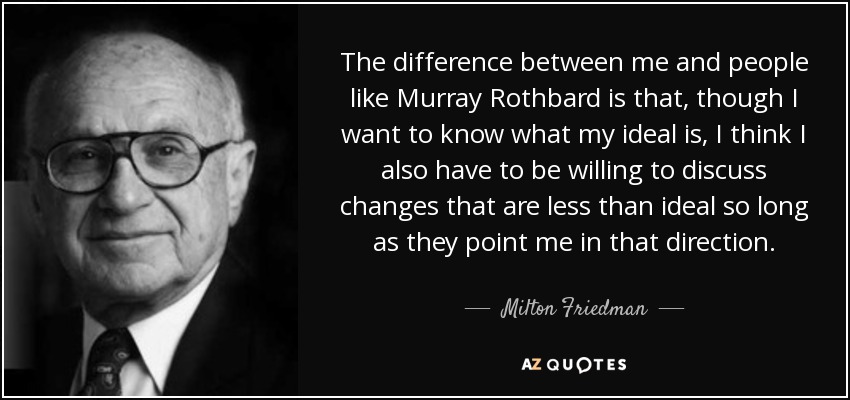
As we'll see, Murray Rothbard is the quintessential destinationist, while Milton Friedman is the quintessential directionalist. Friedman himself perfectly captured this directionalist spirit in a famous quote where he contrasted his own views with Rothbard's.
Murray Rothbard's Radical Destination: Anarcho-Capitalism
Murray Rothbard was a leading figure in the Austrian School of economics and the intellectual father of the modern anarcho-capitalist movement. His entire philosophy is built upon a strict, destinationist interpretation of natural rights.
[PDF] Rothbard and Hoppe versus Classical Liberalists
This academic paper provides a clear summary of Rothbard's core philosophy and contrasts it directly with Friedman's.
First, read the introduction to Rothbard's ideas to understand his starting point. Focus on the text from the start of the document. Notice how his argument flows from a few core principles: individual liberty, self-ownership, and private property. From these, he concludes that the state is "inherently coercive and unjust." Next, jump to the section comparing Rothbard and Friedman. Read the part titled "Rothbard and Hoppe’s Rejection of the State vs. Friedman’s Support for a Minimal State". This will give you a direct comparison of their ultimate goals.
As you read, it becomes clear that Rothbard's thinking follows a logical, step-by-step deduction from a moral absolute:
- Foundation: Every individual has an absolute right to self-ownership and to the property they acquire through their labor and voluntary exchange.
- The Non-Aggression Principle: Therefore, the initiation of physical force (or "aggression") against another person or their property is always morally wrong.
- The State as Aggressor: The state, by its very nature, operates through aggression. It claims a monopoly on the use of force in a given territory and funds itself through the non-voluntary act of taxation.
- Conclusion: The state is a "gang of thieves writ large," an inherently criminal organization. It is not just inefficient or overreaching; it is fundamentally illegitimate and immoral.
Rothbard's destination is therefore anarcho-capitalism: a society with no state, where all goods and services—including law, courts, policing, and defense—are provided competitively on the free market by private individuals and companies. For a destinationist like Rothbard, anything short of the complete abolition of the state is a compromise with evil.
Milton Friedman's Pragmatic Direction: Minarchism
As we've seen, Milton Friedman's starting point is entirely different. He doesn't begin with absolute moral laws, but with a question: What kind of system produces the best results for human freedom and well-being? His philosophy is consequentialist.
Let's watch Friedman himself explain this distinction.
TAKE IT TO THE LIMITS: Milton Friedman on Libertarianism
In this interview, Friedman draws a sharp line between his own consequentialist libertarianism and the rights-based, absolutist version associated with thinkers like Rothbard.
Watch the clip from the definition of libertarianism. Pay close attention to how he describes the "two really different versions." One is based on the single moral principle that it is "immoral to initiate force." The other, which he subscribes to, is based on finding what arrangement leads to the "maximum freedom for each individual."
Friedman's argument is that the evidence overwhelmingly shows that societies based on private property and voluntary exchange (capitalism) produce far better consequences—more prosperity, more innovation, and ultimately more freedom—than societies based on central control.
Milton Friedman Speaks: Is Capitalism Humane?
In this classic lecture, "Is Capitalism Humane?", Friedman makes his consequentialist case.
Watch the first three minutes from the start of his argument. Notice his focus is on the results of different systems, not their stated intentions. He argues that even though socialism has noble goals like equality, it consistently fails to deliver, while capitalism, despite being criticized for relying on self-interest, actually produces better outcomes.
Because his focus is on what works, Friedman is a minarchist, not an anarchist. He believes a minimal state is a necessary and beneficial institution. Its role, however, must be strictly limited to a few core functions that the market cannot easily provide, functions that are necessary to protect the system of voluntary exchange itself. He sees a legitimate role for government in:
- Defense: Protecting the nation from foreign enemies.
- Policing: Protecting individuals from coercion by their fellow citizens.
- Law and Courts: Providing a system to enforce contracts and adjudicate disputes.
For Friedman, the goal of policy is not to achieve an anarchist utopia overnight, but to constantly push the boundaries of what can be handled by the market and shrink the role of the state, moving in the direction of more liberty. This is why he championed specific, incremental reforms like school vouchers, the volunteer army, and floating currency exchange rates.
Head-to-Head: Radicalism vs. Gradualism
Let's summarize the fundamental differences between these two powerful thinkers.
| Area of Disagreement | Murray Rothbard (Radical Destinationist) | Milton Friedman (Pragmatic Directionalist) |
|---|---|---|
| Philosophical Basis | Deontology / Natural Rights. Starts with absolute moral principles (self-ownership, non-aggression). | Consequentialism. Judges systems by their results (freedom, prosperity, human well-being). |
| Role of the State | Anarchism. The state is inherently immoral and must be abolished completely. | Minarchism. A minimal state is necessary for defense, policing, and enforcing contracts. |
| Approach to Politics | Abolition. Rejects the political system as illegitimate. The only moral goal is to eliminate the state. | Incremental Reform. Engages with the political system to advocate for specific policies that increase freedom. |
| View of Democracy | A system of "legalized theft." A mechanism for the majority to plunder the minority. | A flawed but useful tool. The best available system for ensuring government accountability and preventing tyranny. |
This deep divide is not merely academic. It shapes the entire strategy and tone of libertarian engagement with the world. Rothbardians often see political engagement and compromise as a betrayal of principle, while Friedmanites see it as the only practical way to make the world a freer place.
Conclusion
Today we have explored the fundamental rift between two of the most influential figures in modern libertarianism, Murray Rothbard and Milton Friedman. By using the framework of destinationism versus directionalism, we can see that their disagreement is not just about how big the state should be, but stems from two entirely different philosophical starting points.
Here are the key takeaways:
- Murray Rothbard represents the radical, destinationist wing of libertarianism. His anarcho-capitalism is a logical deduction from absolute natural rights, leading to the conclusion that the state is an inherently criminal institution that must be abolished.
- Milton Friedman represents the pragmatic, directionalist wing. His minarchism is the conclusion of a consequentialist argument that a system of free markets with a strictly limited government produces the best outcomes for society.
- This split—between a rights-based, anarchist approach and a consequence-based, minarchist approach—is arguably the most significant division within the libertarian movement.
In our next lesson, we will introduce a third major thinker, Friedrich Hayek. We will see how he carves out a unique position, sharing Friedman's skepticism of radical plans but grounding his arguments in a different concept: spontaneous order. This will further enrich our understanding of the complex and varied landscape of libertarian thought.