Recommended resources
The freely available resources this lesson will direct you to.
- TAKE IT TO THE LIMITS: Milton Friedman on Libertarianismwww.youtube.com
- Milton Friedman - On Libertarianism and Humility - The Turney Collection - Libertarianism.orgwww.youtube.com
- TAKE IT TO THE LIMITS: Milton Friedman on Libertarianismwww.hoover.org
- [PDF] Milton Friedman as a Liberal Philosopher PPE Working Paper 15.0528sites.duke.edu
Introduction
In our last lesson, we journeyed to the most radical edge of libertarian thought, exploring Murray Rothbard's vision of anarcho-capitalism—a society without a state, where even law and defense are provided by the free market. Rothbard's case was built on a foundation of absolute natural rights and the moral impermissibility of coercion. We now pivot to a very different, and vastly more influential, form of libertarianism championed by the Nobel Prize-winning economist Milton Friedman.
This lesson will introduce you to Friedman's pragmatic, consequentialist case for free markets. Instead of starting from absolute moral rules, Friedman starts from a place of intellectual humility and asks a simple question: What kind of society actually works to produce the best results for the people living in it? For Friedman, the answer lies in free markets and limited government, not because they are required by a philosophical blueprint, but because the evidence shows they lead to prosperity, individual well-being, and ultimately, a more humane and free society. This focus on outcomes, or consequences, is what makes his approach "consequentialist."
What is Consequentialist Libertarianism?
The brand of libertarianism you encountered with Rothbard is often called "deontological" or rights-based. It holds that certain actions, like initiating force, are inherently wrong regardless of their outcomes. Friedman represents the other major school of thought, which judges actions and policies by their results.
Let's hear Friedman define this distinction in his own words.
TAKE IT TO THE LIMITS: Milton Friedman on Libertarianism
In this interview with the Hoover Institution, Milton Friedman draws a clear line between two different versions of libertarianism.
Please watch this brief clip from the beginning. Friedman contrasts the "Ayn Rand type of libertarianism," based on the principle that it is immoral to initiate force, with his own "consequentialist libertarianism." His view supports maximum individual freedom because it works to create a better society.
Friedman's argument, then, is not primarily a moral one in the abstract. It is a practical one. He advocates for free markets because he believes they are the most effective engine for human progress and the surest protector of individual liberty. His entire case is built on the idea that good intentions in government policy are not enough; we must rigorously examine the actual consequences of those policies.
The Foundation: Humility and the "Knowledge Problem"
If the goal is to find out what works, what is the philosophical starting point? For Friedman, it is a profound sense of intellectual humility. He argues that no single person or committee could ever possess enough knowledge to centrally plan an economy or to wisely dictate how other people should live their lives.
Milton Friedman - On Libertarianism and Humility - The Turney Collection - Libertarianism.org
In a speech titled "On Libertarianism and Humility," Friedman explains the philosophical anchor of his worldview.
Watch the segment from the beginning of his talk. Friedman states his core belief: "I have no right to coerce someone else, because I cannot be sure that I am right and he is wrong." He sees this humility and tolerance as the fundamental justification for liberty.
This idea is the bedrock of Friedman's political philosophy. A scholar named Michael Munger has termed it Friedman's "Knowledge Problem."
[PDF] Milton Friedman as a Liberal Philosopher PPE Working Paper 15.0528
This paper by Michael Munger provides an excellent analysis of Friedman's philosophical underpinnings. This section explains how Friedman's skepticism about knowledge leads directly to his belief in freedom.
Please read the section beginning with the heading "Liberal Philosophy: Free to Choose". Focus on these key points: Friedman's "Knowledge Problem": His belief that "nobody can be sure that what he believes is really, really right" is the foundation for his entire philosophy. Presumption of Freedom: Because no one has a monopoly on truth, we must start with a strong presumption in favor of individual freedom. Rebuttable Presumption: This presumption isn't absolute. Coercion can be justified, but only on the basis of empirical evidence and broad agreement, not on a priori principles.
This is what makes Friedman so different from a thinker like Rothbard. Rothbard would say a policy is wrong if it violates a natural right. Friedman would say a policy is wrong if the evidence shows it produces bad outcomes—that it makes people worse off than they would have been otherwise. He believes that, in most cases, this is exactly what government intervention does. To prove his point, he critiques other libertarians who he feels are too dogmatic.
Milton Friedman - On Libertarianism and Humility - The Turney Collection - Libertarianism.org
Here, Friedman critiques the absolutist approaches of thinkers like Ludwig von Mises and Ayn Rand.
Watch this segment from "how do I square that". Friedman argues that their methods, which claim to derive absolute truths from pure logic (like "A is A"), become a kind of religion rather than a science. He contrasts this with a scientific approach where you test your ideas against facts and are willing to be proven wrong. This highlights his commitment to empiricism.
The Pragmatic Method: Direction, Not Destination
Friedman's focus on evidence and real-world results made him a pragmatist. He was less interested in describing a perfect libertarian utopia and more interested in proposing practical policies that could move society in the direction of more freedom and prosperity, even if the final result was still imperfect.
A famous early controversy in his career perfectly illustrates this approach.
[PDF] Milton Friedman as a Liberal Philosopher PPE Working Paper 15.0528
This section details the "Roofs or Ceilings" incident, a defining moment that shows the clash between Friedman's consequentialism and the rights-based approach of other libertarians.
Please read the section from the start of the incident. Pay attention to why the pamphlet on rent control he co-authored was so controversial. He argued against rent control not because it violated property rights, but because it was an inefficient and counterproductive way to achieve the stated goal of helping the poor. For the sake of argument, he accepted the goal (more equality) to show that the proposed means (rent control) would backfire.
This "directionalist" approach—focusing on making things better from where we are now—is a hallmark of Friedman's work. He believed it was not enough to simply declare what an ideal society looks like; one must also provide a practical path to get there.
Arguing from Evidence: Two Case Studies
Friedman's power as a public intellectual came from his ability to use clear, real-world examples to show the often-unseen consequences of government policy.
Case Study 1: The Food and Drug Administration (FDA)
The FDA is often held up as a prime example of necessary government regulation to protect public health. Friedman argued that, on balance, it does more harm than good.
TAKE IT TO THE LIMITS: Milton Friedman on Libertarianism
In this famous example, Friedman takes on the FDA, arguing that its good intentions lead to deadly consequences.
Watch the segment from "Food and Drugs". Friedman's key argument is about incentives and hidden costs. An FDA official who approves a bad drug faces public ruin (the visible cost). An official who delays a good drug faces no penalty, but people die while waiting (the invisible cost). Therefore, the system is biased toward delay, costing more lives than it saves. He argues that market forces, like the fear of lawsuits, would be a more effective guarantor of safety.
Case Study 2: Environmental Protection
What about problems like pollution, where one person's actions harm others? This is a classic "externality" that many believe only government can solve. Friedman agreed that there was a role for government here, but argued that market-based solutions are far more effective than top-down commands.
TAKE IT TO THE LIMITS: Milton Friedman on Libertarianism
Friedman discusses how to handle environmental issues like pollution.
Watch this segment from "how a Libertarian addresses them". He makes two key points: Property Rights: "Nobody takes care of somebody else's property as well as he takes care of his own." He argues that government ownership often leads to worse environmental outcomes (e.g., pollution in the Soviet Union). Market Mechanisms: For problems like air pollution where property rights are hard to define, he advocates using the market. Instead of the government dictating technology, it could create a market by, for example, selling the right to emit a certain amount of pollutants. This incentivizes firms to find the cheapest way to reduce pollution.
These examples showcase the core of Friedman's consequentialist case: it's a way of thinking that constantly compares the real-world outcomes of government intervention with the likely outcomes of a market-based alternative, always demanding evidence for which approach works better. The chart below is a classic example of the kind of evidence a consequentialist would find persuasive.
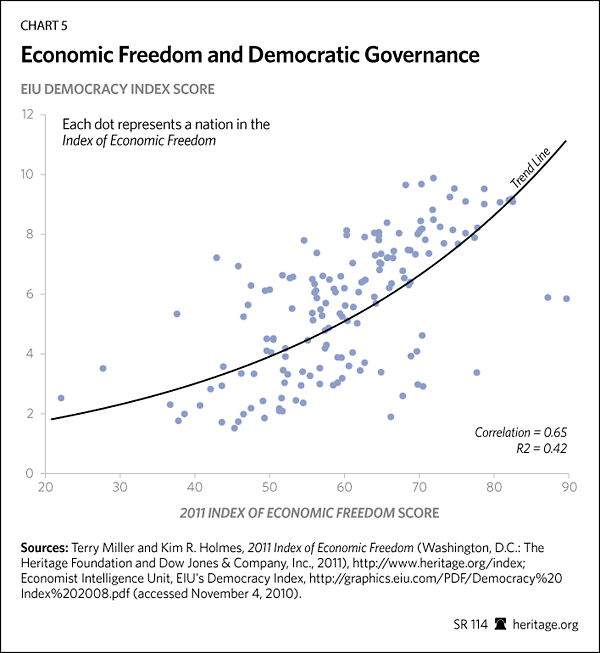
While correlation does not equal causation, a consequentialist like Friedman would point to this pattern as powerful evidence supporting the claim that economic freedom is a vital means to achieving desirable ends like democracy and human well-being.
Conclusion
Milton Friedman offers a powerful alternative to the rights-based libertarianism of thinkers like Rothbard. His case for free markets is not based on abstract moral philosophy but on a pragmatic and evidence-based assessment of what works.
Here are the key takeaways from this lesson:
- Consequentialist Foundation: Friedman's libertarianism is judged by its results. Free markets are good because they lead to prosperity, efficiency, and individual well-being.
- Philosophical Humility: His philosophy begins with the "Knowledge Problem"—the recognition that no one can be certain they are right. This leads to a belief in tolerance and a strong presumption in favor of individual freedom.
- Pragmatic and Empirical: Friedman's method is scientific. He tests ideas against evidence and is focused on proposing practical, gradual reforms that move society in the direction of more liberty ("directionalism").
- Focus on Unintended Consequences: A core part of his analysis is revealing the hidden costs and perverse incentives of well-intentioned government policies, as seen in the FDA and environmental examples.
Having established Friedman's general philosophy, our next lesson will zoom in on one of his most famous and influential policy proposals: school vouchers. It serves as a perfect, concrete case study of his pragmatic, market-based approach to solving a major social problem.