Hello! Welcome back to your course on AI-assisted book authoring.
In our first lesson, we mapped out the AI landscape, discovering that the key to quality is a multi-model workflow—using the right tool for the right job. We saw that ChatGPT is a great all-rounder, Gemini excels at factual research, and Claude is the master of nuanced, human-like prose.
However, knowing your tools is only half the battle. If you give a master carpenter vague instructions, you'll get a wobbly table. The same is true for AI. Your main challenge has been the low quality of AI output, and this lesson directly addresses the root cause. We will focus on mastering the how: giving the AI precise, structured instructions.
By the end of this lesson, you will be able to write effective prompts for your book content using the powerful Role-Task-Context-Format framework. This single skill is the most significant leap you can make in transforming AI from a frustrating toy into a powerful writing partner.
From Vague Questions to Clear Instructions
Most people interact with AI using simple, conversational questions like, "Write a story about a dragon." This invites the AI to guess what you want, often resulting in generic and clichéd content.
A professional approach involves giving the AI a detailed job description for every task. This is where a structured framework comes in. Given your background in IT, you can think of this as the difference between a vague command-line instruction and a well-formed function call with specific parameters. The function needs to know what it's supposed to do, what data to use, and how to return the result. A prompt is no different.
We will use a framework with four essential components: Role, Task, Context, and Format.
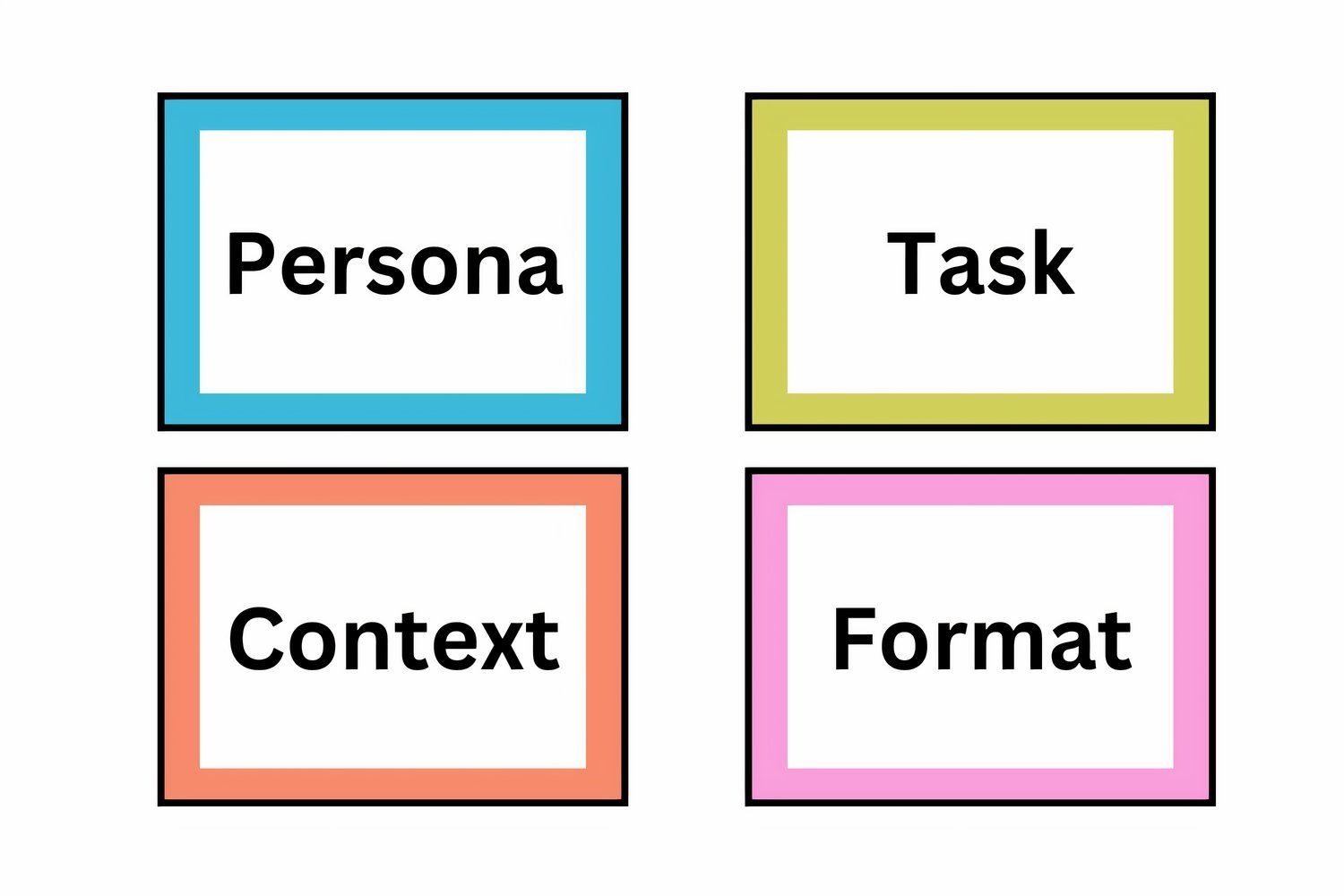
To understand these four pillars in detail, we'll start with a foundational reading that breaks down each component with clear examples.
This guide, titled "PROMPT GUIDELINE," offers an excellent breakdown of what it calls the Persona, Task, Context, and Format (PTCF) framework. It's the same structure we're learning, just with slightly different terminology.
Please read the chapter titled "Anatomy of a great prompt: The essential ingredients." It starts on page 41. Focus on understanding the definition and the 'before-and-after' examples for each of the four components: Persona (Role), Task, Context, and Format. This will take about 15-20 minutes and will form the core of your understanding.
Breaking Down the Framework for Book Writing
Now that you've read the guide, let's solidify those concepts and apply them directly to your goal of writing books.
1. Role (Who the AI should be)
This sets the AI's personality, expertise, and tone. Instead of a generic AI voice, you get a specific expert.
- For your Mentoring Book:
Act as a senior IT architect with 20 years of experience in enterprise systems. - For your Children's Book:
You are a gentle and imaginative storyteller for 5-year-old children. - For your Psychology Book:
Assume the role of a clinical psychologist specializing in cognitive-behavioral therapy. - For your Comic Book:
You are a seasoned comic book writer in the style of the late 1980s, known for gritty and realistic dialogue.
2. Task (What you want the AI to do)
This is the specific, actionable instruction. Use strong verbs.
- Instead of: "Tell me about cybersecurity."
- Try: "
Draftan introductory paragraph explaining the concept of a 'zero-trust' security model." - Other examples: "
Generatefive plot ideas for a children's story about sharing," "Rewritethis technical description to be understandable for a non-technical manager," "Outlinethe key arguments for a chapter on angel investing."
3. Context (The necessary background and constraints)
This is where you prevent generic output by providing the "why," "for whom," and "what to avoid." This is the most critical element for improving quality.
- Audience: "The target reader is a college graduate who has never started a business before."
- Background: "This is the second chapter of a book. The previous chapter introduced the basics of blockchain. This chapter needs to explain smart contracts as the next logical step."
- Constraints: "Do not use overly technical jargon. Avoid clichés like 'in today's fast-paced world.' The tone should be encouraging, not condescending."
- Goal: "The goal of this section is to persuade the reader that building a personal brand is an essential career move."
4. Format (How the output should look)
This ensures the AI's response is immediately usable and saves you editing time.
- Structure: "Present the comparison in a two-column table." "Provide the answer as a bulleted list."
- Length: "Keep the explanation under 200 words."
- Style: "Format the dialogue according to the Chicago Manual of Style." "Write in a witty, informal tone."
Putting It All Together: A Complete Prompt
Let's combine these elements to create a powerful prompt for one of your book ideas.
Scenario: You're writing your mentoring book for junior IT professionals. You want to start a chapter on the importance of "soft skills."
The Prompt:
[Role]
Act as a CTO of a successful tech startup who is mentoring a group of junior software engineers. Your tone is direct, supportive, and full of real-world wisdom.[Context]
I am writing the introduction to a chapter on the importance of soft skills (communication, teamwork, feedback). The audience is technically brilliant but often overlooks these non-coding skills. The goal is to hook them immediately and convince them that soft skills are critical for career advancement, not just "HR fluff."[Task]
Write a compelling 250-word opening anecdote for this chapter. The anecdote should tell a short story about two engineers: one who was technically brilliant but had poor soft skills and was passed over for promotion, and another who was a great communicator and team player and became a team lead.[Format]
The output should be a single block of narrative text. End with a powerful question that makes the reader reflect on their own skills.
See the difference? This detailed prompt leaves almost nothing to chance and is far more likely to produce a high-quality, targeted result than simply asking, "Write about soft skills."
Test your understanding!
You want to start writing a children's book about a shy squirrel named Squeaky who is afraid of heights. Your goal is to generate the opening scene where we meet Squeaky and see his fear.
Using the Role-Task-Context-Format framework, write the prompt you would give to an AI like Claude.
Show answer
Here is one possible high-quality prompt:
[Role]
You are a master storyteller for children aged 4-6. Your writing style is warm, gentle, and uses simple, repetitive language that is easy for young children to follow.[Context]
This is the opening scene for a picture book about a shy squirrel named Squeaky who is afraid of climbing trees. The goal is to introduce Squeaky and clearly establish his fear in a way that makes the reader feel sympathy for him.[Task]
Write the opening scene (around 150 words) where Squeaky is at the bottom of a giant oak tree, watching all the other squirrels scamper up to the highest branches. Describe what Squeaky sees, hears, and feels as he looks up, emphasizing his nervousness.[Format]
Write in simple, short sentences. The output should be three short paragraphs. Avoid complex words and focus on sensory details a child can understand (e.g., "the leaves rustled," "his little heart beat fast").
Expanding the Framework: Rules and Examples
The four-part framework is your foundation. For even more control, you can explicitly add two more elements: Rules (what to do and not do) and Examples (showing the AI what you want). Let's see this in action.
The Step-by-Step master class on writing better prompts than 99% of people
Now that you've mastered the core four components, watch this video from Enovair. It demonstrates a slightly expanded six-part framework that explicitly adds 'Rules' and 'Examples' to what we've learned.
Watch the segment from 1:28 to 4:55. Pay close attention to how the presenter builds a prompt piece by piece, and notice the dramatic difference between the simple prompt and the structured one. Think about how 'Rules' (e.g., 'Don't use guilt') and 'Examples' (providing a sample of the desired tone) give the AI even more precise guardrails.
This video powerfully illustrates how adding constraints and examples takes your prompt from good to great, which is essential for producing book-quality content.
Conclusion
In this lesson, you've acquired the single most important skill for working with writing AIs. By moving away from simple questions and adopting the Role-Task-Context-Format framework, you are now giving the AI a clear and detailed blueprint for success.
Key Takeaways:
- Vague prompts lead to generic, low-quality output. Structured prompts lead to targeted, high-quality results.
- The Role-Task-Context-Format framework provides a reliable structure for any complex writing request.
- Role: Defines who the AI is.
- Task: Defines what the AI should do with clear action verbs.
- Context: Provides the crucial background, audience, goals, and constraints.
- Format: Specifies the length, structure, and style of the final output.
- You can gain even more control by adding explicit Rules and Examples to your prompts.
Preview of the Next Lesson:
You now know how to write a great first prompt. But what happens when the AI's response is 90% of the way there, but not quite perfect? Instead of starting over, we'll learn how to guide the AI to fix its own work. In our next lesson, we will focus on how to apply iterative refinement techniques to improve the quality of AI-generated drafts, turning a good first pass into a polished piece of writing.