Hello! Welcome to the first lesson of your personalized course on writing and publishing books with AI.
Our goal in this lesson is to tackle a fundamental but crucial first step: understanding the tools of the trade. You've mentioned using several AI tools already but finding the quality of their output lacking for book writing. This lesson is designed to address that head-on. We'll explore the distinct capabilities and limitations of the major free AI writing tools. By the end, you'll be able to describe what makes each tool unique, which is the foundation for choosing the right one for a specific writing task and, ultimately, generating higher-quality content.
Let's begin by demystifying the AI writing landscape.
Models vs. Tools: A Quick Clarification
First, it's helpful to distinguish between an AI model and an AI tool (or chatbot).
- Model: This is the underlying "engine" that does the thinking and generating. Examples include OpenAI's
GPT-4o, Anthropic'sClaude 3.5 Sonnet, and Google'sGemini 1.5 Pro. - Tool: This is the user interface you interact with, like the ChatGPT website, Claude.ai, or Google's AI Studio. These tools give you access to one or more models.
Understanding this difference is important because the capabilities of the tool you're using are determined by the power of the model running underneath. Throughout this course, we'll be focusing on the latest and most powerful models available for free.
To get a great overview of the main contenders in the writing space, let's start with a video that compares two of the most popular tools for authors.
ChatGPT vs Claude for Writing in 2024
This video from The Nerdy Novelist provides an excellent head-to-head comparison of ChatGPT and Claude specifically for writing tasks. It will give you a solid understanding of their core differences.
Please watch the following segments: Introduction (0:00 - 2:23): Pay attention to the distinction between the tools and the models they run. Context Window (2:23 - 3:17): This explains how much information each AI can 'remember' at once, which is critical for writing long chapters. General Benchmarks (4:27 - 5:44): This gives a quick overview of performance on various tasks. Prose Quality (6:34 - 13:34): This is the most important section. The creator does a detailed analysis of text generated by both AIs, highlighting what makes one feel more 'human' than the other. Outlining (13:34 - 18:38): See how the two models compare when asked to create a detailed book outline.
The Core Three: A Head-to-Head Comparison
Based on the video and other analyses, let's break down the strengths and weaknesses of the three main free AI writing platforms: ChatGPT, Claude, and Gemini.
1. ChatGPT (by OpenAI)
Think of ChatGPT as the versatile all-rounder. It was the first to gain massive popularity and is competent at a wide range of tasks.
-
Capabilities:
- Versatility: It's a "jack-of-all-trades" that's excellent for brainstorming, generating initial ideas, and creating conventional structures (like blog posts or standard outlines).
- Creative Applications: It has a strong grasp of genre conventions and plot structures, making it useful for initial story development.
- Custom GPTs: A standout feature of the free version is the ability to use and create custom "GPTs." These are like specialized mini-apps you can configure for repetitive tasks, such as summarizing text in a specific format or maintaining a particular character's voice. This will be very useful for building your author workflow.
-
Limitations:
- Generic Prose: It can sometimes produce text that feels a bit generic, overly dramatic, or formulaic. The video you watched highlighted phrases like "pierced the night" or "paralyzed by fear," which are common AI clichés.
- Factual Hallucinations: While improved, it can still confidently present incorrect information. Fact-checking is always necessary.
- Web Access: It can sometimes be hesitant to access and read content from web links, asking you to paste the text instead.
2. Claude (by Anthropic)
Claude is often favored by authors for its superior writing style. It's the thoughtful, nuanced writer in the group.
-
Capabilities:
- Prose Quality: This is Claude's main advantage. It consistently generates prose that is more subtle, natural, and human-like. It's better at showing, not just telling, and its writing often has better flow and psychological depth.
- Large Context Window: Claude models typically have a very large "context window" (the amount of text they can process at once). This is a huge benefit for book writing, as you can feed it an entire chapter for editing or ask it to write a new scene while maintaining consistency with what came before.
- Thorough Reasoning: It excels at explaining complex topics with nuance, making it ideal for your business, mentoring, and psychology book ideas.
-
Limitations:
- Usage Limits: The free version of Claude has stricter daily usage limits than ChatGPT. You might hit your message cap more quickly during intensive writing sessions.
- Fewer Bells and Whistles: Features like the
Projectsfunction (similar to GPTs) are reserved for the paid version. - Safety Restrictions: Claude can be more "cautious" and may refuse to generate content on topics it deems sensitive, even if the context is harmless (like a fight scene in a fantasy novel).
3. Gemini (by Google)
Gemini is the analytical researcher. Leveraging Google's vast data and search capabilities, its strength lies in factual accuracy and technical precision.
-
Capabilities:
- Factual Precision: It's outstanding for research-heavy writing. When you need to incorporate verifiable facts, statistics, or technical details for your IT and business books, Gemini is an excellent choice.
- Technical & Structured Writing: Given your IT background, you'll appreciate its ability to generate clear, systematic, and logical explanations. It's great for drafting "how-to" guides, technical manuals, or educational content.
- Powerful Free Access: Google often makes its top-tier models, like Gemini 1.5 Pro, available for free through platforms like Google AI Studio, which provides a massive 1 million token context window.
-
Limitations:
- Creative Prose: While technically proficient, its creative writing can sometimes feel less inspired or natural compared to Claude.
- Data Privacy: A key trade-off for its powerful free access is that your conversations may be used to train future Google models. This is an important consideration for anyone concerned with intellectual property.
- Verbosity: It can sometimes produce long, dense "walls of text" that require significant editing to be scannable and engaging for a reader.
To help solidify these differences, the following reading provides an excellent breakdown of how these models perform across different types of writing you're interested in, from creative to technical.
Comparing LLM Models for Writing: ChatGPT, Claude, Gemini ...
This blog post, "Comparing LLM Models for Writing," provides a structured analysis of how ChatGPT, Claude, and Gemini perform in different writing applications.
Please read the following sections: Start with "The Core Four: Architecture and Capabilities." This section gives a concise overview of each model's design philosophy and typical output style. Next, focus on the section "Comparative Analysis: Writing Applications." This is highly relevant as it compares the models for academic/research, creative, technical, and marketing content—all genres you've expressed interest in. Finally, read the "Conclusion: The Augmented Writer" to reinforce the core idea of using a multi-model approach.
Visualizing the Differences
Tables and charts can often make these comparisons clearer. Here are two visuals that summarize the key features and performance benchmarks.
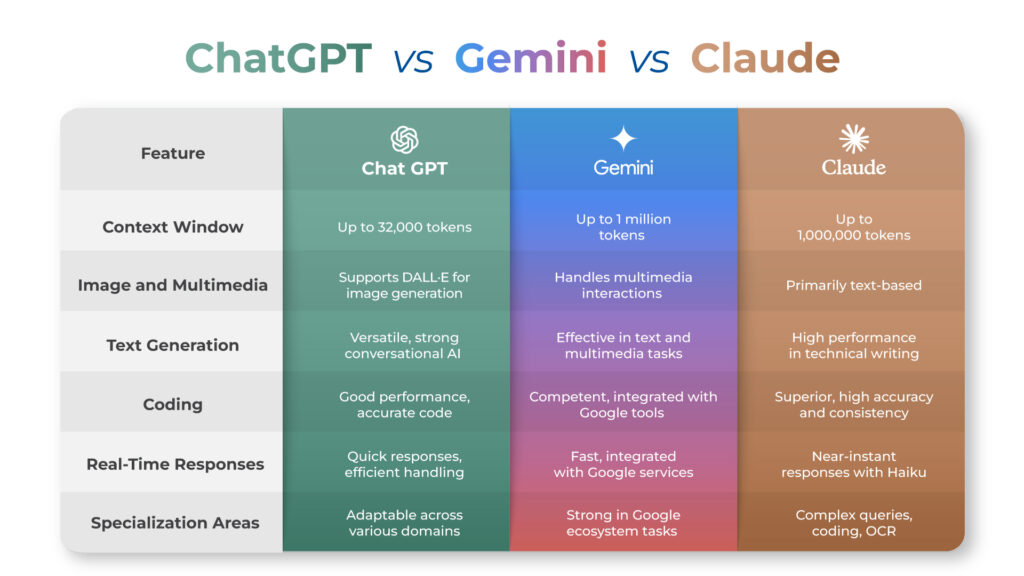
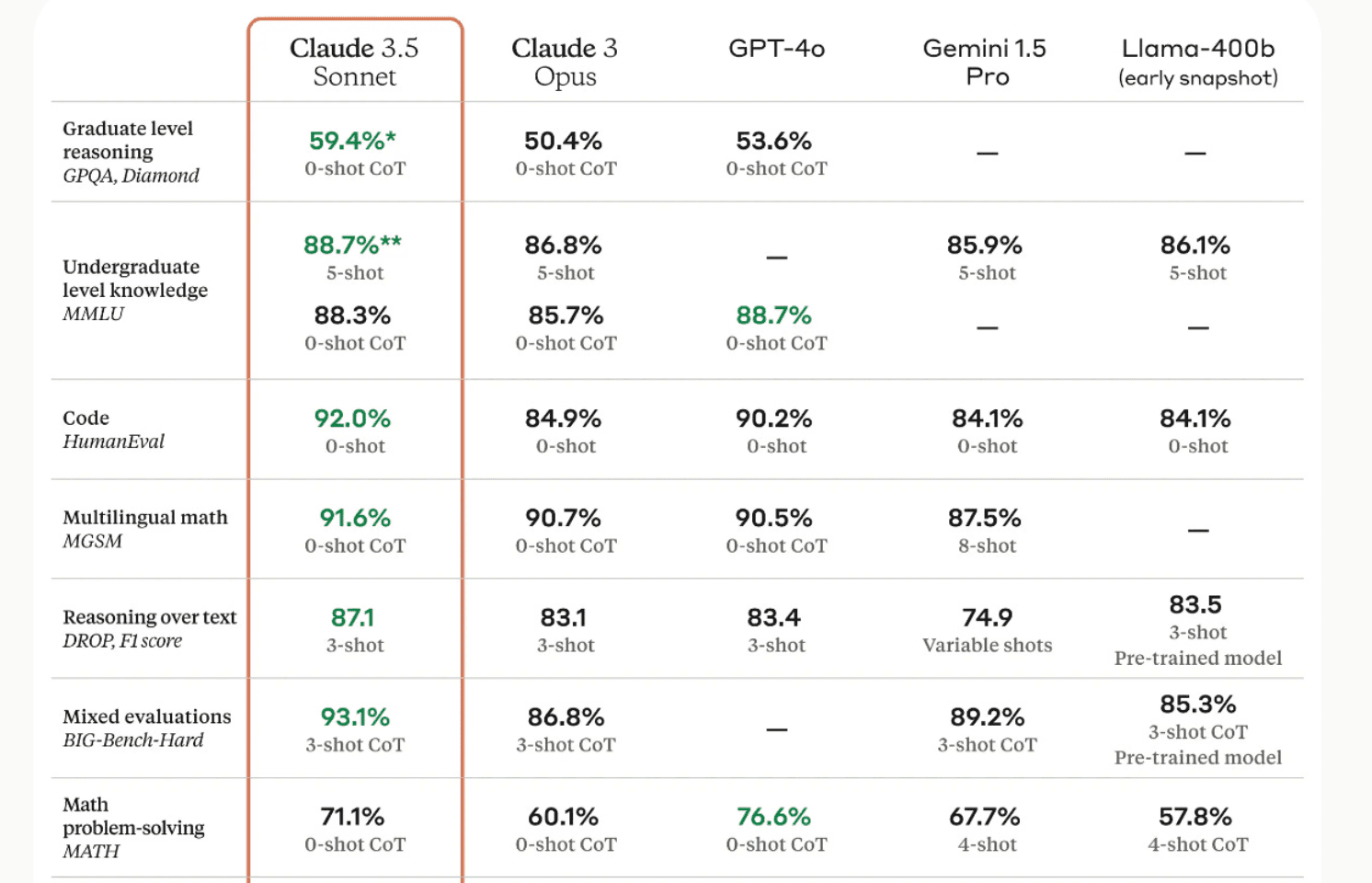
Test your understanding!
You're starting to write a non-fiction book that leverages your 10 years of IT experience to mentor junior engineers. You need to write a chapter explaining the core principles of network security.
- Which AI tool would be your primary choice for drafting the core, fact-heavy content of this chapter, and why?
- After drafting, you notice the text is technically accurate but very dry. Which tool would you use to refine the chapter to make it more engaging and conversational for a junior audience?
Show answer
-
Primary choice: Gemini. Its strengths in factual precision, technical accuracy, and creating systematic, logical explanations make it the ideal tool for drafting the initial, information-dense content. It's the most reliable for getting the technical details right.
-
Refinement choice: Claude. After getting the facts down with Gemini, you would turn to Claude to improve the prose. Claude excels at producing more nuanced, natural, and readable text. You could ask it to "rewrite this chapter in a more conversational and mentoring tone, using analogies to help junior engineers understand these complex concepts," and it would likely produce a much more engaging result than the other tools.
A Multi-Model Workflow: The Key to Quality
As the exercise above suggests, the secret to overcoming the "low-quality output" you've experienced is to stop thinking of these tools as a one-stop shop. The most effective AI-assisted authors use a multi-model workflow. They don't just use one AI; they orchestrate several, delegating tasks based on each tool's unique strengths.
Here's a sample workflow for your book ideas:
-
For Business/Mentoring Books:
- Research/Brainstorming: Use Perplexity or Gemini to gather facts, case studies, and research.
- Outlining: Use Claude or ChatGPT to structure the book and chapters.
- Drafting: Use Gemini for technical sections and Claude for conceptual or narrative sections.
- Refining: Use Claude to polish the entire manuscript for flow, tone, and readability.
-
For Children's Books/Comics:
- Ideation: Use ChatGPT to brainstorm high-level concepts, characters, and plot points.
- Storytelling/Prose: Use Claude to draft the narrative, as its prose is more likely to be charming and age-appropriate.
- Dialogue: Use Claude or Gemini (which also performs well with dialogue) to write character interactions.
Conclusion
In this lesson, we've laid the critical groundwork for your AI authoring journey. You now have a map of the AI landscape and an understanding of your primary tools.
Key Takeaways:
- There is no single "best" AI for writing; success comes from using the right tool for the right task.
- ChatGPT is your versatile all-rounder, great for brainstorming and structure.
- Claude is your master wordsmith, excelling at high-quality, nuanced prose.
- Gemini is your technical expert and researcher, perfect for fact-based content.
- Adopting a multi-model workflow is the most effective strategy for producing a high-quality, human-touch manuscript.
Preview of the Next Lesson:
Now that you know the what—the capabilities of your tools—it's time to learn the how. In our next lesson, "Write effective prompts for book content using the role-task-context-format framework," we will move from theory to practice. You'll learn how to give the AI precise instructions to get exactly the output you need, which is the second crucial step to elevating the quality of your AI-generated content.