Recommended resources
The freely available resources this lesson will direct you to.
Hello again. Last lesson separated studies by the decision they support: planning, interconnection, compliance, or commissioning. A second question now follows: which requirement should the study use? A technically careful ride-through simulation, for example, cannot establish compliance until you know which ride-through criterion applies to that project.
This lesson gives you a way to sort five commonly encountered sources—FERC rules, NERC Reliability Standards, IEEE standards, ISO/RTO procedures, and utility requirements. The goal is not to memorize a universal ranking. It is to determine which sources govern a specified issue, which merely provide technical guidance, and which document you need to verify before stating an acceptance criterion.
A requirement has a source, a scope, and a route to the project
Imagine that a proposed battery plant must demonstrate voltage ride-through. You find an IEEE standard describing inverter performance, a NERC document discussing reliability, and a utility interconnection requirement specifying a disturbance test. It would be a mistake to choose whichever document looks most technical—or simply whichever sets the toughest limit.
Instead, ask three questions:
- What is the issue? Is it permission to connect, a reliability obligation on a registered entity, equipment performance, a study submission, or an installed-system test?
- Does the source cover this project? Check the facility type, connection location, transaction or service requested, responsible entity, and jurisdiction.
- How does the requirement reach the project? It might apply directly to an entity; appear in an applicable tariff; or be incorporated into a utility requirement or interconnection agreement. A document can also be useful guidance without itself imposing a project obligation.
The following distinctions are a starting point, not a precedence ladder:
| Source | Typical role | Applicability question |
|---|---|---|
| FERC | Sets or approves rules for activities within its United States jurisdiction, including applicable transmission and wholesale-market tariffs; approves mandatory NERC Reliability Standards for the United States | Is this facility or transaction within the relevant FERC-jurisdictional process? |
| NERC Reliability Standards | Impose specified reliability duties on entities to which an approved, effective standard applies | Is this entity subject to this standard and its stated requirements? |
| IEEE standards | Define technical performance or testing approaches | Is this the right standard for the equipment and connection, and has it been made applicable here? |
| ISO/RTO tariff and procedures | Set the applicable regional interconnection or market process and its study requirements | Is this service request in the ISO/RTO’s applicable process? |
| Utility requirements | Specify local facility connection, protection, modeling, operating, and testing needs | Which utility requirements apply at this connection, and through which approved documents or agreement? |
An important distinction sits within the ISO/RTO row: a tariff and an explanatory manual need not have equal authority. Likewise, a NERC Reliability Guideline is not a NERC Reliability Standard. The document’s title, scope, and status matter.
Separate reliability obligations from connection specifications
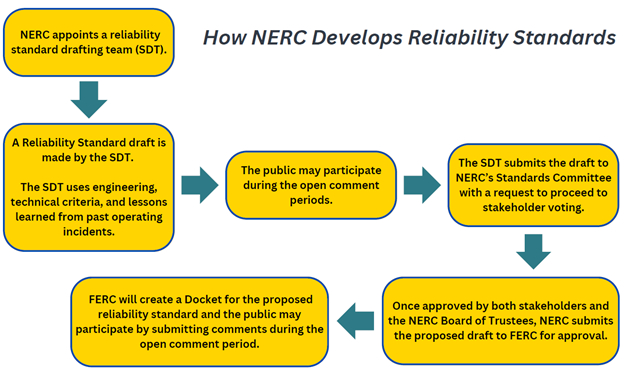
The NERC graphic shows how a proposed Reliability Standard moves through drafting, public comment, stakeholder voting, NERC approval, and submission to FERC. The depicted process reaches FERC’s public-comment stage; it does not by itself show a final FERC decision or establish that a particular standard applies to a particular project.
A useful example of the boundary between NERC obligations and local project requirements appears in NERC’s 2019 Reliability Guideline: Improvements to Interconnection Requirements for BPS-Connected Inverter-Based Resources. Read it for the relationship between the documents, not as a source of current standard-version numbers. It discusses versions that were current when the guideline was written.
Read this NERC guideline excerpt to see why a reliability standard governing an entity's work and a utility's connection requirement for a project can both matter to the same study.
In the Introduction, under "Applicable NERC Facility Interconnection Standards" (printed pp. 2–3), begin where the text describes the minimum performance characteristics in facility interconnection requirements. Read requirements and studies, ending after the list of study contents and the sentence about coordinated results. Then, in the same Introduction, read the connection between documented facility requirements and interconnection studies. Focus on who must document or conduct work versus what performance an interconnecting resource is asked to provide.
The guideline describes one standard concerned with making facility connection requirements available and another concerned with studying the impact of new or materially modified interconnections. It also explains that the studies consider applicable Reliability Standards alongside regional criteria and facility interconnection requirements. In other words, “NERC applies” does not replace the need to find the local performance specification.
Do not assume that every solar plant, battery, or large load is directly subject to every NERC standard. Applicability is requirement-specific: check the standard’s effective version, jurisdiction, named responsible entities, and facility scope. Also distinguish a mandatory Reliability Standard from NERC guidance recommending how connection requirements could be improved. The latter can inform engineering judgment without automatically becoming a pass/fail obligation.
Trace an interconnection issue through the tariff and local process
For a proposed generator, FERC’s jurisdiction and an ISO/RTO’s process may be closely related, but they are not interchangeable labels. In a FERC-jurisdictional interconnection, the applicable filed tariff is the place to establish the formal process; a regional manual can explain how that process is administered. A utility may separately specify the data, protection design, or connection performance required at its facilities.
The boundary is especially important for a generator connecting to distribution facilities. A physical distribution connection does not, by itself, tell you whether the applicable generator process is a state or local utility process, an ISO/RTO process, or both for different purposes. PJM’s manual provides a concrete example. It is a 2023 revision, so use it here to understand the reasoning and check current documents before using its details for a live request.
Read this PJM example to see how the facility, jurisdiction, and requested service affect the procedural path—and how the manual distinguishes its technical provisions from the Tariff.
In Section 1, subsection 1.4, "Interconnection Procedures for FERC Jurisdictional Facilities and Non-FERC Jurisdictional Facilities" (printed p. 12), start at the sentence explaining that the tariff process for a wholesale generator on distribution facilities varies with jurisdiction. Read the jurisdiction distinction through the statement that PJM may still study impacts. Then turn to Attachment C, subsection C.1, "Scope" (printed p. 76), and read tariff precedence. Finally, in subsection C.3, "Background and Discussion" (printed pp. 76–77), find the paragraph beginning "Developed by the PJM Small Generator Interconnection Working Group" and read through the state-rule exception. Focus on why a regional study of system impacts does not necessarily supply permission to connect to another entity's facilities.
The example yields two practical cautions. First, different approvals may answer different questions: a regional organization can need to assess impacts on its system while another entity controls the physical connection process. Second, check the documents’ own statements about scope and precedence. Attachment C expressly says the Tariff controls if its terms conflict with those small-generator provisions; that is evidence for this case, not a universal rule that every manual is subordinate in exactly the same way.
A large data center illustrates another scope boundary. Its new utility supply may require substantial connection studies, but a generator interconnection procedure should not be assigned to it simply because the studies use power flow or fault calculations. Start with the applicable large-load or utility service process. If an on-site generator or battery will export, that aspect may have a separate interconnection path.
Decide whether an IEEE standard governs—or informs—the criterion
IEEE standards supply detailed technical language that other documents can adopt. For example, IEEE 1547 concerns distributed energy resources interconnected with electric power systems; IEEE 2800 concerns inverter-based resources on transmission and networked subtransmission systems. Selecting between them requires attention to the connection and the standard’s scope, not just whether the equipment contains an inverter.
The January 2024 map below is a useful warning against assuming uniform adoption. It depicts differing reported adoption statuses at that time, not the current rule for any project. A map color cannot tell you which edition, implementation date, exceptions, utility specification, or agreement governs your issue.

Here is the distinction to make in a study scope: “IEEE 1547 describes a relevant technical capability” is not the same claim as “this project must demonstrate the capability under IEEE 1547-2018 as adopted in its applicable connection requirements.” The second claim needs a documented route to the project and any applicable qualifications. Similarly, the NERC guideline you just read discusses IEEE P2800 as a developing effort in 2019; do not use that historical description to determine the standard’s present publication or adoption status.
Apply the distinction to three project issues
Suppose you are asked, “What governs this test?” A concise, defensible answer names the issue and project boundary, identifies the likely controlling document, and notes what still needs verification.
A transmission-connected solar plant’s reactive-power performance. Start with its applicable generation interconnection process and filed tariff or agreement, then identify the transmission utility’s performance requirements. Relevant FERC rules may shape those requirements, and an IEEE standard may provide a technical specification if adopted for this connection. Check separately whether a NERC standard imposes a duty on a relevant registered entity. Do not substitute a general guideline’s recommendation for the plant’s documented acceptance criterion.
A distribution-connected battery seeking wholesale participation. Establish both the physical connection path and the requested wholesale service. As the PJM example shows, a regional queue or impact study may coexist with a separate process for permission to connect to non-FERC-jurisdictional facilities. Determine which adopted IEEE requirements and utility specifications apply to the battery’s connection; do not infer a single governing procedure from its wholesale intent alone.
A data center’s proposed load-pickup test. Begin with the utility’s service and facility requirements and the applicable connection or operating agreement. An ISO/RTO or transmission-planning assessment may also be necessary if the load materially affects the wider system. That does not automatically make the data center subject to a generator interconnection rule or every NERC obligation used by the entities studying its impact.
If two sources appear to conflict, do not silently choose the stricter number. Check whether they apply to the same facility, measurement point, condition, and responsible party; then examine any stated precedence or exceptions. Escalate a genuine unresolved conflict to the responsible utility, transmission provider, or other authority, and record the resolution before declaring a pass/fail criterion.
A useful requirement note can be short: issue; governing document and provision; applicable facility and entity; criterion; adoption or agreement route; version/effective date; unresolved questions. That record makes the eventual study assumption auditable.
Key takeaways
Determining what governs an issue is an applicability and traceability task, not a search for the most familiar standard. FERC rules and approved tariffs may establish a process; NERC Reliability Standards impose duties within their stated applicability; IEEE standards provide technical requirements when applicable or adopted; and ISO/RTO and utility documents specify regional and connection-level obligations. Several can matter to one study, but they may govern different decisions or different entities.
For every proposed criterion, be able to say why this source reaches this project, in this version, for this issue. Next lesson, you will put that judgment to work by locating the current interconnection and performance requirements for a project in a selected jurisdiction.