Recommended resources
The freely available resources this lesson will direct you to.
Welcome. This course develops the judgment needed to scope and interpret grid studies for renewable generation, battery energy storage, and large electrical loads. Before choosing software or building a model, you need to know what decision the study is meant to support. That is the focus of this first lesson.
You will distinguish four kinds of work that may use similar electrical analyses but answer different questions: planning, interconnection, compliance, and commissioning. The distinction matters in practice because a technically sound calculation can still be the wrong deliverable if it does not answer the decision-maker’s question.
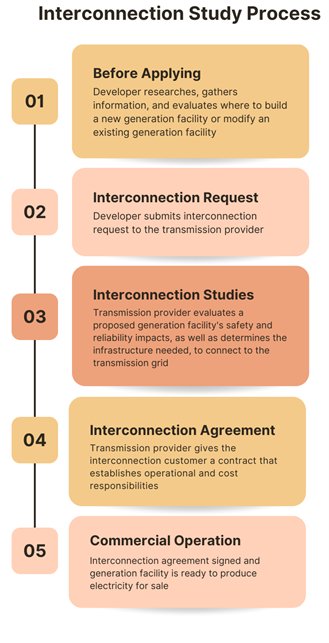
The Federal Energy Regulatory Commission (FERC) graphic below gives a high-level view of a generation project moving from an interconnection request toward operation. It is useful orientation, not a universal schedule: actual procedures vary, and planning and compliance work do not each occupy a single box.
Planning studies: what must the wider grid be able to withstand?
A planning study supports decisions about the future power system, rather than just one applicant’s connection. A transmission planner may need to decide whether existing lines, transformers, reactive-power resources, and protection equipment will remain adequate as demand, generation, and system configurations change. The study looks across credible operating conditions and contingencies—events such as the loss of a line or transformer—and can lead to a corrective action plan.
Read two short portions of TPL-001-5.1 — Transmission System Planning Performance Requirements on NERCipedia. Treat the standard here as an illustration of the planning decision, not as a claim that every project or facility is subject to it.
TPL-001-5.1 — Transmission System Planning Performance Requirements - NERCipedia
NERCipedia presents the purpose and selected requirements of a transmission planning standard. Read to see how an assessment of the wider system leads to decisions about system deficiencies and corrective actions.
Start at “Purpose” and read the planning purpose. Then, under “Requirements and Measures,” read the opening paragraph of R2, beginning with the annual Planning Assessment and ending with its steady-state, short-circuit, and stability analyses; the R2 opening locates it. Finally, go to R2 part 2.7 and read its first paragraph, from “For planning events shown in Table 1” through the requirement for corrective action plans; the corrective-action passage marks the central decision. You can leave the detailed event categories for a later lesson.
Notice the scale of the question. A planner might test peak and off-peak demand, anticipated generation additions, and equipment outages. If a line would overload after a credible contingency in a future year, the decision is not simply “approve or reject this particular solar plant.” It is what system change or operating measure is needed to maintain required performance, and whether that action belongs in a plan.
Planning can nevertheless include proposed projects. A forecasted battery plant or data-center expansion may materially change a system assessment. The distinction is the decision being made: adequacy and development of the wider grid over a planning horizon. Also note that planning work can itself be performed to meet a reliability standard. “Planning” describes the decision the analysis supports; it does not mean the work has no compliance obligations.
Interconnection studies: what does this specific connection require?
An interconnection study starts with a proposed connection or modification and asks what happens if that request is implemented. For a generation project, the central decisions include whether the proposed point and requested service can be accommodated safely and reliably, what facilities or network upgrades are needed, and what their likely cost and construction implications are.
The following older FERC large-generator procedures illustrate three study purposes. They are useful for understanding the questions, not as a checklist of the current required sequence in every jurisdiction. Applicable tariffs and procedures must be checked for the actual project—a task we will tackle later in this module.
This FERC-hosted procedures document distinguishes preliminary feasibility, system impact, and facilities work by the decisions each informs. Read the stated scopes rather than the surrounding procedural details.
In Section 6.2, “Scope of Interconnection Feasibility Study” (printed p. 34), read from the preliminary-feasibility statement through the non-binding facility, cost, and construction-time estimates: feasibility scope. In Section 7.3, “Scope of Interconnection System Impact Study” (printed p. 37), read from its opening statement through its list of required facilities and preliminary estimates: impact scope. In Section 8.2, “Scope of Interconnection Facilities Study” (printed p. 39), read from its opening statement through the estimate of construction and installation time: facilities scope. Watch how the decision becomes more specific across these descriptions.
The three scopes progress from a preliminary question—does this look feasible, and at what approximate cost?—to an impact question—what problems does this request cause under the studied assumptions?—and then an implementation question—which connection equipment and upgrades must be specified, and what will they take to build? A system impact study might use power-flow, fault, and stability analyses. Those are methods, not interchangeable names for the study’s purpose.
Suppose a proposed solar plant would increase fault duty beyond a nearby breaker’s rating. In an interconnection study, the consequential decision is whether the proposed connection requires a breaker replacement or other modification, and how that affects the request. The same breaker may also appear in a wider transmission planning assessment. The calculation overlaps; the decisions and scope differ.
The cited procedures address large generating facilities. A data center seeking a new utility supply also needs a connection-impact assessment, but you should not assume that the generator procedure applies to that load. Its utility or other applicable connection process determines the formal requirements.
Compliance studies: does the project meet an applicable requirement?
A compliance study supports a different claim: under defined conditions, does the project meet a specified, applicable requirement? The requirement might concern voltage or frequency ride-through, reactive-power capability, power quality, protection behavior, or another performance obligation. Evidence might come from simulations, design documentation, equipment tests, or field measurements, depending on what the requirement calls for.
A sound compliance finding needs more than a plot labeled “pass.” It needs:
- the applicable requirement and its source;
- a measurable criterion and the conditions under which it applies;
- evidence produced using a suitable model or test;
- a comparison between that evidence and the criterion, including any limitations.
For example, imagine a battery plant required by its applicable connection documents to remain connected during a defined voltage disturbance. A compliance study would identify the specified disturbance and permitted response, simulate the plant’s controls under relevant operating conditions, and report whether the modeled response meets that criterion. A successful simulation is evidence about the modeled design, not proof by itself that the installed equipment has been configured correctly.
The word applicable is essential. FERC rules, NERC standards, IEEE standards, ISO/RTO procedures, and utility requirements can play different roles; an IEEE document is not automatically a binding pass/fail rule for every project. Later lessons will show you how to determine which requirements govern a particular issue.
The boundary with planning can be subtle. An annual transmission planning assessment may demonstrate conformance with a planning standard. It remains a planning study when you describe the system decision it supports; it also produces compliance evidence for the entity responsible for that standard. These categories describe purposes of work, not four mutually exclusive file types.
Commissioning studies and tests: does the installed system work?
A model may predict correct performance while an installed relay has the wrong settings, a measurement is wired incorrectly, or a plant controller is not coordinating with its inverters. Commissioning addresses that gap between the studied design and the physical installation. Its practical decision is whether equipment and integrated systems have been verified sufficiently to proceed through the relevant startup, energization, and handover stages.
The video below uses examples from industrial facilities rather than a grid interconnection. Focus on its transferable distinction: checks on individual installed equipment are not the same as testing components operating together.
Pre-Commissioning vs Commissioning - What Takes Place During Each Stage?
Watch “Pre-Commissioning vs Commissioning - What Takes Place During Each Stage?” from ICxA for the distinction between individual equipment checks and integrated system checks.
In equipment checks, note the examples involving wiring, controls, relays, and interlocks, and the explanation that pre-commissioning generally examines items individually. Then watch integrated checks to see what changes when multiple components are tested as a functioning subsystem. Apply that distinction to a plant controller, inverters, transformer, breaker, metering, and protection system rather than to the video’s process-equipment example.
For a renewable plant, battery installation, or large load facility, commissioning evidence could include installation and wiring checks, protection and interlock tests, control signal checks, staged energization results, and observed response of the integrated facility. The exact test plan and permission to energize depend on the project and responsible parties. Commissioning is not merely rerunning an interconnection simulation on site: it verifies what was actually installed and how its parts behave together.
Commissioning measurements may also help establish compliance with a performance requirement. The purposes still differ. A commissioning test asks, “Does this installed system operate as intended, and can this startup stage be accepted?” A compliance assessment asks, “Does the available evidence demonstrate that the applicable criterion has been met?” One test record can inform both decisions.
Choose the study by its decision, not its software
Consider a proposed solar-plus-battery facility connecting at an existing substation. A power-flow model might be used in several deliverables:
| Study purpose | Decision the work supports |
|---|---|
| Planning | Will the future grid remain adequate across forecast conditions and contingencies, and what broader corrective action is needed? |
| Interconnection | What impacts and connection facilities or upgrades result from this request? |
| Compliance | Does the project meet a stated, applicable performance criterion under specified conditions? |
| Commissioning | Has the installed facility and its integrated equipment demonstrated the behavior needed for startup and handover? |
This is why “we ran a fault study” is an incomplete scope statement. A planner may use fault results to assess future breaker adequacy; an interconnection engineer may use them to identify an upgrade caused by a request; a compliance assessment may use them as evidence against a stated requirement; and a commissioning team may test the installed protection system’s response. Each needs different assumptions, evidence, and conclusions.
When you receive a study request, first ask: Who must decide what, using which evidence? Then identify the applicable project and system boundaries. Only after that should you settle on analyses, models, and deliverables.
Key takeaways
Planning studies inform future system adequacy and corrective actions. Interconnection studies inform the impacts and implementation needs of a particular connection request. Compliance studies determine whether applicable criteria are met with adequate evidence. Commissioning verifies the installed equipment and integrated system for startup and handover. Their analyses can overlap, but their decisions are not interchangeable.
Next, we will examine how to determine whether FERC rules, NERC standards, IEEE standards, ISO/RTO procedures, or utility requirements govern a particular project issue—so that a study is judged against the right authority as well as the right technical question.