Recommended resources
The freely available resources this lesson will direct you to.
Hello again. Last lesson established that a standard can be technically relevant without automatically governing a project. This lesson turns that distinction into a document-finding method. You will follow a hypothetical 100 MW solar plant connecting to transmission facilities in the U.S. PJM region, identify where its current interconnection and performance requirements would be found, and record what you can—and cannot—verify.
The example deliberately leaves the exact transmission owner and connection point unspecified. Those details are necessary before anyone can claim to have found all applicable local requirements. That is part of the lesson: a defensible answer identifies missing project facts rather than filling them in by guesswork.
Establish the jurisdiction before opening a standard
“PJM region” is a useful starting description, but it is not a complete jurisdictional determination. An ISO/RTO operates a regional process; the physical connection is to particular facilities, and the service requested determines which interconnection process to check. The map shows why a regional name helps orient a search, not why a particular tariff provision applies.
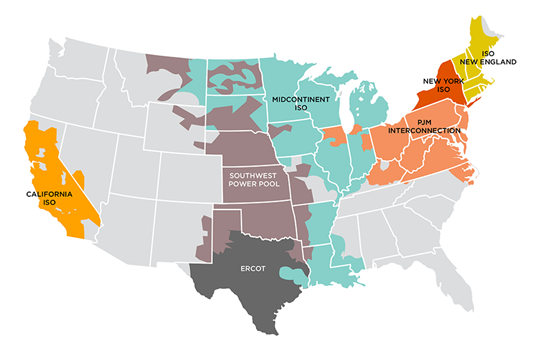
For this lesson, assume the solar plant requests generator interconnection service through a FERC-jurisdictional transmission process in the PJM region. The project’s 100 MW proposed capacity makes the large-generator route the appropriate starting place to investigate. Before applying that route to a real project, confirm the service request and the facilities involved.
Write down four search facts first: project type and capacity; intended connection point and facility owner; service requested; and the date at which requirements must apply. A requirement effective today might not be the one governing an earlier executed agreement or a request subject to a transition provision.
Use FERC’s page as an index, not as the project specification
FERC’s Generator Interconnection page distinguishes its large- and small-generator materials and points to several orders. Read the short page to see how it orients a search. Do not treat its list of orders as a consolidated set of current acceptance criteria.
Generator Interconnection | Federal Energy Regulatory Commission
Read FERC’s Generator Interconnection page to find the starting route for the assumed 100 MW generator and to distinguish a regulatory index from the requirements in an applicable filed tariff.
Under “Final Rules Establishing and Revising Standard Interconnection Agreements & Procedures for Large Generators,” begin with the large-generator description. Continue through “Standard Interconnection Agreements & Procedures for Small Generators” and its description of generators no larger than 20 MW. Then scan the “Quick Links” list from the listed orders. Notice that the page supplies routes to regulatory material, not a project-specific study criterion or a determination of which tariff revision governs a request.
The next document to locate for the assumed project is the currently applicable filed PJM tariff, specifically its generator-interconnection procedures and agreement provisions. Use PJM’s official tariff or governing-documents navigation, or the official filed-tariff record, rather than an undated search-result excerpt. Within the tariff, look for the provisions covering the requested service, application and study process, technical obligations, and any transition or effective-date terms.
Why not simply cite an order from FERC’s Quick Links? An order can require changes to tariffs, but the question for a project is which filed provisions apply to this request at the relevant time. A useful search record therefore captures the tariff provision and its effective version, not just the order that prompted a change. If the tariff points to an agreement or another document for a technical requirement, follow that reference and record both links in the chain.
Follow the technical requirements to the facility owner
The regional tariff is not necessarily where every test setting or equipment specification lives. A transmission owner may publish facility interconnection requirements concerning matters such as protection, modeling, design, or performance. NERC FAC-001-4 explains who has a duty to document and make certain facility interconnection requirements available. It does not, by itself, give this hypothetical solar plant a ride-through curve or reactive-power acceptance value.
[PDF] NERC Standard FAC-001-4 “Facility Interconnection Requirements”
Read the introduction and Requirement R1 of NERC’s FAC-001-4 to understand why the relevant facility owner is a necessary stop in a requirements search.
On pp. 1–2, begin in “A. Introduction,” item 3, “Purpose.” Read the purpose and R1 through “B. Requirements and Measures,” R1 items 1.1–1.3; stop before M1. Notice both the named responsible entities in “Applicability” and that R1 calls for requirements addressing generation, transmission, and end-user facilities. On p. 1, also note that “Effective Date” refers to an implementation plan: the PDF alone is not proof of its present effective status in every jurisdiction.
For our assumed plant, identify the actual transmission owner at the proposed connection using project and interconnection records. Then locate that owner’s facility interconnection requirements, check the generation-facility portion, and request the applicable document if it is not publicly available. Record its revision and date. FAC-001-4 is useful here as a locator and an explanation of the owner’s documentation role; verify the standard’s applicable and effective version separately before making a compliance claim about the owner.
Do not confuse these two findings:
- “The transmission owner must document specified categories of interconnection requirements under an applicable NERC obligation.”
- “This solar plant must pass a particular voltage-performance test.”
The first may help you find the document that establishes the second. It is not a substitute for reading that document.
Build a requirements trail for one performance issue
Suppose the study team needs to assess the solar plant’s behavior during a voltage disturbance. Searching for “solar voltage ride-through requirement” will produce many plausible-looking answers, including IEEE material, older manuals, and requirements from other regions. A narrower trail is more reliable:
- Confirm the connection process. Find the applicable PJM tariff provisions for this generator request, including any effective-date or transition language.
- Find the technical route. Follow the tariff’s references to the applicable agreement, procedures, or facility-specific requirements. An explanatory manual can help you navigate, but check its status against the governing provisions. The older PJM Manual 14G discussed last lesson remains an example of how to read such a manual—not proof of today’s requirements.
- Identify the facility owner’s criteria. Find the owner’s generation interconnection requirements and determine whether they address the disturbance and the proposed connection.
- Check adoption of technical standards. If a document invokes an IEEE standard, record the specified edition, scope, exceptions, and whether the invocation applies to this project. Do not turn a generally relevant IEEE provision into a project obligation without that link.
- Resolve the measurable criterion. Locate the governing passage for the disturbance conditions, measurement location, required response, and pass/fail threshold. If those elements are missing or apparently conflicting, record the question for the responsible provider or owner rather than inventing a value.
The same trail works for other issues, but it may end in different places. An application-data requirement might be specified in a regional procedure; a protection interface might depend heavily on the facility owner; an equipment capability might be described in an adopted IEEE standard. Current means current for the relevant request and decision, after checking revisions, effective dates, and applicable agreements—not merely the newest PDF returned by a search engine.
A compact locator record prevents a promising find from becoming an unsupported assertion:
| Record field | What to capture |
|---|---|
| Project scope | Generator type, requested capacity and service, connection facility and owner |
| Issue | For example, voltage-disturbance performance |
| Governing route | Tariff provision and any referenced agreement or technical document |
| Exact criterion | Section or clause; tested condition, measurement point, and threshold |
| Version check | Revision, effective date, access date, and any transition provision |
| Status | Verified applicable, potentially applicable, or awaiting confirmation |
For the hypothetical plant, we can verify the search route from the supplied material, but we cannot fill in an exact owner-specific performance threshold: the connection facility and current filed technical provisions have not been supplied. Label that field awaiting confirmation. This is more useful to a study team than a confident number taken from the wrong jurisdiction.
Key takeaways
To locate applicable requirements, begin with the project’s service, connection, owner, and relevant date. Use FERC’s generator page to orient the regulatory search; verify the applicable filed regional tariff and its effective provisions; then follow its references and obtain the transmission owner’s facility requirements. FAC-001-4 helps explain why those owner requirements are an essential part of the trail, without supplying the plant’s performance criterion itself.
The result should be an auditable record: where a requirement was found, why it reaches this project, which version applies, and what remains unconfirmed. In the next lesson, you will make the physical boundaries behind that record precise by marking the connection point, common coupling point, study area, and equipment ownership on a one-line diagram.