Recommended resources
The freely available resources this lesson will direct you to.
- How to Feel Energized & Sleep Better With One Morning Activity | Dr. Andrew Hubermanwww.youtube.com
- 10 Minute Non-Sleep Deep Rest (NSDR) to Restore Mental & Physical Energy | Dr. Andrew Hubermanwww.youtube.com
- The Science & Use of Cold Exposure for Health ...www.hubermanlab.com
- After a Study Session, Take a Short Rest Using a Non-Sleep Deep ...metalhatscats.com
Welcome to the second lesson in our module on "Advanced Protocols for Peak Daytime Energy." In our last session, you developed a protocol for strategic movement breaks to manage your energy rhythmically throughout the day. That system is your frontline defense against sedentary fatigue.
Today, we add more specialized tools to your arsenal. This lesson addresses the inevitable midday energy slump—that period in the afternoon when alertness naturally dips. Your learning outcome is to apply a non-caffeinated alertness reset protocol using tools like light, cold, and structured rest to combat these slumps without resorting to another coffee.
The Midday Slump: A Biological Feature, Not a Flaw
First, it's critical to understand that the post-lunch dip in energy is not a personal failure; it's a predictable feature of your circadian rhythm. Your internal body clock, which governs your sleep-wake cycle, also dictates your alertness levels throughout the day. There is a natural, biologically driven dip in alertness in the early to mid-afternoon.
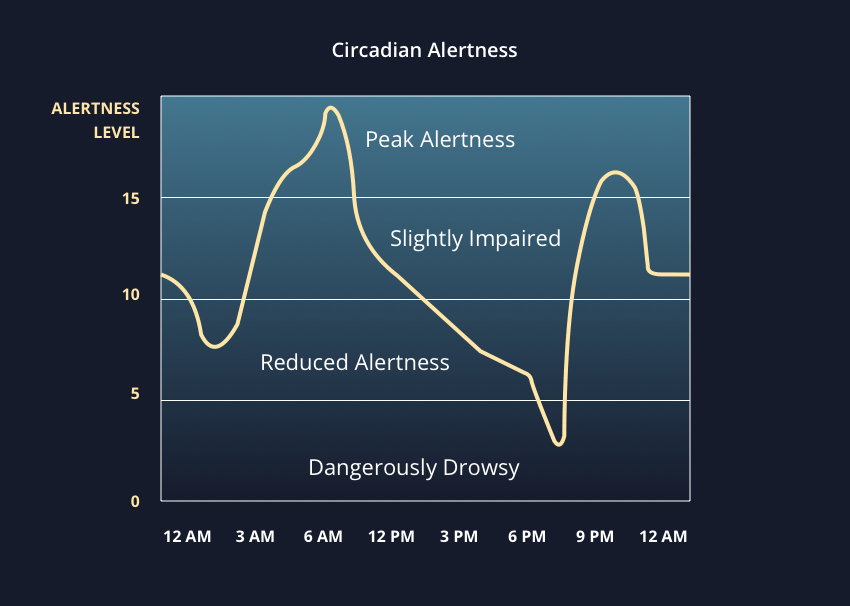
Instead of fighting this dip with willpower or caffeine (which can disrupt your sleep later), we can use specific, non-caffeinated protocols to reset your alertness. We'll cover three distinct methods: Light Exposure, Cold Exposure, and Non-Sleep Deep Rest (NSDR).
Protocol 1: The Light Exposure Reset
Just as morning sunlight sets your circadian clock, a brief dose of bright light in the afternoon can provide a powerful wake-up signal to your brain.
The "Why": Bright light exposure triggers the release of cortisol and other neurochemicals that directly promote alertness and focus. Sunlight is intensely more powerful than typical indoor lighting for this purpose.
To understand the potency of sunlight, the mechanism is the same one we use to anchor our rhythm in the morning.
How to Feel Energized & Sleep Better With One Morning Activity | Dr. Andrew Huberman
Dr. Huberman explains why natural sunlight is far more effective than artificial indoor light for triggering the brain's alertness mechanisms. Although the video focuses on morning light, the principles apply directly to our goal of getting an afternoon alertness boost.
Watch the segment from 02:49 to 04:47 to understand why indoor lights are insufficient for a strong alertness signal. Then, watch from 05:33 to 06:26 to see why getting outside is crucial and viewing light through a window doesn't work.
The Protocol:
- Timing: When you feel the afternoon slump begin (typically between 1:00 PM and 4:00 PM).
- Action: Go outside for 5-10 minutes.
- Execution:
- Do not wear sunglasses. Eyeglasses or contacts are fine.
- Face the general direction of the sun. You do not need to look at it directly.
- If you can't go outside, use a bright (900-1000 lux) artificial light or SAD lamp, positioned about 1-2 feet from your face for the same duration. The effect will be less pronounced but still beneficial.
This is your go-to, low-intensity option for a quick and gentle alertness reset.
Protocol 2: The Cold Exposure Reset
For moments when you need a more powerful and immediate jolt of energy, cold exposure is an extremely effective tool.

The "Why": Deliberate cold exposure causes a massive release of epinephrine (adrenaline) and norepinephrine in your brain and body. This creates an immediate state of high alertness. It also triggers a prolonged release of dopamine, a neurotransmitter that elevates mood, motivation, and focus for hours after the exposure.
The Science & Use of Cold Exposure for Health & Performance
This article by Dr. Huberman outlines the science behind cold exposure. It details how this stressor can be leveraged to enhance energy, mood, and focus.
Read the sections titled 'To Increase Energy and Focus' and 'Enhancing Your Mood'. Focus on the roles of epinephrine, norepinephrine, and dopamine in creating the alert, focused state we're aiming for.
The Protocol:
- Timing: Use during a significant energy slump when a powerful reset is needed. Avoid doing this within 3-4 hours of bedtime, as the increase in core body temperature afterward can interfere with sleep.
- Action (Choose one):
- High-Intensity (1-3 minutes): Take a cold shower. Start with cool water and gradually make it colder until it is uncomfortably cold (but safe).
- Low-Intensity (30-60 seconds): Splash your face and neck repeatedly with the coldest water from your tap.
- Execution: The goal is the initial shock and adaptation, not endurance. Focus on your breathing during the exposure.
Protocol 3: The NSDR (Non-Sleep Deep Rest) Reset
Sometimes, afternoon fatigue isn't just sleepiness; it's mental exhaustion. Your brain feels scattered, overstimulated, or "fried." In this case, stimulating it further with light or cold isn't the answer. You need a deep reset.
The "Why": NSDR is a practice of guided relaxation that shifts your nervous system out of a state of high-arousal ("fight-or-flight") and into a state of deep rest ("rest-and-digest"). This rapidly restores mental energy and focus without you actually falling asleep, allowing you to bypass the grogginess of a full nap.
10 Minute Non-Sleep Deep Rest (NSDR) to Restore Mental & Physical Energy | Dr. Andrew Huberman
This video is a 10-minute guided NSDR protocol from Dr. Huberman. It will walk you through the exact process of using breathwork and a body scan to enter a state of deep relaxation.
Listen to the first 2 minutes (00:04-02:39) to understand the setup and breathing technique. You can then try the full 10-minute protocol when you have time. The key is to understand that it is a guided, structured process.
The Protocol:
- Timing: Use when you feel mentally fatigued, overstimulated, or unfocused. It's particularly effective after an intense block of cognitive work.
- Action: Perform a 10-20 minute NSDR session.
- Execution:
- Find a quiet place where you can sit or lie down without being disturbed.
- Use a guided audio track (like the one above). This reduces the mental effort of trying to guide yourself.
- Set an alarm to ensure you don't accidentally fall into a deep sleep.
For a busy day, you can even use a Micro-NSDR. As described in the metalhatscats.com article on NSDR, this can be done in under 5 minutes: lie back, close your eyes, take 10 slow nasal breaths with extended exhales, and then re-engage.
Test your understanding!
It's 2 PM. You've just finished a series of demanding client calls and now need to switch gears to do deep, focused work on a business proposal. You feel mentally scattered and slightly agitated, and the thought of starting the proposal feels overwhelming.
Which non-caffeinated reset protocol is the most appropriate for this situation and why?
A) Light Exposure: Go outside for 10 minutes to get a cortisol boost.
B) Cold Exposure: Take a 2-minute cold shower for a jolt of adrenaline.
C) NSDR: Do a 15-minute guided relaxation session.
Show answer
The correct answer is C) NSDR.
The key here is the description of your state: "mentally scattered," "agitated," and "overwhelmed." This indicates mental fatigue and overstimulation, not just physical sleepiness.
- Light and Cold exposure (A and B) are stimulating protocols. While they would increase alertness, they might add to the feeling of agitation.
- NSDR (C) is a recovery protocol designed to calm the nervous system and reduce mental fatigue, making it the ideal choice to reset your mind before tackling deep, focused work.
Conclusion
You now have a toolkit of three distinct, non-caffeinated protocols to manage midday energy slumps. Your ability to choose the right tool for the job is key to maintaining high performance throughout the day.
Key Takeaways:
- The midday energy slump is a predictable part of your circadian rhythm.
- Light Exposure (5-10 mins) is a gentle protocol for a mild alertness boost.
- Cold Exposure (1-3 mins) is a high-intensity protocol for a powerful and immediate jolt of energy and focus.
- Non-Sleep Deep Rest (10-20 mins) is a recovery protocol for combating mental fatigue and overstimulation.
- Match the protocol to the type of fatigue you are experiencing: use stimulants (light, cold) for lethargy and recovery (NSDR) for mental burnout.
In our final lesson, we will address the most common energy management tool: caffeine. Now that you have a robust set of alternatives, you'll learn how to design a caffeine taper strategy to reset your sensitivity and ensure you're using it as a strategic tool, not a dependency.