Recommended resources
The freely available resources this lesson will direct you to.
Hello! Welcome back to our course on the statistical mechanics of phase transitions.
In our last lesson, we introduced the Landau theory and saw how its simple, symmetry-based structure, , elegantly describes a continuous phase transition. By minimizing this free energy, we derived the temperature dependence of the order parameter below and found the critical exponent .
Today, we will build directly on that foundation to achieve our learning goal: to demonstrate that Landau theory reproduces the standard mean-field critical exponents. We will complete the set by deriving the exponents for the specific heat (), the susceptibility (), and the critical isotherm (). By the end of this lesson, you will see how this general theory encapsulates the universal predictions of all mean-field approaches.
To begin, let's define the standard set of exponents that characterize the singular behavior of physical quantities near a critical point .
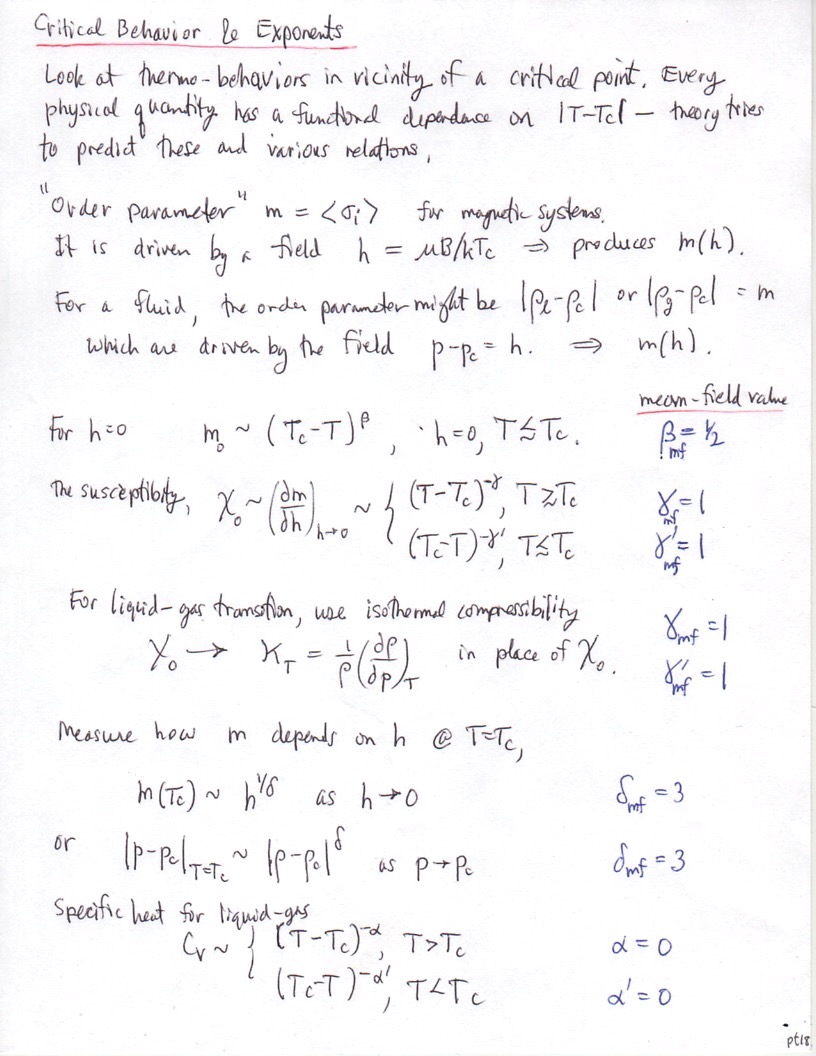
1. The Critical Exponents from Theory
Our starting point is the Landau free energy. To analyze the response to an external field (like a magnetic field for a ferromagnet), we add a term that couples linearly to the order parameter :
The equilibrium state is found by minimizing this free energy with respect to , which gives the equation of state:
This single equation contains all the information we need to find the remaining critical exponents. The following document provides a clear, step-by-step derivation of these exponents within the context of the mean-field Ising model, whose free energy expansion is precisely the form we are studying.
Critical Exponents within the Mean-Field Approximation for the Ising Model
This document, 'Critical Exponents within the Mean-Field Approximation' from the University of Rochester, systematically derives the exponents δ, β, γ, and α. It begins by expanding the mean-field self-consistency equation into the Landau form, which should feel very familiar from our previous lesson.
Please read the sections titled: 'Magnetization along the critical isotherm T = Tc and the critical exponent δ' 'Magnetization along the coexistence curve at h = 0 and the critical exponent β' (this will be a review) 'Magnetic susceptibility at h = 0 and the critical exponent γ' 'Specific Heat at h = 0 and the critical exponent α' Focus on how each exponent's definition is applied to the equation of state to extract the power-law behavior.
Now, let's walk through the derivations together, highlighting the key physical and mathematical steps.
The Critical Isotherm Exponent:
The exponent describes how the order parameter scales with the external field exactly at the critical temperature, .
- Definition: at .
- Derivation: We set in our equation of state, which makes the first term vanish:
Comparing this directly with the definition, we immediately find:
The Order Parameter Exponent: (Recap)
We derived this last time, but let's quickly re-verify it using our equation of state. The exponent describes the spontaneous emergence of the order parameter below in the absence of an external field.
- Definition: for and .
- Derivation: Setting and considering , the non-trivial solutions are:
Taking the square root gives . This confirms our previous result:
The Susceptibility Exponent:
The susceptibility, , measures the linear response of the order parameter to a small external field. Given your background in condensed matter and experimental physics, you'll recognize this as a crucial measurable quantity.
-
Definition: .
-
Derivation: We find by implicitly differentiating the equation of state with respect to and then evaluating at :
Now we must analyze this expression above and below .- For : The spontaneous order parameter is .
- For : We substitute .
In both cases, the susceptibility diverges as . Therefore:
- For : The spontaneous order parameter is .
Test your understanding!
A common feature of critical phenomena is that the ratios of critical amplitudes (the prefactors of the power laws) are also universal. Based on our derivation for and , what is the predicted universal amplitude ratio in mean-field theory?
Show answer
From the derivation, we have:
The amplitude ratio is therefore:
This ratio of 2 is a classic prediction of mean-field theory.
The Specific Heat Exponent:
Finally, describes the behavior of the specific heat . Its derivation requires us to find the equilibrium free energy, , and then take two derivatives with respect to temperature.
- Definition: .
- Derivation:
- For : , so . The specific heat contribution from the ordering process is zero. .
- For : As we found in the last lesson's exercise, substituting into the free energy gives:
The singular part of the entropy is .
The singular part of the specific heat near is :
This result is a constant for . This means the specific heat does not diverge; instead, it exhibits a finite jump discontinuity of at the critical point. A finite, non-zero value at the critical point corresponds to an exponent of zero.
2. Summary: The Mean-Field Exponents
Let's gather our results. By analyzing the simple Landau free energy, we have derived the full set of standard thermodynamic critical exponents:
| Exponent | Definition | Physical Quantity | Mean-Field Value |
|---|---|---|---|
| $C \sim | t | ^{-\alpha}$ | |
| Order Parameter | 1/2 | ||
| $\chi \sim | t | ^{-\gamma}$ | |
| Critical Isotherm | 3 |
These values are known as the mean-field critical exponents. The fact that we derived them from the Landau theory, which is built only on general symmetry principles, demonstrates that Landau theory is a general formulation of mean-field theory. It successfully predicts the exponents for any system where fluctuations are neglected, from the van der Waals gas to the Weiss model of ferromagnetism.
For completeness, it's worth noting two other standard exponents related to spatial correlations, which we will derive properly in the next module on Landau-Ginzburg theory. They are also predicted by mean-field theory:
- : Describes the divergence of the correlation length, .
- : Describes the decay of the correlation function at , .
The resource LINK (Landau Field Theory) provides a concise summary of all these exponents in section 7.4 (labeled in the text as "Summarizing the critical exponents in Landau theory..."), confirming the values we've derived.
Conclusion
Key Takeaways:
- By adding an external field term, , to the free energy, we can derive the equation of state.
- Analyzing this equation of state at and near the critical point allows for the derivation of the full set of thermodynamic critical exponents.
- Landau theory predicts the universal mean-field exponents: , , , and .
- This confirms that Landau theory is a powerful and general framework that captures the essence of mean-field approximations, independent of the microscopic details of the system.
Preview of the Next Lesson:
Our model, with the crucial assumption that the coefficient is positive, successfully describes continuous (second-order) phase transitions. But what about first-order transitions, like the boiling of water, where the order parameter jumps discontinuously? What happens if the coefficient itself depends on temperature and can become negative? To answer these questions, we must extend our free energy expansion to the next order, leading us to theory. In the next lesson, we will use this extended model to describe first-order transitions and locate a special point in the phase diagram where the nature of the transition changes: the tricritical point.