Recommended resources
The freely available resources this lesson will direct you to.
Welcome to your next lesson in our study of Landau theory.
In our previous session, we established the foundational principle of Landau theory: the form of the free energy expansion near a phase transition is dictated by the symmetries of the high-temperature, disordered phase. For a vast class of systems exhibiting an "up/down" or Ising-like symmetry (where the order parameter can be inverted, ), we found that the free energy must be an even function of . Truncating at the first non-trivial order necessary for stability gives us the renowned (or ) model:
Today, we will analyze this expression to achieve our learning goal: to describe a continuous phase transition and derive the temperature dependence of the order parameter. We will see how this simple, symmetry-based form elegantly captures the essence of critical phenomena.
1. The Canonical Model
Let's dissect the coefficients and to imbue our model with physical meaning.
-
The Quartic Term, : For the free energy to be bounded from below as , we must have . A system with would be unstable, with the order parameter growing without limit. Near the critical temperature , we can generally assume that is a slowly varying function of temperature, and it is sufficient to approximate it by a positive constant, .
-
The Quadratic Term, : This coefficient is the engine of the phase transition.
- For , in the disordered phase, we expect the free energy to have a single minimum at . This requires the curvature at the origin to be positive, so .
- For , in the ordered phase, the system develops a non-zero order parameter. This means must become unstable (a local maximum), and two new minima must appear at . This requires .
The simplest functional form for that satisfies these conditions is a linear one that passes through zero at . We can write this as a Taylor expansion around :
where is a positive constant.
Putting this together, our working model for the free energy density (per unit volume or per site) near a continuous phase transition is:
2. Minimization and Temperature Dependence
The equilibrium state of the system corresponds to the value of the order parameter, , that minimizes the free energy . The following reading from David Tong's lecture notes on Statistical Field Theory provides a concise and clear derivation of this minimization process and its consequences.
Statistical Field Theory by David Tong
These notes will walk you through the analysis of the Landau free energy for a continuous phase transition. You will see how the shape of the free energy potential changes as the temperature crosses the critical value, leading to the emergence of a non-zero order parameter.
Please read section 1.2.1, titled 'B=0: A Continuous Phase Transitions' (note: B here refers to the magnetic field, not the Landau coefficient). Start from the equation for f(m) (Eq. 1.13) and read to the end of the paragraph discussing equation 1.14. Focus on how the minima of the free energy are found and how their position depends on temperature relative to Tc.
Let's summarize the key steps and insights from the reading. To find the minimum, we solve :
This equation yields two possible sets of solutions for the equilibrium order parameter .
Case 1: High Temperature Phase ()
Here, . The only real solution to the minimization equation is . The second derivative, , is positive, confirming this is a stable minimum. The system is in its symmetric, disordered phase.
Case 2: Low Temperature Phase ()
Here, . We now have three real solutions:
- . The second derivative is now negative (), meaning the symmetric state has become a local maximum and is unstable.
- . This gives two non-zero solutions:
The second derivative at these points is , confirming they are the new stable minima.
The system must "choose" one of these two degenerate ground states, spontaneously breaking the symmetry. This change in the free energy landscape is the heart of the Landau description of a continuous phase transition.

3. The Critical Exponent
The result from our analysis is one of the most important predictions of Landau theory. For , the magnitude of the order parameter grows as:
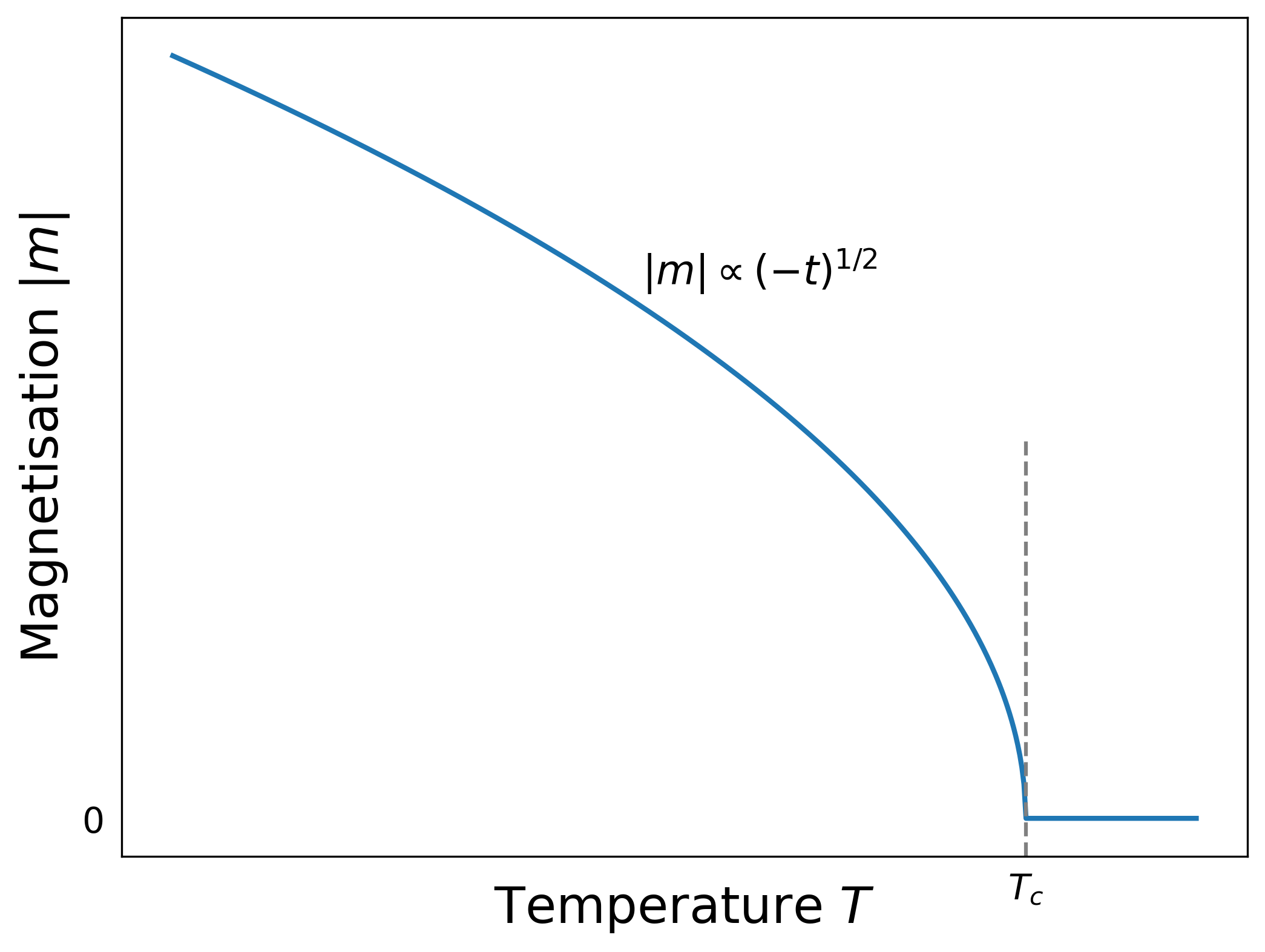
This behavior defines a critical exponent. The exponent describes how the order parameter vanishes as the critical point is approached from the ordered phase:
From our derivation, we find that Landau's theory predicts a universal value for this exponent:
This value is characteristic of all mean-field theories. While we derived it from a general symmetry argument, you will find it also emerges from specific models like the van der Waals gas or the mean-field Ising model. The following video illustrates exactly this, showing how expanding the mean-field free energy for the Ising model naturally leads to the form we have been studying.
This video by Jonathon Riddell connects the abstract Landau theory back to the concrete Ising model you've studied. It shows how performing a Taylor expansion of the mean-field free energy directly yields the φ⁴ polynomial.
Watch the segment from 11:21 to 13:12. The goal is to see how the expression for the free energy per spin from the Ising model, when expanded for a small order parameter (psi, ψ), results in the characteristic Landau form with ψ² and ψ⁴ terms.
This connection is crucial: Landau theory provides a powerful, general framework whose simplest application reproduces the results of simpler, model-specific mean-field approximations. Its power lies in its independence from microscopic details, relying only on the system's symmetries.
Test your understanding!
For the low-temperature phase (), calculate the value of the free energy density at the minimum, . How does this "condensation energy" (the energy difference between the ordered and disordered states) scale with ?
Show answer
We start with the free energy .
We substitute the equilibrium value .
The energy of the disordered state (if it were stable) would be . Therefore, the condensation energy, , scales as .
Conclusion
Key Takeaways:
- The Landau theory, , is the minimal model for describing a continuous phase transition in a system with up/down () symmetry.
- The phase transition is driven by the change in sign of the coefficient of the quadratic term, , which destabilizes the symmetric phase () below .
- By minimizing the free energy, we derived the temperature dependence of the order parameter in the ordered phase: .
- This result defines the mean-field value of the critical exponent .
Preview of the Next Lesson:
We have successfully used the Landau free energy to derive the behavior of the order parameter and find the critical exponent . But there are other critical exponents, such as those governing the specific heat (), susceptibility (), and the critical isotherm (). In the next lesson, we will continue our analysis of the model to demonstrate that Landau theory reproduces the full set of standard mean-field critical exponents.