Recommended resources
The freely available resources this lesson will direct you to.
Welcome back to our module on payroll.
In the previous lesson, we focused on the employee's side of the equation, calculating the mandatory social contributions (CNSS and AMO) that are deducted from their gross salary. This was our first step in moving from the Salaire Brut Global (SBG) towards the final net pay.
Today, we will address the other side of this partnership. Our objective is to calculate the employer's share of mandatory social contributions (CNSS and AMO). The employer is legally required to pay these amounts in addition to the employee's salary. Understanding this calculation is fundamental for any accountant, as it reveals the true cost of an employee to a business and is a major component of a company's monthly financial obligations.
1. The Scope of Employer Contributions (Charges Patronales)
While the employee contributes to their own pension and health insurance, the employer's contribution is broader, covering a wider range of social funds. These employer-paid amounts are known as charges patronales.
Let's begin by identifying the different components. The following table gives a clear overview of the employer's obligations.

As you can see, the employer's share consists of several distinct contributions. Let's get the specific rates from a reliable, up-to-date source.
Taux des cotisations dues à la CNSS au 01 Janvier 2024
To perform our calculations, we need the official rates for the employer's share. This document provides the rates and ceilings applicable from January 2024.
Please review the two tables in this resource. From the first table, 'Taux de cotisation à la CNSS', note the rates for the 'Taux Part Patronale' and the 'Plafond' (ceiling). From the second table, 'Taux de cotisation à l’AMO', do the same. We will be using all these rates.
Based on these resources, the employer's mandatory contributions are:
- Prestations Sociales (Social Benefits): Funds long-term benefits like pensions and short-term benefits like sickness allowances.
- Rate: 8.98%
- Allocations Familiales (Family Allowances): Funds payments made to employees with children.
- Rate: 6.40%
- Taxe de Formation Professionnelle (TFP) (Professional Training Tax): Contributes to the national vocational training system.
- Rate: 1.60%
- Assurance Maladie Obligatoire (AMO) (Mandatory Health Insurance): The employer's portion of the national health insurance scheme.
- Rate: 2.26%
- Participation AMO: An additional employer contribution to the health insurance scheme.
- Rate: 1.85%
A crucial detail you will have noticed is the concept of the plafond (ceiling). This brings us to the next important point.
2. The Contribution Base: Capped vs. Uncapped
Just like with the employee's share, these percentages are applied to a base, the assiette de cotisation. As a general rule, this base is the Salaire Brut Global (SBG) we learned to calculate. The official CNSS circular assiette de cotisation.pdf confirms that the base includes all remuneration: salary, bonuses, allowances, and benefits in kind, with very specific exceptions.
However, for employer contributions, there's a key distinction:
- Plafonné (Capped) Base: For the
Prestations Sociales, the calculation base is the SBG, but it is capped at 6,000.00 MAD per month. If the employee earns more than this, the employer's contribution for this specific item is still calculated on 6,000 MAD. - Non-plafonné (Uncapped) Base: For all other contributions (
Allocations Familiales, TFP, and both AMO contributions), the calculation is based on the fullSalaire Brut Global, with no ceiling.
This is a critical rule to remember.
A Note on Evolving Rates: You may notice the ceiling of 6,000 MAD differs from the 8,000 MAD ceiling used in the previous lesson's resources. This is a perfect real-world example of how rates and ceilings are subject to change by law. As an accountant, you must always verify and apply the rates that are legally in effect for the specific payroll period you are processing. For our current exercise, we will strictly use the figures from the provided 2024 resource (Taux des cotisations dues à la CNSS au 01 Janvier 2024).
3. Step-by-Step Calculation of Employer Contributions
Let's apply these rules with a concrete example. We'll continue with our employee, Karim, whose Salaire Brut Global (SBG) was 11,420.00 DH.
1. Prestations Sociales (Capped)
- Karim's SBG (11,420 DH) is greater than the ceiling (6,000 DH).
- Base de calcul = 6,000.00 DH
- Contribution = 6,000.00 × 8.98% = 538.80 DH
2. Allocations Familiales (Uncapped)
- The full salary is used.
- Base de calcul = 11,420.00 DH
- Contribution = 11,420.00 × 6.40% = 730.88 DH
3. Taxe de Formation Professionnelle (TFP) (Uncapped)
- Base de calcul = 11,420.00 DH
- Contribution = 11,420.00 × 1.60% = 182.72 DH
4. Cotisation AMO (Uncapped)
- Base de calcul = 11,420.00 DH
- Contribution = 11,420.00 × 2.26% = 258.10 DH
5. Participation AMO (Uncapped)
- Base de calcul = 11,420.00 DH
- Contribution = 11,420.00 × 1.85% = 211.27 DH
Total Employer Contributions (Total Charges Patronales)
Now, we sum all the individual contributions:Total = 538.80 + 730.88 + 182.72 + 258.10 + 211.27 = 1,921.77 DH
So, for an employee with a gross salary of 11,420 DH, the company must pay an additional 1,921.77 DH in social charges for that month.
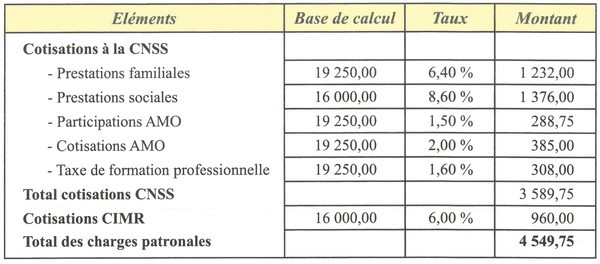
The image below shows a typical layout for presenting these calculations. While the specific numbers in the image are for a different scenario, the structure—listing each contribution with its base, rate, and amount—is exactly what you would use in practice.
Test your understanding!
An employee, Amina, has a Salaire Brut Global of 5,800.00 DH. This salary is below the CNSS ceiling.
Calculate the total employer contributions (Total Charges Patronales) for Amina.
Show answer
Since Amina's salary is below the 6,000 DH ceiling, her full SBG is used as the base for all calculations.
-
Prestations Sociales: 5,800.00 × 8.98% = 520.84 DH
-
Allocations Familiales: 5,800.00 × 6.40% = 371.20 DH
-
Taxe de Formation Professionnelle: 5,800.00 × 1.60% = 92.80 DH
-
Cotisation AMO: 5,800.00 × 2.26% = 131.08 DH
-
Participation AMO: 5,800.00 × 1.85% = 107.30 DH
-
Total Employer Contributions: 520.84 + 371.20 + 92.80 + 131.08 + 107.30 = 1,223.22 DH
Conclusion
You have now mastered the calculation of the employer's share of social contributions, a critical skill for managing payroll and understanding corporate expenses in Morocco.
Key Takeaways:
- The employer pays five main mandatory contributions:
Prestations Sociales,Allocations Familiales,Taxe de Formation Professionnelle,Cotisation AMO, andParticipation AMO. - The contribution for
Prestations Socialesis calculated on a capped base (plafond) of 6,000 DH per month (as per 2024 rates). - All other contributions are calculated on the full, uncapped
Salaire Brut Global. - The total of these contributions represents a significant additional cost to the employer, above the employee's gross salary.
Preview of the Next Lesson:
We have now fully accounted for the social contributions from both the employee and the employer. The next logical step in constructing the payslip is to determine the Salaire Net Imposable (Net Taxable Salary). In our next lesson, we will learn how to calculate this by subtracting the employee's social contributions and other deductible professional expenses from the gross salary. This Salaire Net Imposable will become the foundation for calculating the final piece of the puzzle: the income tax.